Kabbage Mehdi, Kessens Ryan, Dickman Martin B
University of Wisconsin-Madison, Department of Plant Pathology, Madison, WI 53706.
Texas A&M University, Department of Plant Pathology and Microbiology, Institute for Plant Genomics and Biotechnology, College Station, TX 77843.
Microb Cell. 2016 Apr 16;3(5):224-226. doi: 10.15698/mic2016.05.501.
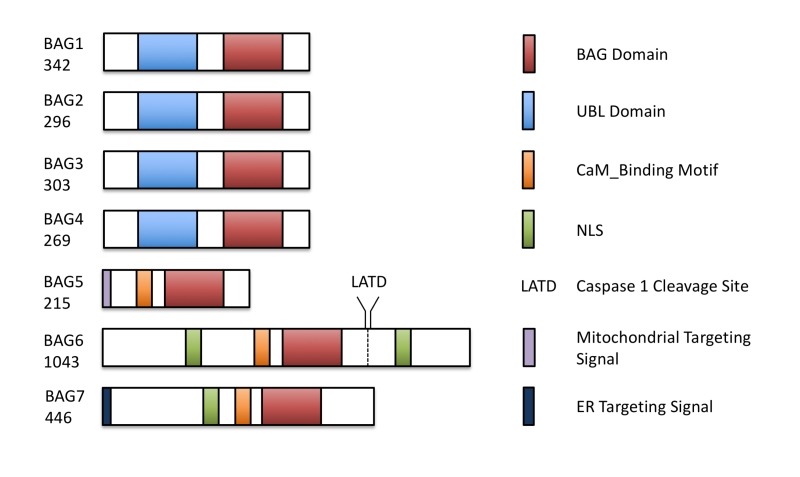
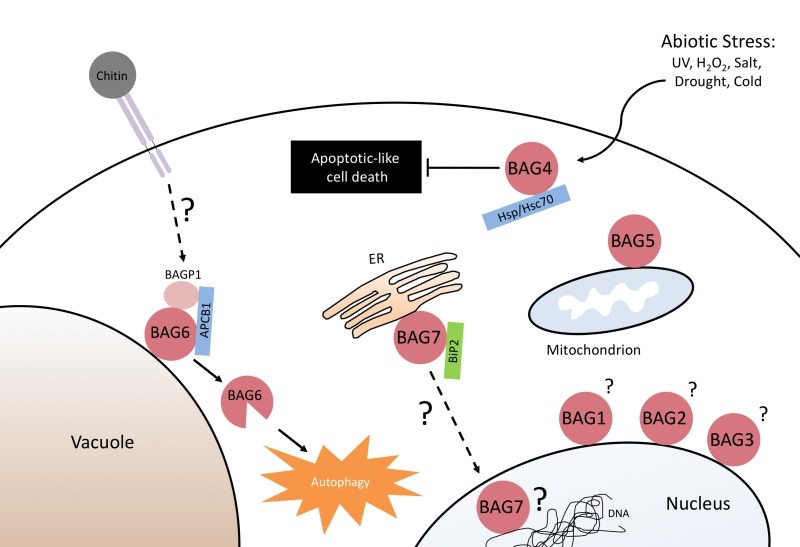
The Bcl-2-associated athanogene (BAG) family is a multifunctional group of proteins involved in numerous cellular functions ranging from apoptosis to tumorigenesis. These proteins are evolutionarily conserved and encode a characteristic region known as the BAG domain. BAGs function as adapter proteins forming complexes with signaling molecules and molecular chaperones. In humans, a role for BAG proteins has been suggested in tumor growth, HIV infection, and neurodegenerative diseases; as a result, the BAGs are attractive targets for therapeutic interventions, and their expression in cells may serve as a predictive tool for disease development. The genome contains seven homologs of BAG family proteins (Figure 1), including four with a domain organization similar to animal BAGs (BAG1-4). The remaining three members (BAG5-7) contain a predicted calmodulin-binding motif near the BAG domain, a feature unique to plant BAG proteins that possibly reflects divergent mechanisms associated with plant-specific functions. As reported for animal BAGs, plant BAGs also regulate several stress and developmental processes (Figure 2). The recent article by Li focuses on the role of BAG6 in plant innate immunity. This study shows that BAG6 plays a key role in basal plant defense against fungal pathogens. Importantly, this work further shows that BAG6 is proteolytically activated to induce autophagic cell death and resistance in plants. This finding underscores the importance of proteases in the execution of plant cell death, yet little is known about proteases and their substrates in plants.
Bcl-2相关永生基因(BAG)家族是一组多功能蛋白质,参与从细胞凋亡到肿瘤发生等众多细胞功能。这些蛋白质在进化上是保守的,编码一个称为BAG结构域的特征区域。BAG蛋白作为衔接蛋白,与信号分子和分子伴侣形成复合物。在人类中,BAG蛋白在肿瘤生长、HIV感染和神经退行性疾病中被认为发挥作用;因此,BAG蛋白是治疗干预的有吸引力的靶点,它们在细胞中的表达可能作为疾病发展的预测工具。基因组包含七个BAG家族蛋白的同源物(图1),其中四个的结构域组织与动物BAG蛋白相似(BAG1-4)。其余三个成员(BAG5-7)在BAG结构域附近含有一个预测的钙调蛋白结合基序,这是植物BAG蛋白特有的特征,可能反映了与植物特定功能相关的不同机制。正如动物BAG蛋白的报道一样,植物BAG蛋白也调节几种应激和发育过程(图2)。李等人最近的文章聚焦于BAG6在植物先天免疫中的作用。这项研究表明,BAG6在植物对真菌病原体的基础防御中起关键作用。重要的是,这项工作进一步表明,BAG6被蛋白酶激活以诱导植物自噬性细胞死亡和抗性。这一发现强调了蛋白酶在植物细胞死亡执行中的重要性,但对于植物中的蛋白酶及其底物知之甚少。