LeRoy Angie S, Murdock Kyle W, Jaremka Lisa M, Loya Asad, Fagundes Christopher P
Department of Psychology, University of Houston.
Department of Psychology, Bioscience Research Collaborative, Rice University.
Health Psychol. 2017 May;36(5):512-520. doi: 10.1037/hea0000467. Epub 2017 Mar 30.
Loneliness is a well-established risk factor for poor physical health. Much less is known about how loneliness affects patient-reported outcomes (PROs), such as somatic symptoms, which are increasingly important for guiding symptom management and assessing quality of patient care. The current study investigates whether (a) loneliness and social isolation predict cold symptoms independent of each other, and (b) whether loneliness is a more robust risk factor than objective social isolation for experiencing cold symptoms.
As part of a larger parent study, 213 healthy participants completed the Short Loneliness Scale (LON) and the Social Network Index (SNI) at baseline. They were given nasal drops containing rhinovirus 39 (RV39; i.e., a common cold virus), then quarantined for 5 days during which they reported on subjective cold symptoms in addition to being monitored for objective indicators of infection. Data from 160 of the participants (who were infected with the virus) were used in the present analyses.
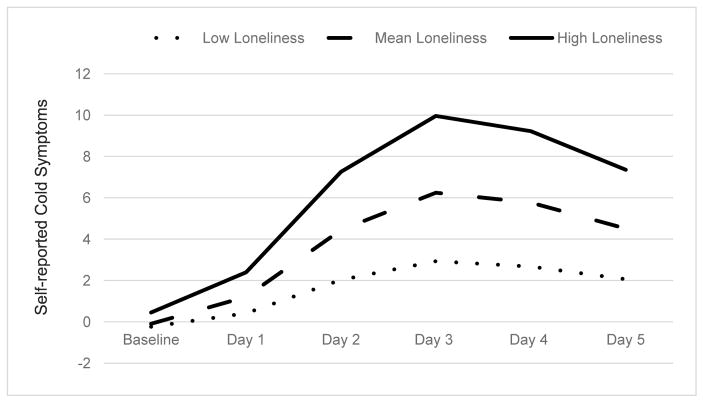
A hierarchical multiple regression revealed that baseline loneliness predicted self-reported cold symptoms over time (assessed via area under the curve), over and above demographic variables, season of participation, and depressive affect. Interestingly, social network size and diversity did not predict cold symptoms.
These findings suggest that the perception of loneliness is more closely linked to self-reported illness symptoms than objectively measured social isolation. Assessing psychosocial factors such as loneliness when treating and evaluating the common cold could contribute to health care practitioners' understanding of their patients' experiences with acute illness. (PsycINFO Database Record
孤独是身体健康不佳的一个公认风险因素。关于孤独如何影响患者报告的结局(PROs),如躯体症状,人们了解得要少得多,而这些症状对于指导症状管理和评估患者护理质量正变得越来越重要。本研究调查:(a)孤独和社会隔离是否相互独立地预测感冒症状;(b)对于出现感冒症状而言,孤独是否比客观的社会隔离是一个更强有力的风险因素。
作为一项更大规模母研究的一部分,213名健康参与者在基线时完成了简短孤独量表(LON)和社交网络指数(SNI)。给他们滴鼻含有鼻病毒39(RV39,即一种普通感冒病毒),然后隔离5天,在此期间他们除了报告主观感冒症状外,还接受感染客观指标的监测。本分析使用了160名参与者(感染了该病毒)的数据。
分层多元回归显示,基线孤独能预测随时间推移自我报告的感冒症状(通过曲线下面积评估),超越了人口统计学变量、参与季节和抑郁情绪的影响。有趣的是,社交网络规模和多样性并不能预测感冒症状。
这些发现表明,孤独感与自我报告的疾病症状的联系比客观测量的社会隔离更为紧密。在治疗和评估普通感冒时评估诸如孤独等心理社会因素,可能有助于医护人员理解患者的急性疾病体验。(PsycINFO数据库记录)