Graim Kiley, Liu Tiffany Ting, Achrol Achal S, Paull Evan O, Newton Yulia, Chang Steven D, Harsh Griffith R, Cordero Sergio P, Rubin Daniel L, Stuart Joshua M
Biomedical Engineering, University of California, Santa Cruz, USA.
UC Santa Cruz Genomics Institute, University of California, Santa Cruz, USA.
BMC Med Genomics. 2017 Mar 31;10(1):20. doi: 10.1186/s12920-017-0256-3.
Patient stratification to identify subtypes with different disease manifestations, severity, and expected survival time is a critical task in cancer diagnosis and treatment. While stratification approaches using various biomarkers (including high-throughput gene expression measurements) for patient-to-patient comparisons have been successful in elucidating previously unseen subtypes, there remains an untapped potential of incorporating various genotypic and phenotypic data to discover novel or improved groupings.
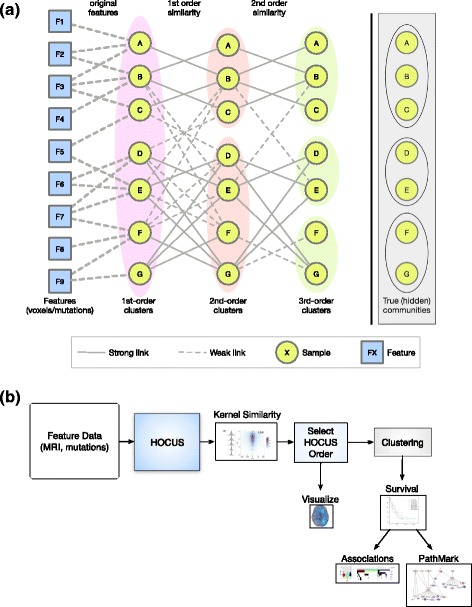
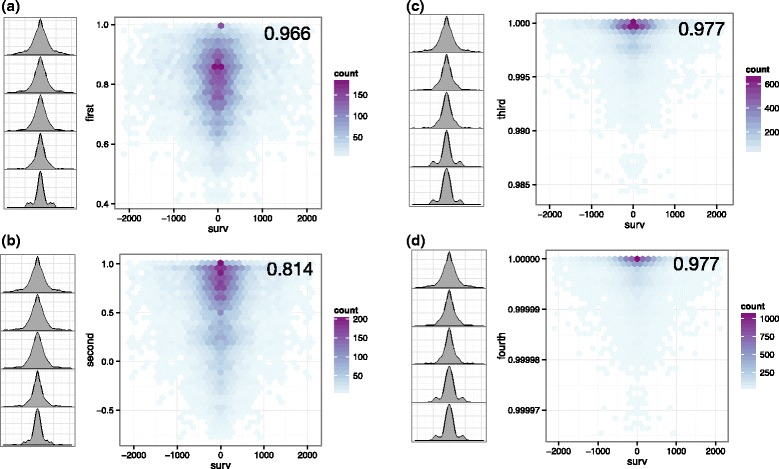
Here, we present HOCUS, a unified analytical framework for patient stratification that uses a community detection technique to extract subtypes out of sparse patient measurements. HOCUS constructs a patient-to-patient network from similarities in the data and iteratively groups and reconstructs the network into higher order clusters. We investigate the merits of using higher-order correlations to cluster samples of cancer patients in terms of their associations with survival outcomes.
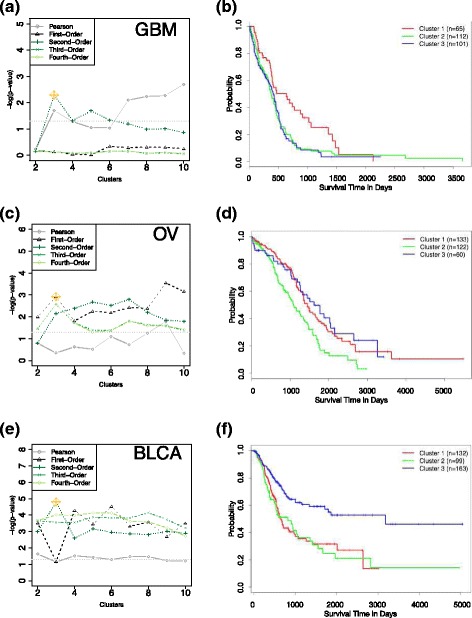
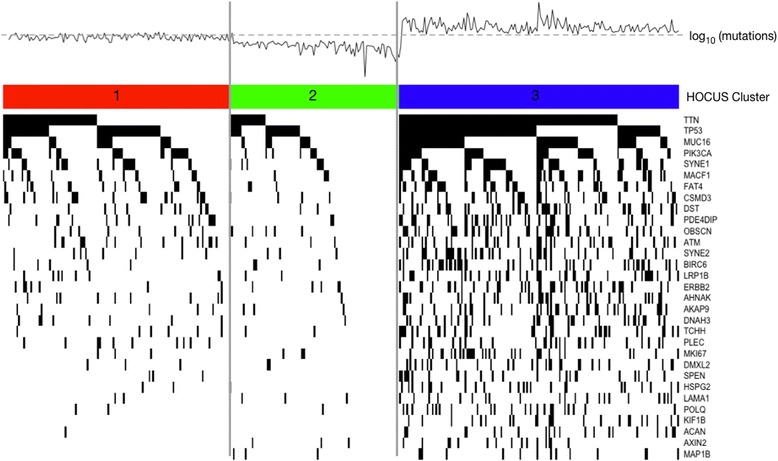
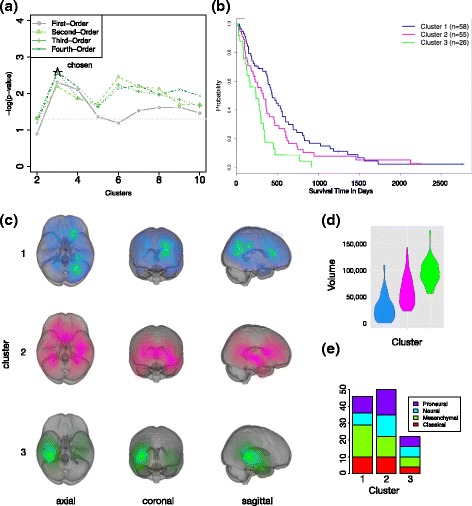
In an initial test of the method, the approach identifies cancer subtypes in mutation data of glioblastoma, ovarian, breast, prostate, and bladder cancers. In several cases, HOCUS provides an improvement over using the molecular features directly to compare samples. Application of HOCUS to glioblastoma images reveals a size and location classification of tumors that improves over human expert-based stratification.
Subtypes based on higher order features can reveal comparable or distinct groupings. The distinct solutions can provide biologically- and treatment-relevant solutions that are just as significant as solutions based on the original data.
在癌症诊断和治疗中,对患者进行分层以识别具有不同疾病表现、严重程度和预期生存时间的亚型是一项关键任务。虽然使用各种生物标志物(包括高通量基因表达测量)进行患者间比较的分层方法已成功阐明了以前未发现的亚型,但整合各种基因型和表型数据以发现新的或改进的分组仍有未开发的潜力。
在此,我们提出了HOCUS,这是一种用于患者分层的统一分析框架,它使用社区检测技术从稀疏的患者测量数据中提取亚型。HOCUS根据数据中的相似性构建患者间网络,并迭代地对网络进行分组并将其重构为更高阶的聚类。我们根据癌症患者样本与生存结果的关联,研究使用高阶相关性对样本进行聚类的优点。
在该方法的初步测试中,该方法在胶质母细胞瘤、卵巢癌、乳腺癌、前列腺癌和膀胱癌的突变数据中识别出癌症亚型。在几种情况下,HOCUS比直接使用分子特征比较样本有改进。将HOCUS应用于胶质母细胞瘤图像可揭示肿瘤的大小和位置分类,比基于人类专家的分层有所改进。
基于高阶特征的亚型可以揭示可比的或不同的分组。这些不同的解决方案可以提供与生物学和治疗相关的解决方案,与基于原始数据的解决方案同样重要。