Peppa Maria, John Edmunds W, Funk Sebastian
London School of Hygiene and Tropical Medicine, Keppel Street, London, WC1E 7HT, UK.
BMC Infect Dis. 2017 Mar 31;17(1):238. doi: 10.1186/s12879-017-2337-5.
Seasonal influenza epidemics place considerable strain on health services. Robust systems of surveillance are therefore required to ensure preparedness. Sentinel surveillance does not accurately capture the community burden of epidemics as it misses cases that do not present to health services. In this study, Flusurvey (an internet-based community surveillance tool) was used to examine how severity of disease influences health-seeking behaviour in the UK.
Logistic regression with random effects was used to investigate the association between health-seeking and symptom severity, duration of illness and reduction in self-reported health-score over four flu seasons between 2011 and 2015.
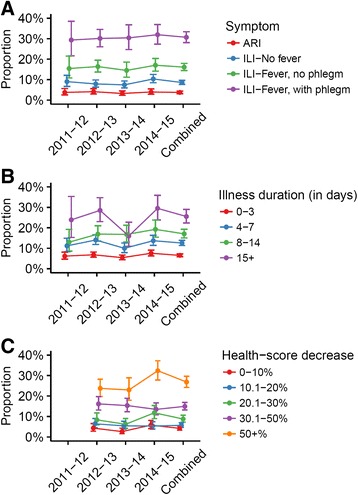
The majority of individuals did not seek care. In general, there was very strong evidence for an association between all severity indicators and visiting a health service (p < 0.0001). Being female (OR 1.62, 95% CI 1.23-2.14, p = 0.0003) and a self-diagnosis of the flu (OR 3.39, 95% CI 2.38-4.83, p < 0.0001) were also associated with increased likelihood of visiting a health service. During the 2012-13 and 2014-15 flu seasons, there was a significantly larger proportion of individuals with more severe sets of symptoms and a longer duration of illness. Despite this, the proportion of individuals with particular sets of symptoms visiting a health service showed only very slight variation across years.
Traditional surveillance systems capture only the more severe episodes of illness. However, in spite of variation in flu activity, the proportion of individuals visiting a health service remains relatively stable within specific sets of symptoms across years. These data could be used in combination with data on consultation rates to provide better estimates of community burden.
季节性流感疫情给卫生服务带来了相当大的压力。因此,需要强大的监测系统来确保做好应对准备。哨点监测无法准确反映社区疫情负担,因为它会遗漏未前往卫生服务机构就诊的病例。在本研究中,使用了流感调查(一种基于互联网的社区监测工具)来研究疾病严重程度如何影响英国的就医行为。
采用随机效应逻辑回归分析,研究2011年至2015年四个流感季节中,就医行为与症状严重程度、病程以及自我报告健康评分降低之间的关联。
大多数人未寻求医疗护理。总体而言,有非常有力的证据表明所有严重程度指标与前往卫生服务机构就诊之间存在关联(p < 0.0001)。女性(比值比1.62,95%置信区间1.23 - 2.14,p = 0.0003)以及自我诊断为流感(比值比3.39,95%置信区间2.38 - 4.83,p < 0.0001)也与前往卫生服务机构就诊的可能性增加有关。在2012 - 13年和2014 - 15年流感季节,症状更严重且病程更长的个体比例显著更高。尽管如此,有特定症状组合的个体前往卫生服务机构就诊的比例在各年份之间仅显示出非常轻微的变化。
传统监测系统仅捕捉到病情较严重的发作情况。然而,尽管流感活动存在差异,但在特定症状组合中,前往卫生服务机构就诊的个体比例多年来相对稳定。这些数据可与就诊率数据结合使用,以更好地估计社区负担。