Zheng Xiaochen, Vieira Campos Alba, Ordieres-Meré Joaquín, Balseiro Jose, Labrador Marcos Sergio, Aladro Yolanda
Department of Industrial Engineering, Technical University of Madrid , Madrid , Spain.
University Hospital of Getafe, Getafe , Madrid , Spain.
Front Neurol. 2017 Mar 15;8:96. doi: 10.3389/fneur.2017.00096. eCollection 2017.
Essential tremor (ET) shows amplitude fluctuations throughout the day, presenting challenges in both clinical and treatment monitoring. Tremor severity is currently evaluated by validated rating scales, which only provide a timely and subjective assessment during a clinical visit. Motor sensors have shown favorable performances in quantifying tremor objectively.
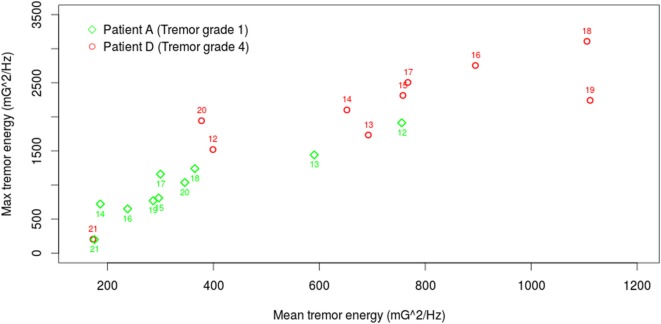
A new highly portable system was used to monitor tremor continuously during daily lives. It consists of a smartwatch with a triaxial accelerometer, a smartphone, and a remote server. An experiment was conducted involving eight ET patients. The average effective data collection time per patient was 26 (±6.05) hours. Fahn-Tolosa-Marin Tremor Rating Scale (FTMTRS) was adopted as the gold standard to classify tremor and to validate the performance of the system. Quantitative analysis of tremor severity on different time scales is validated.
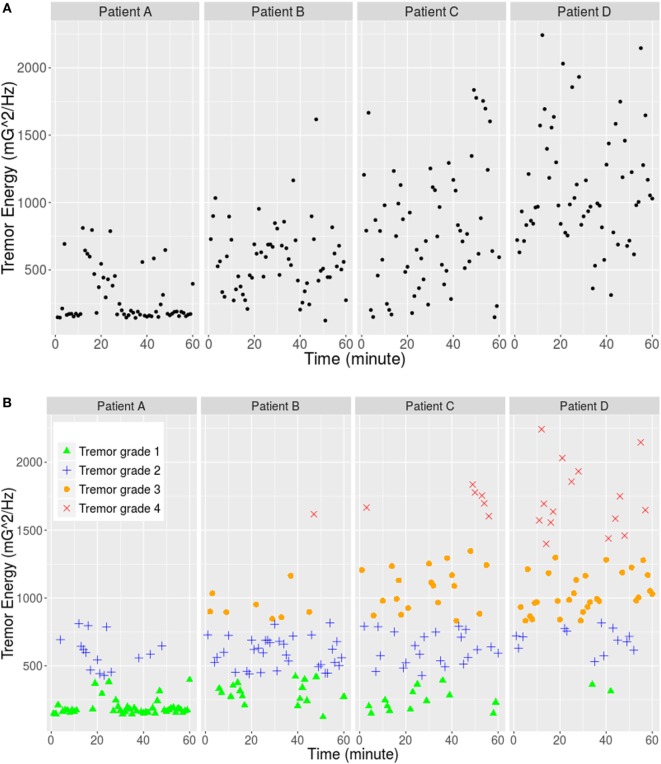
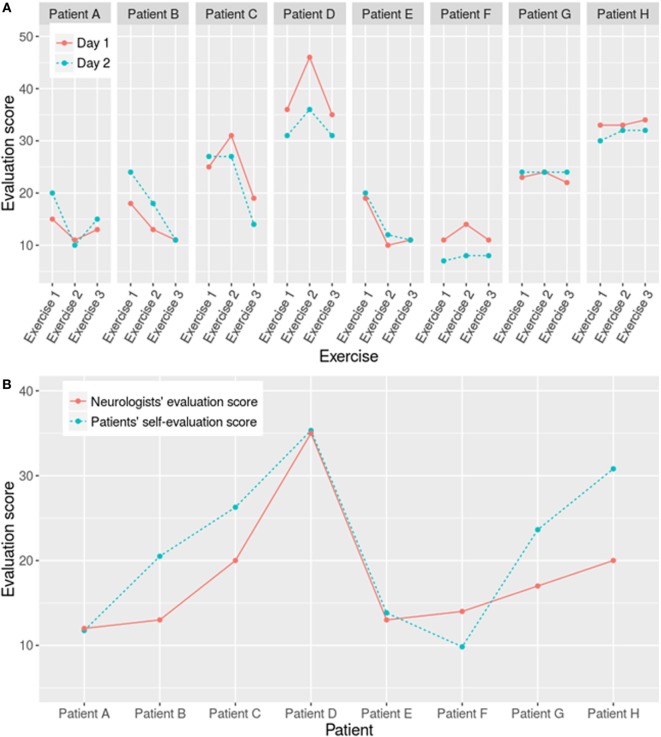
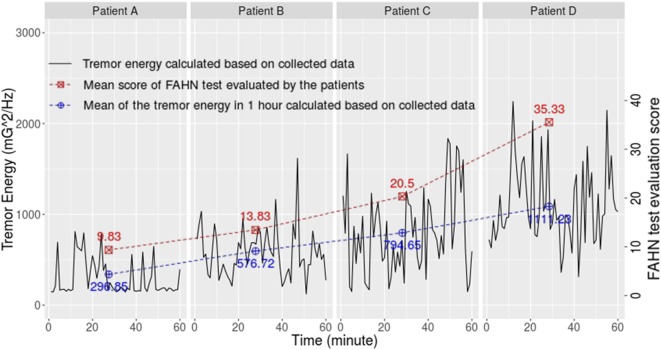
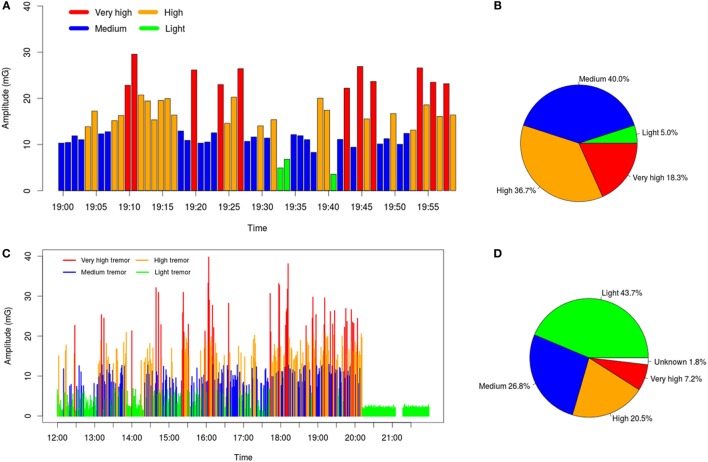
Significant correlations were observed between neurologist's FTMTRS and patient's FTMTRS auto-assessment scores ( = 0.84; = 0.009), between the device quantitative measures and the scores from the standardized assessments of neurologists ( = 0.80; = 0.005) and patient's auto-evaluation ( = 0.97; = 0.032), and between patient's FTMTRS auto-assessment scores day-to-day ( = 0.87; < 0.001). A graphical representation of four patients with different degrees of tremor was presented, and a representative system is proposed to summarize the tremor scoring at different time scales.
This study demonstrates the feasibility of prolonged and continuous monitoring of tremor severity during daily activities by a highly portable non-restrictive system, a useful tool to analyze efficacy and effectiveness of treatment.
特发性震颤(ET)在一天中会出现振幅波动,这给临床和治疗监测带来了挑战。目前,震颤严重程度通过经过验证的评分量表进行评估,而这些量表仅在临床就诊期间提供及时且主观的评估。运动传感器在客观量化震颤方面已显示出良好的性能。
使用一种新型高度便携系统在日常生活中持续监测震颤。该系统由一块带有三轴加速度计的智能手表、一部智能手机和一个远程服务器组成。对8名ET患者进行了一项实验。每位患者的平均有效数据收集时间为26(±6.05)小时。采用Fahn - Tolosa - Marin震颤评分量表(FTMTRS)作为分类震颤和验证系统性能的金标准。对不同时间尺度上的震颤严重程度进行了定量分析验证。
观察到神经科医生的FTMTRS与患者的FTMTRS自我评估分数之间存在显著相关性(= 0.84;= 0.009),设备定量测量与神经科医生标准化评估分数之间存在显著相关性(= 0.80;= 0.005)以及与患者自我评估分数之间存在显著相关性(= 0.97;= 0.032),并且患者的FTMTRS自我评估分数在每日之间存在显著相关性(= 0.87;< 0.001)。展示了四名不同震颤程度患者的图形表示,并提出了一个代表性系统以总结不同时间尺度上的震颤评分。
本研究证明了通过一种高度便携的非限制性系统在日常活动中长时间持续监测震颤严重程度的可行性,这是一种分析治疗效果和有效性的有用工具。
需注意,原文中部分“= ”表述可能有误,正常应是相关系数等具体数值,但按照要求未对原文进行修正直接翻译。