Engineering Design and Computing Laboratory, D-MAVT, ETH Zurich, Switzerland.
Sci Rep. 2017 Mar 31;7:45671. doi: 10.1038/srep45671.
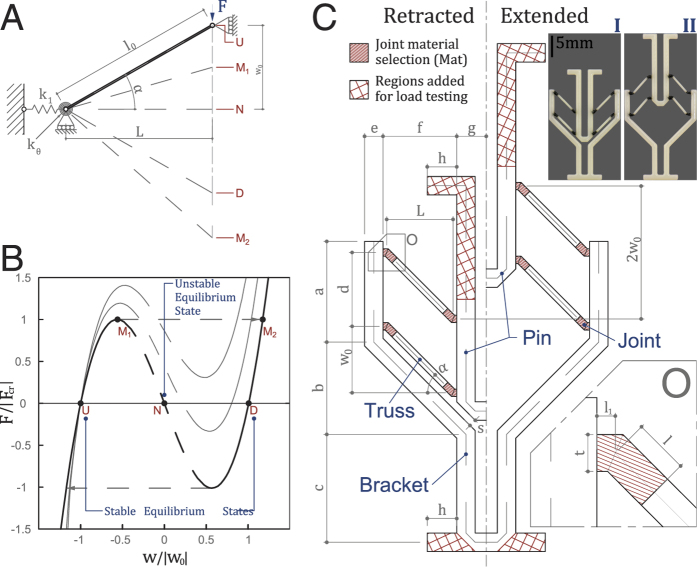
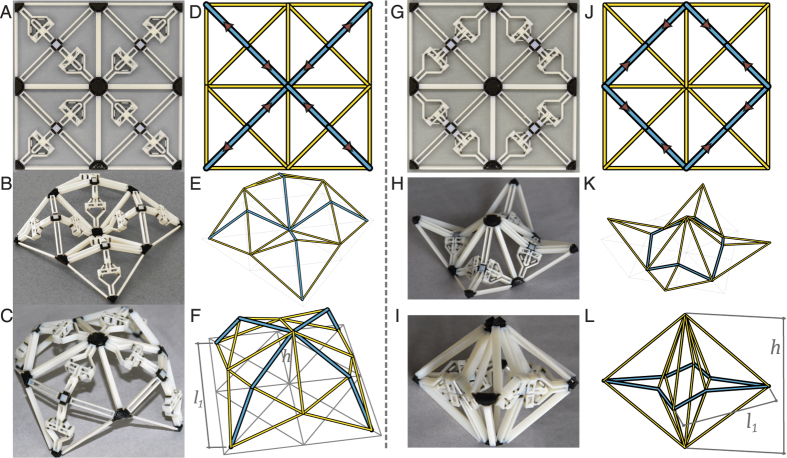
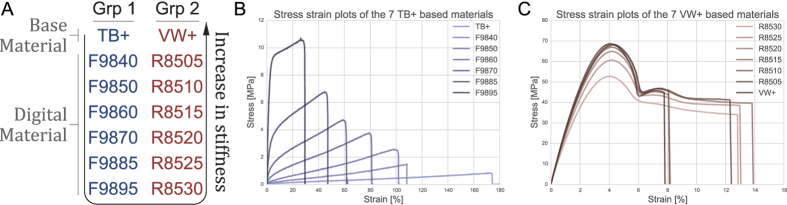
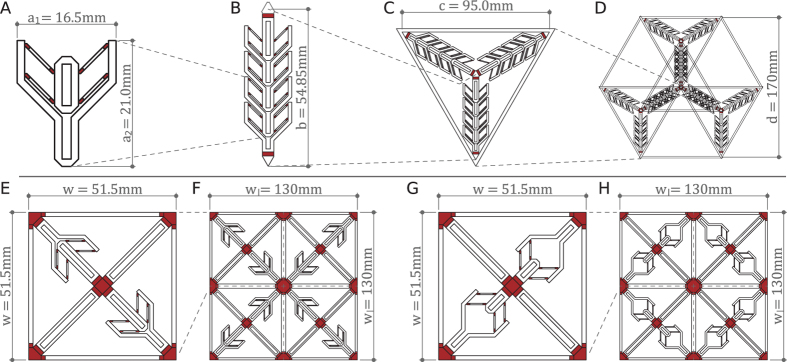
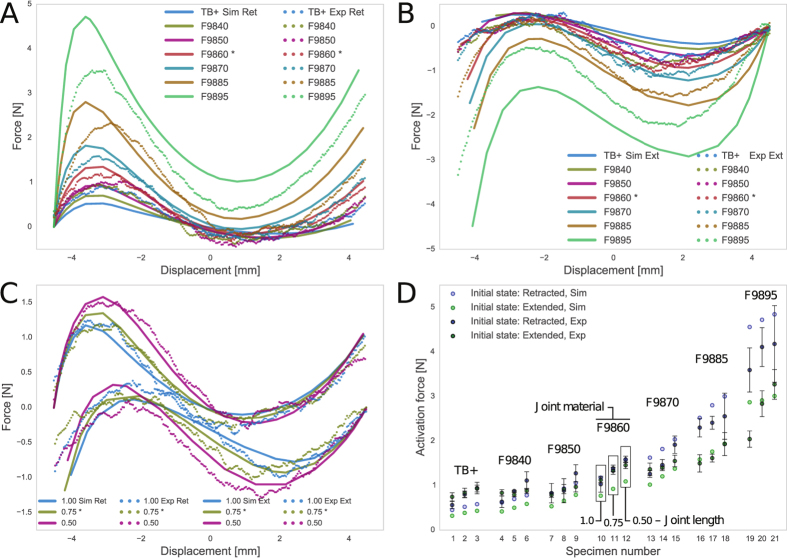
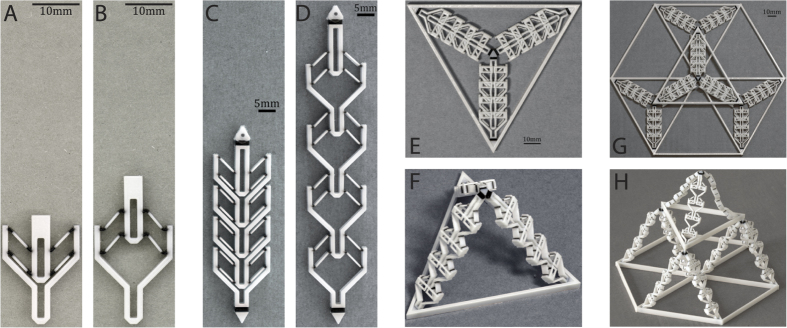
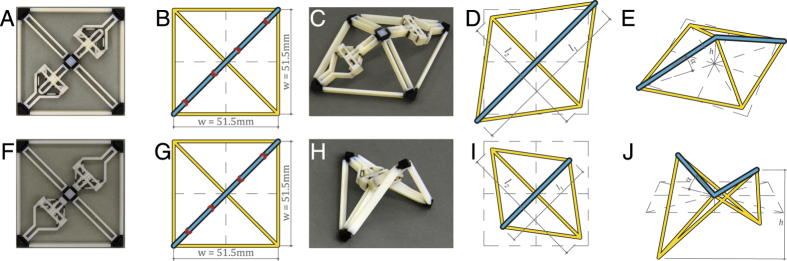
Multi-material 3D printing has created new opportunities for fabricating deployable structures. We design reversible, deployable structures that are fabricated flat, have defined load bearing capacity, and multiple, predictable activated geometries. These structures are designed with a hierarchical framework where the proposed bistable actuator serves as the base building block. The actuator is designed to maximise its stroke length, with the expansion ratio approaching one when serially connected. The activation force of the actuator is parameterised through its joint material and joint length. Simulation and experimental results show that the bistability triggering force can be tuned between 0.5 and 5.0 N. Incorporating this bistable actuator, the first group of hierarchical designs demonstrate the deployment of space frame structures with a tetrahedron module consisting of three active edges, each containing four serially connected actuators. The second group shows the design of flat structures that assume either positive or negative Gaussian curvature once activated. By flipping the initial configuration of the unit actuators, structures such as a dome and an enclosure are demonstrated. A modified Dynamic Relaxation method is used to simulate all possible geometries of the hierarchical structures. Measured geometries differ by less than 5% compared to simulation results.
多材料 3D 打印为可展开结构的制造创造了新的机会。我们设计了可重复使用、可展开的结构,这些结构可以被制造为平面结构,具有定义的承载能力和多种可预测的激活几何形状。这些结构采用分层框架设计,所提出的双稳态执行器作为基本构建块。该执行器旨在最大化其行程长度,当串联连接时,扩展比接近 1。执行器的激活力通过其关节材料和关节长度进行参数化。模拟和实验结果表明,双稳态触发力可以在 0.5 和 5.0 N 之间进行调节。通过引入这种双稳态执行器,第一组分层设计展示了具有四面体模块的空间框架结构的展开,该四面体模块由三个具有四个串联连接执行器的活动边缘组成。第二组展示了平面结构的设计,这些结构一旦激活就具有正或负的高斯曲率。通过翻转单元执行器的初始配置,可以展示出穹顶和外壳等结构。使用改进的动态松弛方法来模拟分层结构的所有可能的几何形状。与模拟结果相比,测量的几何形状的差异小于 5%。