van Leeuwen Lucie A G, Hinchy Elizabeth C, Murphy Michael P, Robb Ellen L, Cochemé Helena M
MRC London Institute of Medical Sciences, Du Cane Road, London W12 0NN, UK; Institute of Clinical Sciences, Imperial College London, Hammersmith Hospital Campus, Du Cane Road, London W12 0NN, UK.
MRC Mitochondrial Biology Unit, University of Cambridge, Wellcome Trust/MRC Building, Cambridge Biomedical Campus, Hills Road, Cambridge CB2 0XY, UK.
Free Radic Biol Med. 2017 Jul;108:374-382. doi: 10.1016/j.freeradbiomed.2017.03.037. Epub 2017 Mar 31.
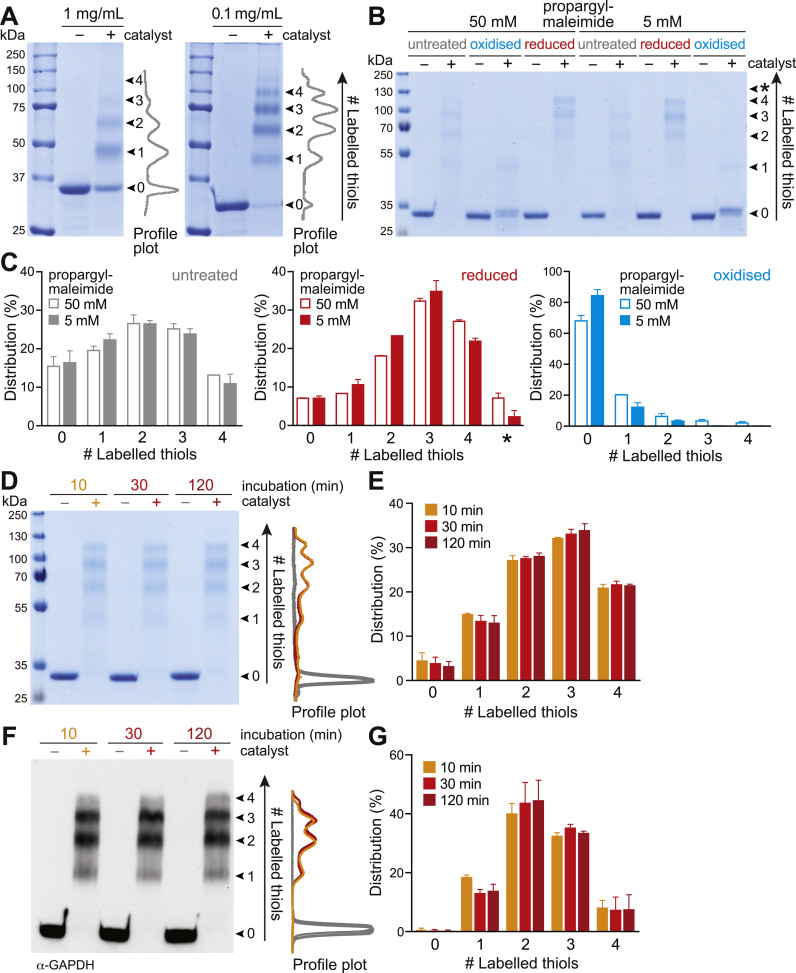
The redox state of cysteine thiols is critical for protein function. Whereas cysteines play an important role in the maintenance of protein structure through the formation of internal disulfides, their nucleophilic thiol groups can become oxidatively modified in response to diverse redox challenges and thereby function in signalling and antioxidant defences. These oxidative modifications occur in response to a range of agents and stimuli, and can lead to the existence of multiple redox states for a given protein. To assess the role(s) of a protein in redox signalling and antioxidant defence, it is thus vital to be able to assess which of the multiple thiol redox states are present and to investigate how these alter under different conditions. While this can be done by a range of mass spectrometric-based methods, these are time-consuming, costly, and best suited to study abundant proteins or to perform an unbiased proteomic screen. One approach that can facilitate a targeted assessment of candidate proteins, as well as proteins that are low in abundance or proteomically challenging, is by electrophoretic mobility shift assays. Redox-modified cysteine residues are selectively tagged with a large group, such as a polyethylene glycol (PEG) polymer, and then the proteins are separated by electrophoresis followed by immunoblotting, which allows the inference of redox changes based on band shifts. However, the applicability of this method has been impaired by the difficulty of cleanly modifying protein thiols by large PEG reagents. To establish a more robust method for redox-selective PEGylation, we have utilised a Click chemistry approach, where free thiol groups are first labelled with a reagent modified to contain an alkyne moiety, which is subsequently Click-reacted with a PEG molecule containing a complementary azide function. This strategy can be adapted to study reversibly reduced or oxidised cysteines. Separation of the thiol labelling step from the PEG conjugation greatly facilitates the fidelity and flexibility of this approach. Here we show how the Click-PEGylation technique can be used to interrogate the redox state of proteins.
半胱氨酸硫醇的氧化还原状态对蛋白质功能至关重要。半胱氨酸通过形成分子内二硫键在维持蛋白质结构方面发挥重要作用,而其亲核硫醇基团可因各种氧化还原挑战而发生氧化修饰,从而在信号传导和抗氧化防御中发挥作用。这些氧化修饰会因一系列因素和刺激而发生,可能导致给定蛋白质存在多种氧化还原状态。因此,要评估蛋白质在氧化还原信号传导和抗氧化防御中的作用,关键是要能够评估多种硫醇氧化还原状态中哪些存在,并研究它们在不同条件下如何变化。虽然可以通过一系列基于质谱的方法来做到这一点,但这些方法耗时、成本高,最适合研究丰富的蛋白质或进行无偏蛋白质组学筛选。一种有助于对候选蛋白质以及低丰度或蛋白质组学研究困难的蛋白质进行靶向评估的方法是电泳迁移率变动分析。氧化还原修饰的半胱氨酸残基用一个大基团(如聚乙二醇(PEG)聚合物)进行选择性标记,然后通过电泳分离蛋白质,随后进行免疫印迹,这可以根据条带移动推断氧化还原变化。然而,由于用大PEG试剂干净地修饰蛋白质硫醇存在困难,该方法的适用性受到了影响。为了建立一种更强大的氧化还原选择性聚乙二醇化方法,我们采用了一种点击化学方法,其中游离硫醇基团首先用一种修饰为含有炔基部分的试剂进行标记,随后与含有互补叠氮化物功能的PEG分子进行点击反应。这种策略可用于研究可逆还原或氧化的半胱氨酸。将硫醇标记步骤与PEG缀合分开极大地促进了该方法的保真度和灵活性。在这里,我们展示了点击聚乙二醇化技术如何用于探究蛋白质的氧化还原状态。