Kaur Maninder, Sidhu Shailpreet K, Singh Kanwardeep, Devi Pushpa, Kaur Manpreet, Singh Nachhatar Jit
Department of Microbiology, Government Medical College, Amritsar, Punjab, India.
J Lab Physicians. 2017 Apr-Jun;9(2):121-124. doi: 10.4103/0974-2727.199636.
Acute viral hepatitis (AVH) caused by enterically transmitted hepatitis A virus (HAV) and hepatitis E virus (HEV) poses a major health problem in developing countries such as India. Despite improving sanitation, heath awareness, and socioeconomic conditions, these infections continue to occur both in sporadic as well as in epidemic forms in different parts of India.
The aim of this study is to determine the total as well as age-specific prevalence rates of HAV and HEV in the outbreaks of waterborne hepatitis in districts surrounding Amritsar region of Punjab.
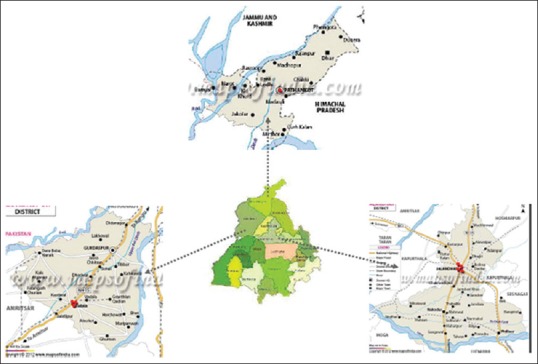
The study was conducted in the Virology Research and Diagnostic Laboratory, Government Medical College, Amritsar, during the study period of January 2015-March 2016. Samples from suspected outbreaks of AVH occurring in various districts around Amritsar were included as a part of the study. A total of 95 sera were tested for IgM antibody to HEV and HAV using IgM capture ELISA kit.
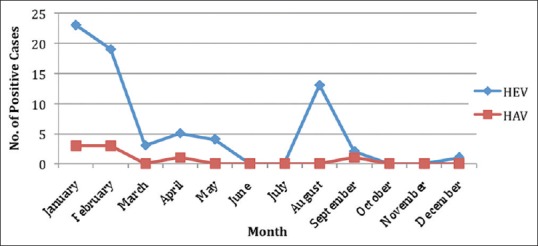
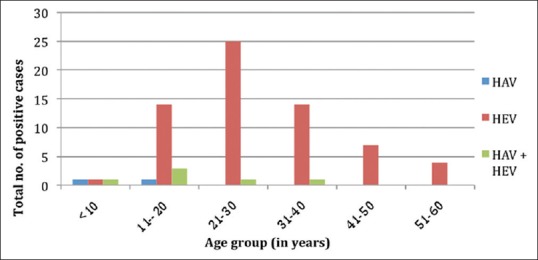
Out of the total 95 samples received, 73 samples (76.84%) were positive for HAV/HEV. Out of the total positive cases, 65 (68.42%) had HEV infection, 2 (2.1%) had HAV, and 6 cases (6.31%) were coinfected with both HAV and HEV. The 21-30 years age group (25 cases) was identified as the most susceptible group for HEV infection. The coinfected subjects presented a wider range of age distribution (1-10 years: 1; 11-20 years: 3; 21-30 years: 1; 31-40 years: 1). Seasonal distribution of data revealed bimodal peaks for HEV infection.
There should be some surveillance system to regularly monitor the portability of drinking water from time to time to avoid such preventable outbreaks in future.
由经肠道传播的甲型肝炎病毒(HAV)和戊型肝炎病毒(HEV)引起的急性病毒性肝炎(AVH)在印度等发展中国家构成了一个重大的健康问题。尽管卫生条件、健康意识和社会经济状况有所改善,但这些感染在印度不同地区仍以散发和流行形式持续发生。
本研究的目的是确定旁遮普邦阿姆利则地区周边各地区水源性肝炎暴发中HAV和HEV的总体以及年龄特异性患病率。
该研究于2015年1月至2016年3月期间在阿姆利则政府医学院病毒学研究与诊断实验室进行。来自阿姆利则周边各地区疑似AVH暴发的样本被纳入本研究。使用IgM捕获ELISA试剂盒对总共95份血清进行HEV和HAV IgM抗体检测。
在总共收到的95份样本中,73份样本(76.84%)HAV/HEV呈阳性。在所有阳性病例中,65例(68.42%)感染了HEV,2例(2.1%)感染了HAV,6例(6.31%)同时感染了HAV和HEV。21 - 30岁年龄组(25例)被确定为最易感染HEV的群体。合并感染的受试者年龄分布范围更广(1 - 10岁:1例;11 - 20岁:3例;21 - 30岁:1例;31 - 40岁:1例)。数据的季节性分布显示HEV感染有双峰高峰。
应建立一些监测系统,定期随时监测饮用水的可携带性,以避免未来发生此类可预防的疫情暴发。