Chauhan Naresh T, Prajapati Prakash, Trivedi Atul V, Bhagyalaxmi A
Department of Community Medicine, BJ Medical College, Ahmedabad, Gujarat, India.
Indian J Community Med. 2010 Apr;35(2):294-7. doi: 10.4103/0970-0218.66864.
Since 1976, seven outbreaks of hepatitis E occurred in Ahmedabad. Clusters of jaundice cases were reported on June 19, 2008, by a civic center, Girdharnagar ward, Ahmedabad.
THE OBJECTIVES WERE AS FOLLOWS: (1) to identify the etiological agent, source of outbreak, and mode of transmission; (2) to propose a control measure based on the outbreak investigation.
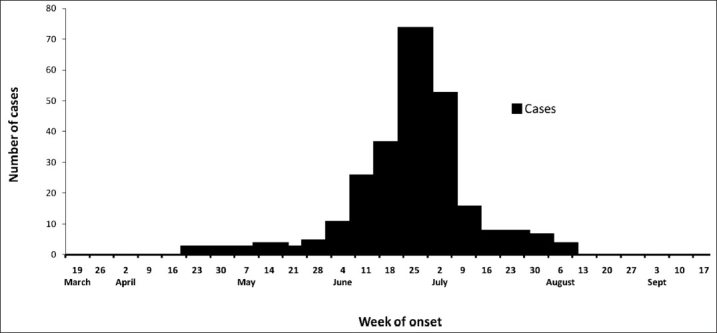
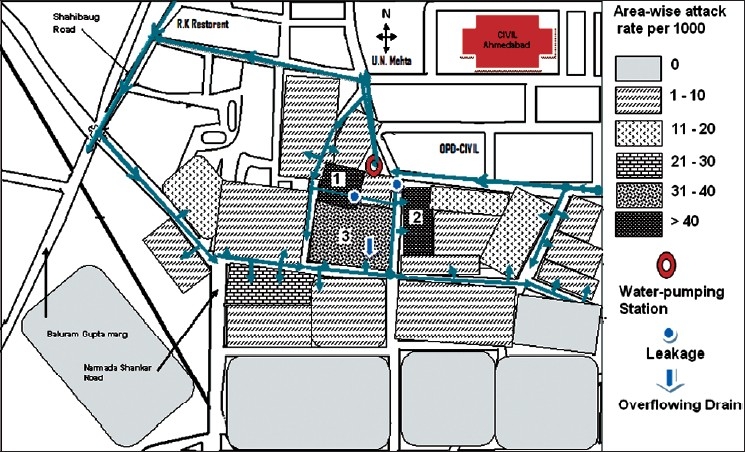
We defined a case as an acute illness with (a) a discrete onset of symptoms and (b) jaundice or elevated serum aminotransferase levels, from March to September 2008 in the households of the Girdharnagar ward. We collected data through a door-to-door survey and hospital records. We described the outbreak in terms of time, place, and person. We collected laboratory investigation reports of case patients admitted to the civil hospital. To test our hypothesis we conducted a retrospective cohort study to find out the relative risk for hepatitis. We conducted environment investigation to find out the source of contamination of water supply.
A total 233 case patients of hepatitis were identified with the attack rate of 10.9/1000 population. Cases were reported in all the age groups with a higher attack rate in the age group of 20-29 years (18.5/1000). Out of 17 case patients, 16 were positive for the hepatitis E IgM antibody. The attack rate was two times more among those who were exposed to the leaking pipeline than the non-exposed (RR=2.3, 95% CI 1.76, 2.98). Environmental investigation also confirmed the sewage contamination of drinking water in the distribution system.
The outbreak was due to hepatitis E virus. We recommended a temporary alternative water supply, repair of the leakages, and water quality surveillance.
自1976年以来,艾哈迈达巴德发生了7次戊型肝炎疫情。2008年6月19日,艾哈迈达巴德吉尔德纳加尔区的一个市民中心报告了黄疸病例群。
目的如下:(1)确定病原体、疫情源头和传播方式;(2)根据疫情调查提出控制措施。
我们将病例定义为2008年3月至9月在吉尔德纳加尔区家庭中出现的具有(a)症状离散发作和(b)黄疸或血清转氨酶水平升高的急性疾病。我们通过挨家挨户调查和医院记录收集数据。我们从时间、地点和人物方面描述了疫情。我们收集了入住市民医院的病例患者的实验室调查报告。为了验证我们的假设,我们进行了一项回顾性队列研究以找出肝炎的相对风险。我们进行了环境调查以找出供水污染的源头。
共确定了233例肝炎病例患者,发病率为10.9/1000人口。所有年龄组均有病例报告,20 - 29岁年龄组的发病率较高(18.5/1000)。在17例病例患者中,16例戊型肝炎IgM抗体呈阳性。接触漏水管道的人群发病率是非接触人群的两倍(相对风险=2.3,95%置信区间1.76,2.98)。环境调查也证实了供水系统中饮用水受到污水污染。
此次疫情是由戊型肝炎病毒引起的。我们建议临时提供替代水源、修复漏水处并进行水质监测。