Bansal Yashik, Singla Nidhi, Garg Karan, Sharma Geetanjali, Gill Meenakshi, Chander Jagdish
Department of Microbiology, VCSG Government Institute of Medical Science and Research, Srinagar, Uttarakhand, India.
Department of Microbiology, Government Medical College Hospital, Chandigarh, India.
J Family Med Prim Care. 2022 Feb;11(2):567-572. doi: 10.4103/jfmpc.jfmpc_1212_21. Epub 2022 Feb 16.
Considering the diverse socio-economic and demographic factors in a vast country like India, it is important to study the long-term trends of hepatitis A (HAV) and hepatitis E (HEV) viruses. This study describes their seroprevalence and long-term trends in a tertiary care center of North India.
The present retrospective observational study was conducted over a period of 8 years (January 2011-December 2018). Serological testing was done for detecting IgM antibodies against HAV and HEV using enzyme-linked immunosorbent assay.
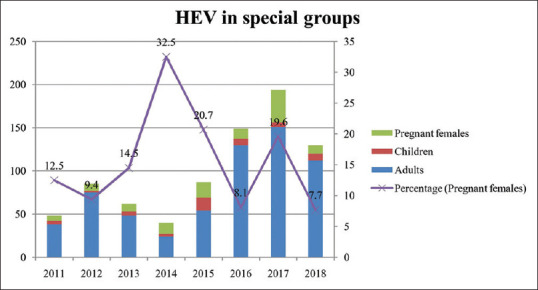
A total of 5319 samples were received during the study period, of which 903 (16.9%) were reactive for anti-HAV IgM antibodies and 795 (14.9%) were reactive for anti-HEV IgM antibodies. Majority of the cases occurred from June to October while HEV cases had a constant presence during the later years. Among HAV group, 534 (59.1%) were children, 336 (37.2%) were adults, and 33 (3.7%) were pregnant females. In HEV group, 632 (79.5%) were adults, 114 (14.3%) were pregnant females, whereas only 49 (6.2%) were children. Among those who were co-infected ( = 87), 48 (55.2%) were adults, 22 (25.3%) were pregnant females, and the rest 17 (19.5%) were children.
The shift in seroprevalence toward adults, along with an increasing trend of the number of cases reporting to the hospital, warrants active surveillance of HAV. Similarly, screening protocols for HEV should be set up as part of the antenatal management for early detection of the cases among pregnant females.
鉴于像印度这样幅员辽阔的国家存在各种社会经济和人口因素,研究甲型肝炎(HAV)和戊型肝炎(HEV)病毒的长期趋势很重要。本研究描述了它们在印度北部一家三级医疗中心的血清流行率和长期趋势。
本回顾性观察研究历时8年(2011年1月至2018年12月)。采用酶联免疫吸附测定法进行血清学检测,以检测抗HAV和抗HEV IgM抗体。
研究期间共收到5319份样本,其中903份(16.9%)抗HAV IgM抗体呈阳性,795份(14.9%)抗HEV IgM抗体呈阳性。大多数病例发生在6月至10月,而后期戊型肝炎病例持续存在。在甲型肝炎组中,534例(59.1%)为儿童,336例(37.2%)为成人,33例(3.7%)为孕妇。在戊型肝炎组中,632例(79.5%)为成人,114例(14.3%)为孕妇,而儿童仅49例(6.2%)。在合并感染的患者中(n = 87),48例(55.2%)为成人,22例(25.3%)为孕妇,其余17例(19.5%)为儿童。
血清流行率向成人转移,以及向医院报告的病例数呈上升趋势,这就需要对甲型肝炎进行积极监测。同样,应制定戊型肝炎筛查方案,作为产前管理的一部分,以便早期发现孕妇中的病例。