Kwak Sang Gyu, Kim Jong Hae
Department of Medical Statistics, School of Medicine, Catholic University of Daegu, Daegu, Korea.
Department of Anesthesiology and Pain Medicine, School of Medicine, Catholic University of Daegu, Daegu, Korea.
Korean J Anesthesiol. 2017 Apr;70(2):144-156. doi: 10.4097/kjae.2017.70.2.144. Epub 2017 Feb 21.
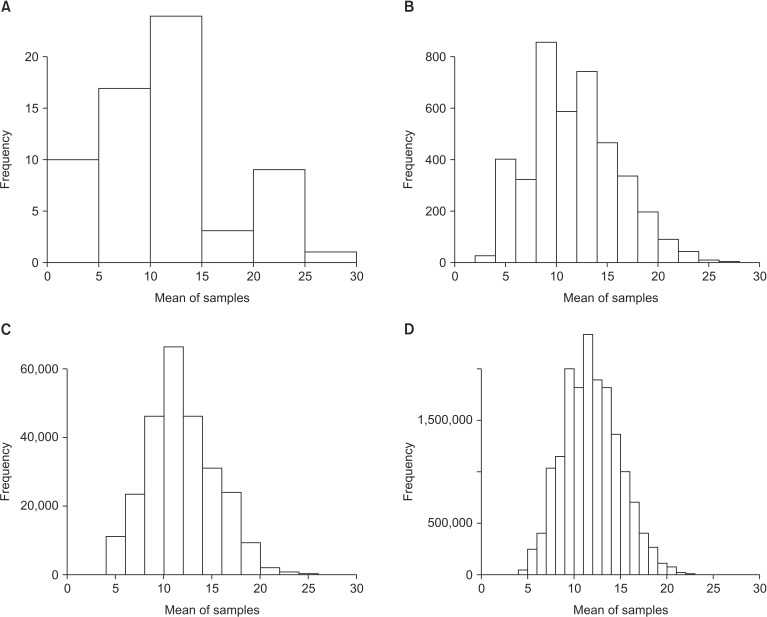
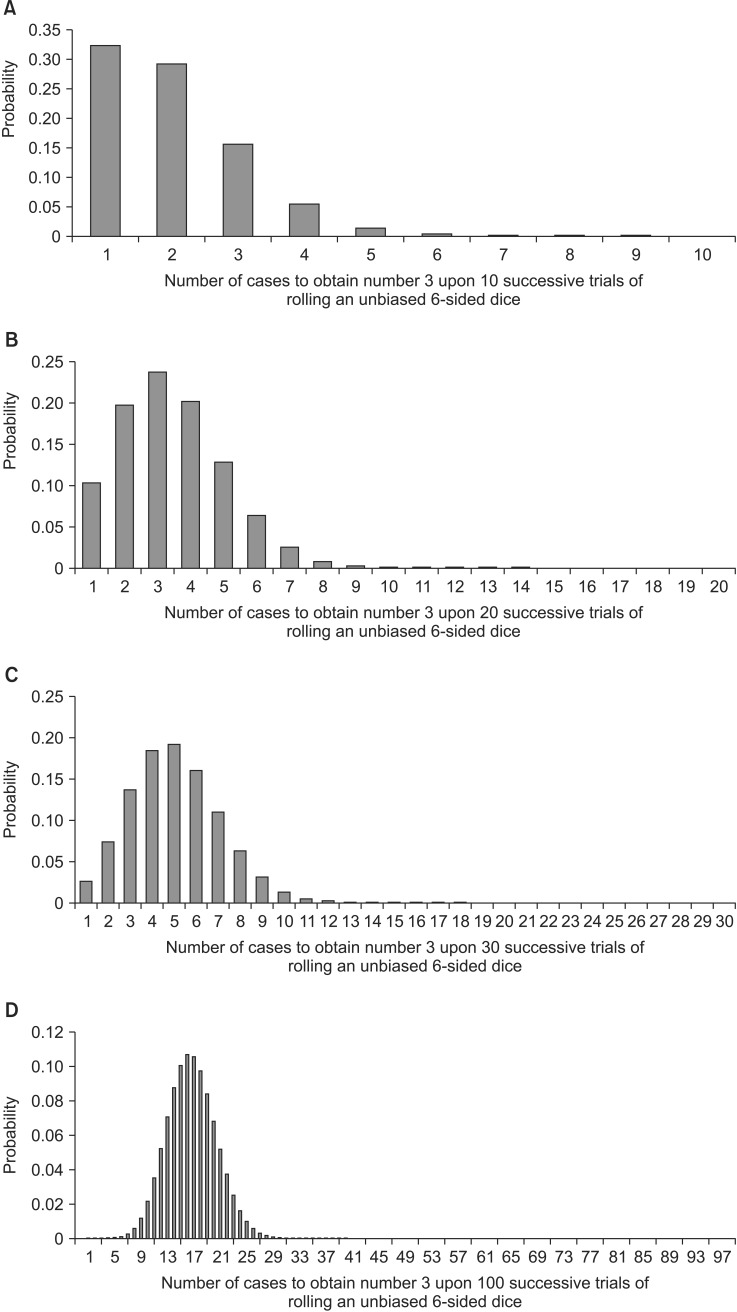
According to the central limit theorem, the means of a random sample of size, , from a population with mean, µ, and variance, σ, distribute normally with mean, µ, and variance, [Formula: see text]. Using the central limit theorem, a variety of parametric tests have been developed under assumptions about the parameters that determine the population probability distribution. Compared to non-parametric tests, which do not require any assumptions about the population probability distribution, parametric tests produce more accurate and precise estimates with higher statistical powers. However, many medical researchers use parametric tests to present their data without knowledge of the contribution of the central limit theorem to the development of such tests. Thus, this review presents the basic concepts of the central limit theorem and its role in binomial distributions and the Student's t-test, and provides an example of the sampling distributions of small populations. A proof of the central limit theorem is also described with the mathematical concepts required for its near-complete understanding.
根据中心极限定理,从均值为µ、方差为σ的总体中抽取的大小为n的随机样本的均值呈正态分布,其均值为µ,方差为[公式:见正文]。利用中心极限定理,在关于确定总体概率分布的参数的假设下,已经开发了各种参数检验。与不需要对总体概率分布做任何假设的非参数检验相比,参数检验能以更高的统计功效产生更准确和精确的估计。然而,许多医学研究人员在使用参数检验来呈现他们的数据时,并不了解中心极限定理对这类检验发展的贡献。因此,本综述介绍了中心极限定理的基本概念及其在二项分布和学生t检验中的作用,并提供了一个小总体抽样分布的示例。还描述了中心极限定理的证明以及近乎完全理解它所需的数学概念。