Aubè Lydiane, Fatnassi Meriem, Monaco Davide, Khorchani Touhami, Lacalandra Giovanni Michele, Hammadi Mohamed, Padalino Barbara
Department of Emergency and Organ Transplantation (D.E.T.O.), Veterinary Clinics and Animal Production Section, University of Bari Aldo Moro, University of Bari , Italy.
Livestock and Wildlife Laboratory, Arid Lands Institute (I.R.A.) , Médenine , Tunisia.
PeerJ. 2017 Mar 29;5:e3074. doi: 10.7717/peerj.3074. eCollection 2017.
Daily rhythmicity has been observed for a number of hormonal and behavioral variables in mammals. It can be entrained by several external factors, such as light-dark cycle and scheduled feeding. In dromedary camels, daily rhythmicity has been documented only for melatonin secretion and body temperature. In this study, the daily rhythmicity of behavioral repertoire, cortisol and testosterone levels was investigated in captive male camels.
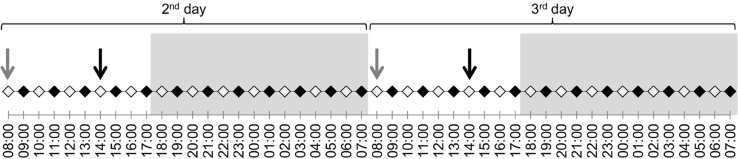
Six clinically healthy male dromedary camels () were used. The animals were housed in single boxes for 24 h daily and fed twice a day. Over a period of 48 h, behavioral observations were made and blood samples taken every two hours. The data were analyzed using diurnality index, conisor analysis and PROC mixed procedure.
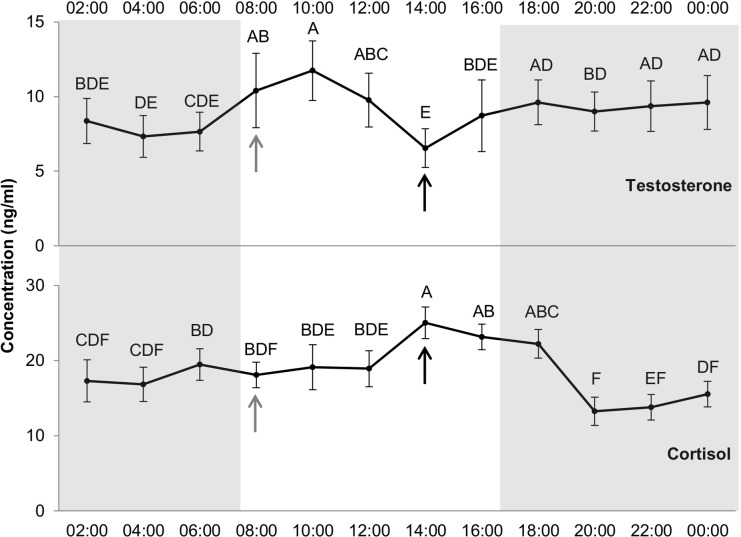
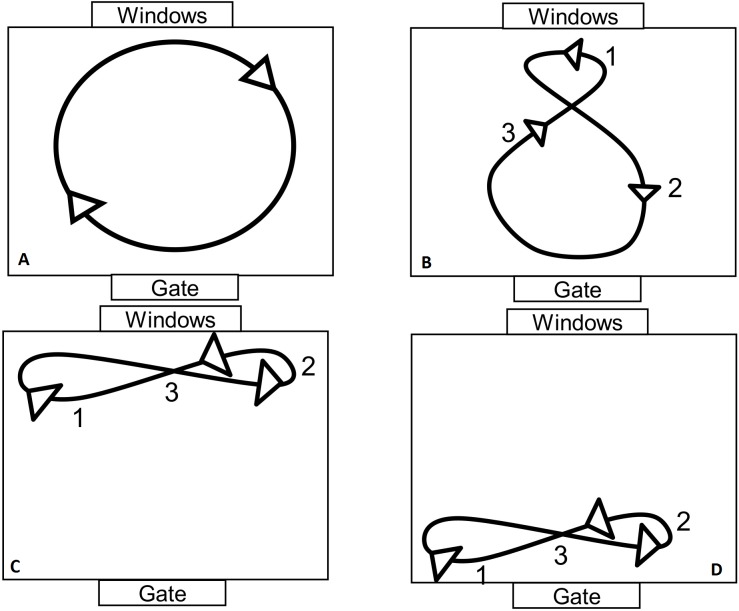
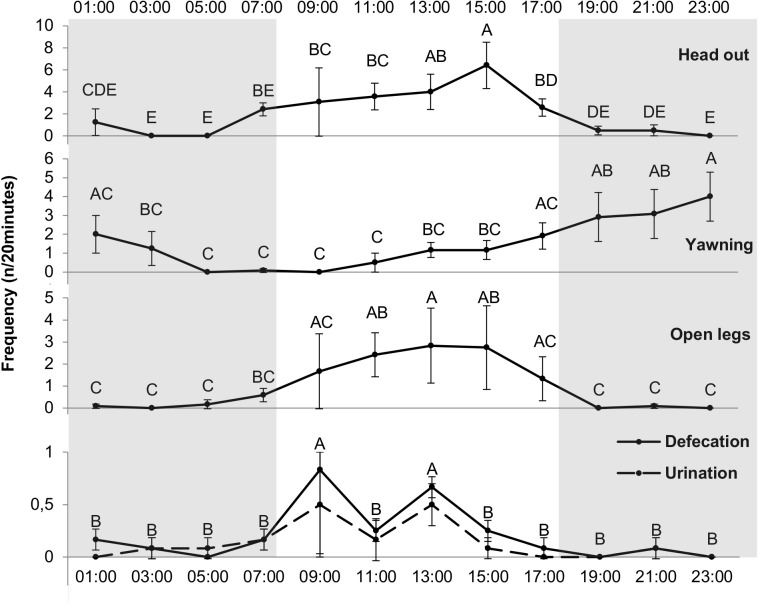
The diurnality index for rumination and lying down was close to 0 (respectively, 0.09 and 0.19), while the indices for stereotypy, standing, feeding and walking were close to 1 (respectively, 0.74, 0.84, 0.92 and 0.85). Cosinor analysis revealed daily rhythmicity for all behaviors and for cortisol levels (acrophase at 12:57) but not for testosterone. Rumination and lying down (inactive behaviors) reached a peak during the scotophase, whereas feeding, walking and stereotypy (active behaviors) reached a peak during the photophase around midday. Cortisol level and expression of stereotypies peaked before and after food distribution and were negatively correlated ( = - 0.287, = 0.005). Testosterone levels and expression of sexual behaviors were stimulated by the visual and olfactory contacts with the females and were positively correlated ( = 0.164, = 0.040). Testosterone was also negatively correlated with cortisol ( = - 0.297; = 0.003).
These preliminary results provided new knowledge about the daily rhythm of behaviors in camels housed in boxes, suggesting that camels exhibit diurnal behavior pattern in the maintenance conditions outlined in the study. Daily rhythmicity seemed to be entrained not only by the light-dark cycle but also by scheduled feeding. The rise in stereotypy after food distribution could be due to the persistence of feeding motivation and frustration after the ingestion of food. Therefore, feeding practices should be improved to satisfy the foraging and feeding motivation of these camels. Behavioral and hormonal daily patterns in camels should be taken in consideration to adapt the management system, giving the animals more freedom during the light period and a diet richer in fiber, so as to improve reproductive performance, health and welfare.
在哺乳动物中,已观察到多种激素和行为变量存在每日节律性。它可被多种外部因素所调节,如明暗周期和定时喂食。在单峰骆驼中,仅记录到褪黑素分泌和体温的每日节律性。在本研究中,对圈养雄性骆驼的行为模式、皮质醇和睾酮水平的每日节律性进行了调查。
使用了6只临床健康的雄性单峰骆驼()。动物每天被单独关在笼子里24小时,每天喂食两次。在48小时内,每两小时进行一次行为观察并采集血样。使用昼夜节律指数、余弦分析和PROC混合程序对数据进行分析。
反刍和躺卧的昼夜节律指数接近0(分别为0.09和0.19),而刻板行为、站立、进食和行走的指数接近1(分别为0.74、0.84、0.92和0.85)。余弦分析显示所有行为和皮质醇水平均有每日节律性(峰值相位在12:57),但睾酮没有。反刍和躺卧(非活动行为)在暗期达到峰值,而进食、行走和刻板行为(活动行为)在中午左右的光期达到峰值。皮质醇水平和刻板行为的表达在食物分发前后达到峰值,且呈负相关(= - 0.287,= 0.005)。睾酮水平和性行为的表达受到与雌性的视觉和嗅觉接触的刺激,且呈正相关(= 0.164,= 0.040)。睾酮也与皮质醇呈负相关(= - 0.297;= 0.003)。
这些初步结果提供了关于圈养在笼子里的骆驼行为每日节律的新知识,表明骆驼在本研究所述的饲养条件下表现出昼夜行为模式。每日节律性似乎不仅受明暗周期的调节,还受定时喂食的调节。食物分发后刻板行为的增加可能是由于进食动机的持续以及进食后产生的挫折感。因此,应改进饲养方式以满足这些骆驼的觅食和进食动机。应考虑骆驼的行为和激素每日模式以调整管理系统,在光照期给予动物更多自由,并提供富含纤维的饮食,以提高繁殖性能、健康和福利。