Ai Yanbiao, Sun Zhenzhen, Peng Chuan, Liu Lingli, Xiao Xiaoqiu, Li Jibin
Department of Nutrition and Food Hygiene, School of Public Health and Management, Chongqing Medical University, Chongqing 400016, China.
Laboratory of Lipid & Glucose Metabolism, The First Affiliated Hospital of Chongqing Medical University, Chongqing 400016, China.
Nutrients. 2017 Apr 1;9(4):346. doi: 10.3390/nu9040346.
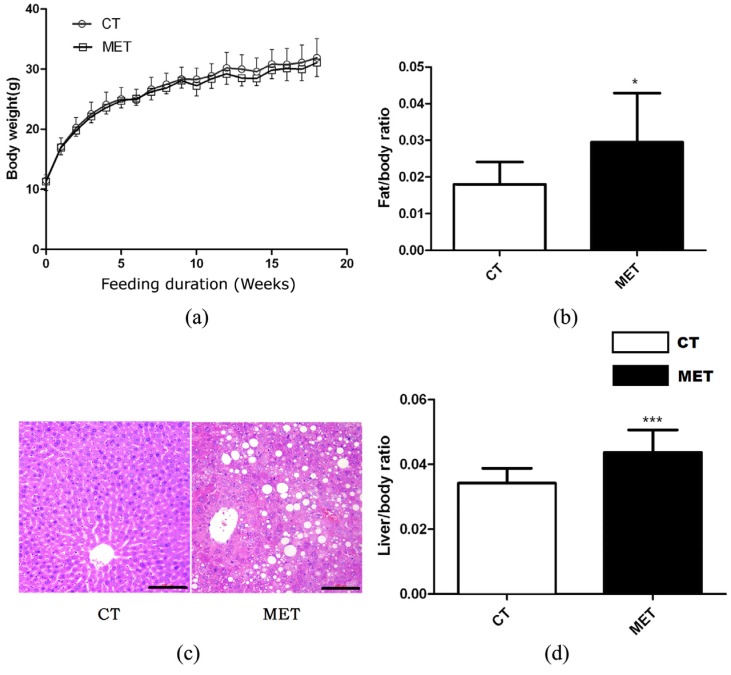
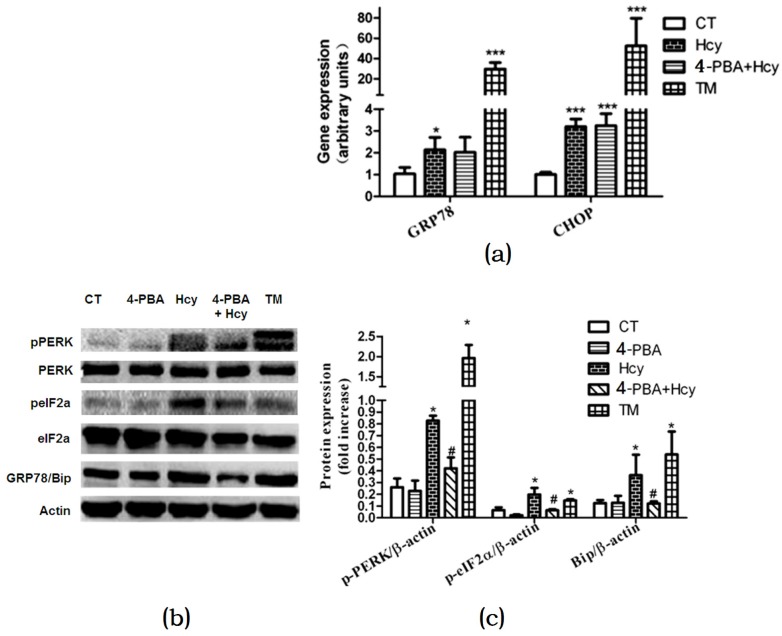
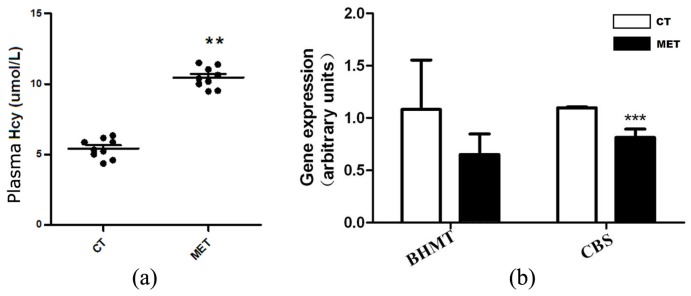
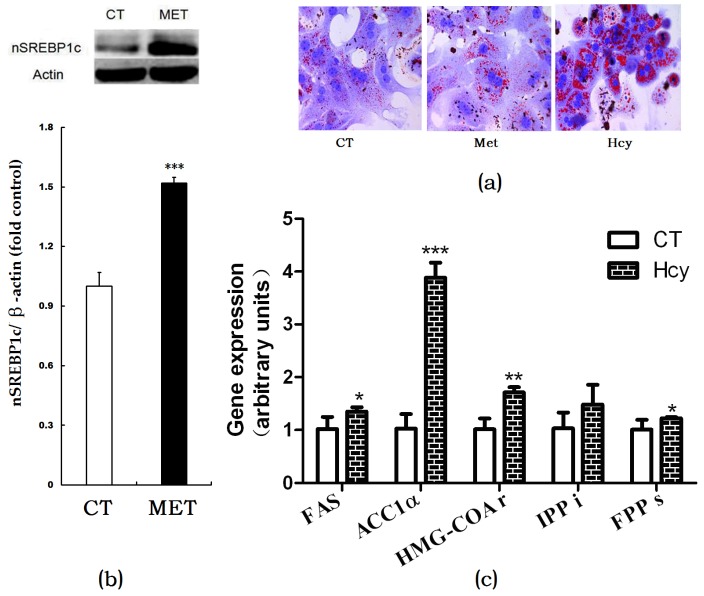
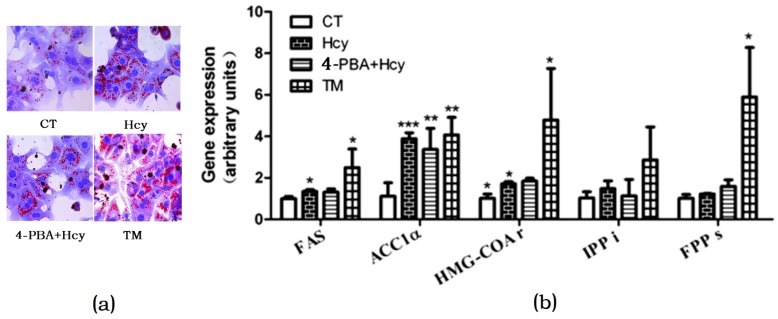
Elevated circulating homocysteine (Hcy) has been proposed to be associated with non-alcoholic fatty liver disease (NAFLD). It is also reported that Hcy causes protein misfolding in the endoplasmic reticulum (ER). In this study, we used a high methionine diet (HMD)-fed mouse model and cultured primary hepatocytes to investigate the effects of Hcy on hepatic lipids metabolism. C57BL/6J mice received either standard chow diet (CT, = 10) or diet supplemented with 2% methionine (MET, = 10) for 16 weeks. In in vitro experiments, cultured mouse primary hepatocytes were treated with Hcy, or Hcy combined with 4-phenylbutyric acid (4-PBA), or tunicamycin (TM), respectively. HMD-fed mice exhibited a mild increase in plasma Hcy level. There was no significant difference of body weight gain between the two groups. Nevertheless, HMD feeding increased epididymal fat/body weight ratio, elevated plasma triglyceride (TG) level, and decreased high-density lipoprotein cholesterol (HDL) level. Similarly, mice on HMD displayed higher liver/body weight ratio, plasma aspartate aminotransferase (AST) and its ratio to alanine aminotransferase (ALT), which was supported by the morphological observations of hepatic triglyceride accumulation in liver tissue as well as primary hepatocytes. Activation of the sterol response element-binding protein 1c (SREBP1c) in Hcy-treated hepatocytes with increased expression of genes involved in hepatic de novo lipogenesis was partially reduced by pretreatment of 4-PBA. Hcy-induced ER stress was also ameliorated by 4-PBA pretreatment, thus demonstrating an important role of Hcy-induced ER stress response in hepatic steatosis. These findings suggest that elevated Hcy was a critical factor in the pathogenesis of NAFLD. Activation of the ER stress response may be involved in Hcy-induced hepatic steatosis.
循环中同型半胱氨酸(Hcy)水平升高被认为与非酒精性脂肪性肝病(NAFLD)有关。也有报道称Hcy会导致内质网(ER)中的蛋白质错误折叠。在本研究中,我们使用高蛋氨酸饮食(HMD)喂养的小鼠模型和培养的原代肝细胞来研究Hcy对肝脏脂质代谢的影响。C57BL/6J小鼠分别接受标准饲料(CT,n = 10)或添加2%蛋氨酸的饲料(MET,n = 10),持续16周。在体外实验中,培养的小鼠原代肝细胞分别用Hcy、Hcy与4-苯基丁酸(4-PBA)联合处理或衣霉素(TM)处理。HMD喂养的小鼠血浆Hcy水平轻度升高。两组之间体重增加没有显著差异。然而,HMD喂养增加了附睾脂肪/体重比,升高了血浆甘油三酯(TG)水平,并降低了高密度脂蛋白胆固醇(HDL)水平。同样,HMD喂养的小鼠肝脏/体重比、血浆天冬氨酸转氨酶(AST)及其与丙氨酸转氨酶(ALT)的比值更高,肝脏组织和原代肝细胞中肝甘油三酯积累的形态学观察结果也证实了这一点。4-PBA预处理可部分降低Hcy处理的肝细胞中固醇调节元件结合蛋白1c(SREBP1c)的激活以及参与肝脏从头脂肪生成的基因表达增加。4-PBA预处理也改善了Hcy诱导的内质网应激,从而证明了Hcy诱导的内质网应激反应在肝脂肪变性中的重要作用。这些发现表明,Hcy升高是NAFLD发病机制中的一个关键因素。内质网应激反应的激活可能参与了Hcy诱导的肝脂肪变性。