Ganjian Haleh, Zietz Christin, Mechtcheriakova Diana, Blaas Dieter, Fuchs Renate
Department of Pathophysiology and Allergy Research, Medical University of Vienna, Währinger Gürtel 18-20, A-1090 Wien, Austria.
Max F. Perutz Laboratories, Department of Medical Biochemistry, Medical University of Vienna, Dr. Bohr Gasse 9/3, A-1030 Vienna, Austria.
Viruses. 2017 Apr 1;9(4):68. doi: 10.3390/v9040068.
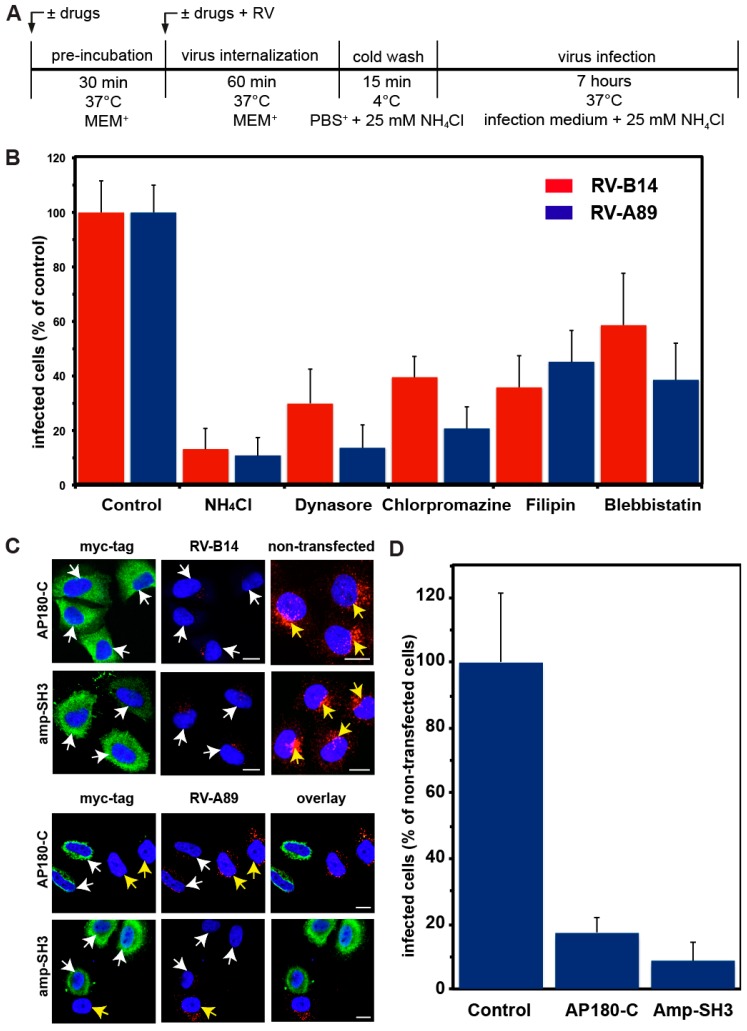
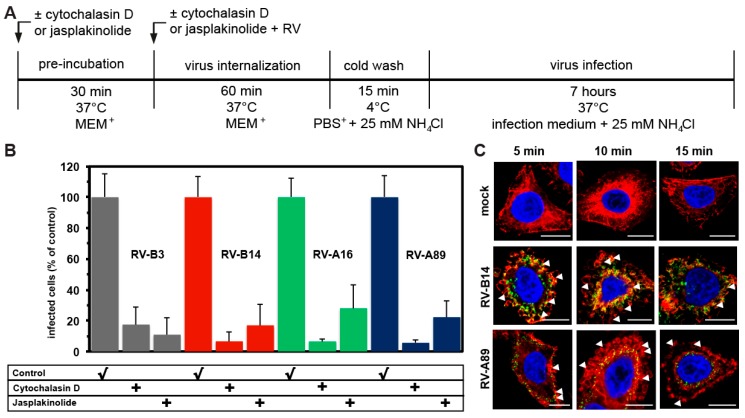
Of the more than 150 human rhinovirus (RV) serotypes, 89 utilize intercellular adhesion molecule-1 (ICAM-1) for cell entry. These belong either to species A or B. We recently demonstrated that RV-B14 and RV-A89, despite binding this same receptor, are routed into distinct endosomal compartments for release of their RNA into the cytosol. To gain insight into the underlying mechanism we now comparatively investigate the port of entry, temperature-dependence of uncoating, and intracellular routing of RV-B3, RV-B14, RV-A16, and RV-A89 in HeLa cells. The effect of various drugs blocking distinct stages on the individual pathways was determined via comparing the number of infected cells in a TissueFaxs instrument. We found that RV-B14 and RV-A89 enter via clathrin-, dynamin-, and cholesterol-dependent pathways, as well as by macropinocytosis. Drugs interfering with actin function similarly blocked entry of all four viruses, indicating their dependence on a dynamic actin network. However, uniquely, RV-A89 was able to produce progeny when internalized at 20 °C followed by neutralizing the endosomal pH and further incubation at 37 °C. Blocking dynein-dependent endosomal transport prevented uncoating of RV-A16 and RV-A89, but not of RV-B3 and RV-B14, indicative for routing of RV-A16 and RV-A89 into the endocytic recycling compartment for uncoating. Our results call for caution when developing drugs aimed at targeting entry or intracellular trafficking of all rhinovirus serotypes.
在150多种人鼻病毒(RV)血清型中,有89种利用细胞间黏附分子1(ICAM-1)进入细胞。这些血清型属于A种或B种。我们最近证明,尽管RV-B14和RV-A89结合相同的受体,但它们被转运到不同的内体区室,以便将其RNA释放到细胞质中。为了深入了解潜在机制,我们现在比较研究RV-B3、RV-B14、RV-A16和RV-A89在HeLa细胞中的进入途径、脱壳的温度依赖性以及细胞内转运。通过在TissueFaxs仪器中比较感染细胞的数量,确定了阻断不同阶段的各种药物对各个途径的影响。我们发现,RV-B14和RV-A89通过网格蛋白、发动蛋白和胆固醇依赖性途径以及巨胞饮作用进入细胞。干扰肌动蛋白功能的药物同样阻断了所有四种病毒的进入,表明它们依赖于动态的肌动蛋白网络。然而,独特的是,RV-A89在20℃内化,随后中和内体pH值并在37℃进一步孵育时能够产生子代。阻断动力蛋白依赖性内体转运可防止RV-A16和RV-A89脱壳,但不能防止RV-B3和RV-B14脱壳,这表明RV-A16和RV-A89被转运到内吞再循环区室进行脱壳。我们的结果表明,在开发针对所有鼻病毒血清型进入或细胞内运输的药物时需要谨慎。