Institute of Biochemistry, ETH Zurich, Switzerland.
EMBO J. 2011 Jul 26;30(17):3647-61. doi: 10.1038/emboj.2011.245.
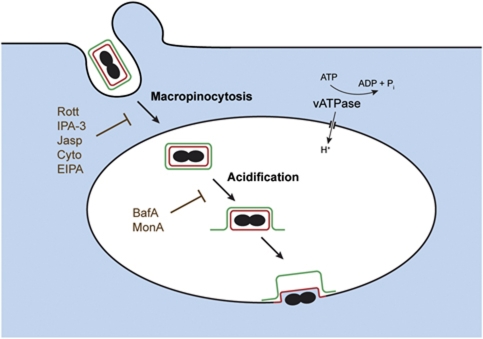
Vaccinia virus (VACV), the model poxvirus, produces two types of infectious particles: mature virions (MVs) and extracellular virions (EVs). EV particles possess two membranes and therefore require an unusual cellular entry mechanism. By a combination of fluorescence and electron microscopy as well as flow cytometry, we investigated the cellular processes that EVs required to infect HeLa cells. We found that EV particles were endocytosed, and that internalization and infection depended on actin rearrangements, activity of Na(+)/H(+) exchangers, and signalling events typical for the macropinocytic mechanism of endocytosis. To promote their internalization, EVs were capable of actively triggering macropinocytosis. EV infection also required vacuolar acidification, and acid exposure in endocytic vacuoles was needed to disrupt the outer EV membrane. Once exposed, the underlying MV-like particle presumably fused its single membrane with the limiting vacuolar membrane. Release of the viral core into the host cell cytosol allowed for productive infection.
痘苗病毒(VACV)是一种模式正痘病毒,可产生两种类型的感染性颗粒:成熟病毒粒子(MVs)和细胞外病毒粒子(EVs)。EV 颗粒具有双层膜,因此需要一种不寻常的细胞进入机制。通过荧光和电子显微镜以及流式细胞术的组合,我们研究了 EV 感染 HeLa 细胞所需的细胞过程。我们发现 EV 颗粒被内吞,内化和感染取决于肌动蛋白重排、Na(+)/H(+)交换器的活性以及典型的巨胞饮作用的胞吞作用的信号事件。为了促进它们的内化,EV 能够主动触发巨胞饮作用。EV 感染还需要液泡酸化,并且需要内吞小泡中的酸性暴露来破坏外 EV 膜。一旦暴露,推测下面的 MV 样颗粒将其单层膜与限定的液泡膜融合。病毒核心释放到宿主细胞细胞质中允许进行有效的感染。