Zhu Jianhui, Wu Jing, Pei Xiucong, Tan Zhijing, Shi Jiaqi, Lubman David M
Department of Surgery, University of Michigan Medical Center, Ann Arbor, MI, United States of America.
Department of Toxicology, School of Public Health, Shenyang Medical College, Liaoning, China.
PLoS One. 2017 Apr 3;12(4):e0175039. doi: 10.1371/journal.pone.0175039. eCollection 2017.
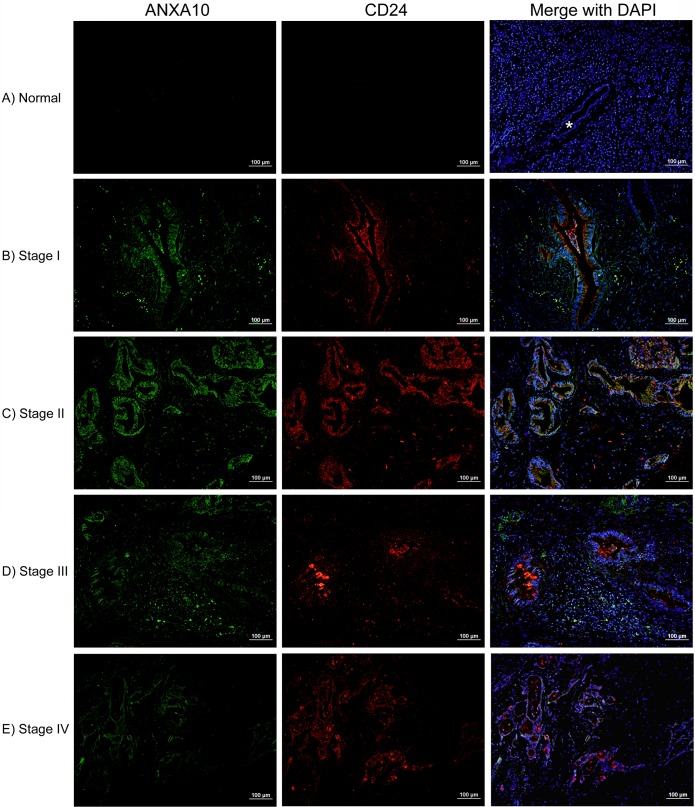
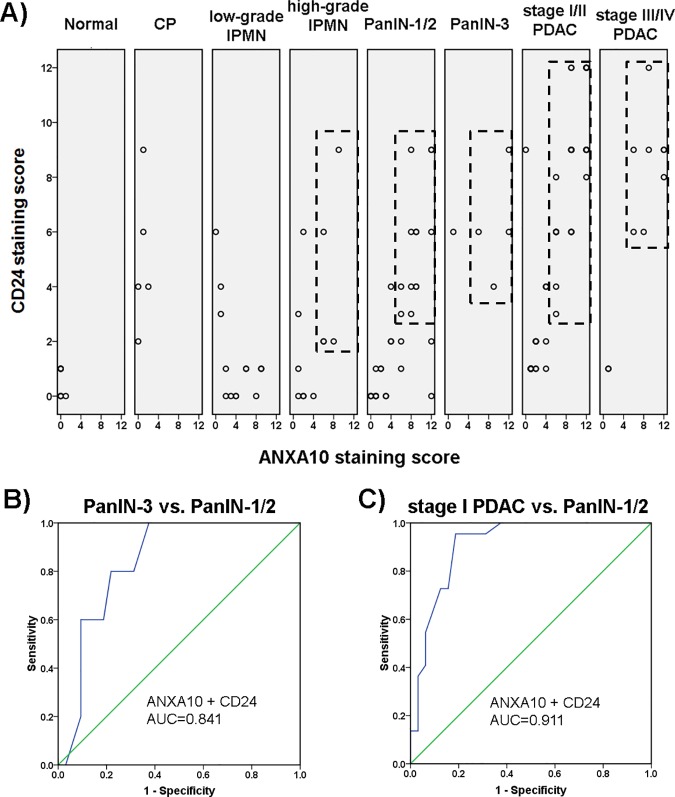
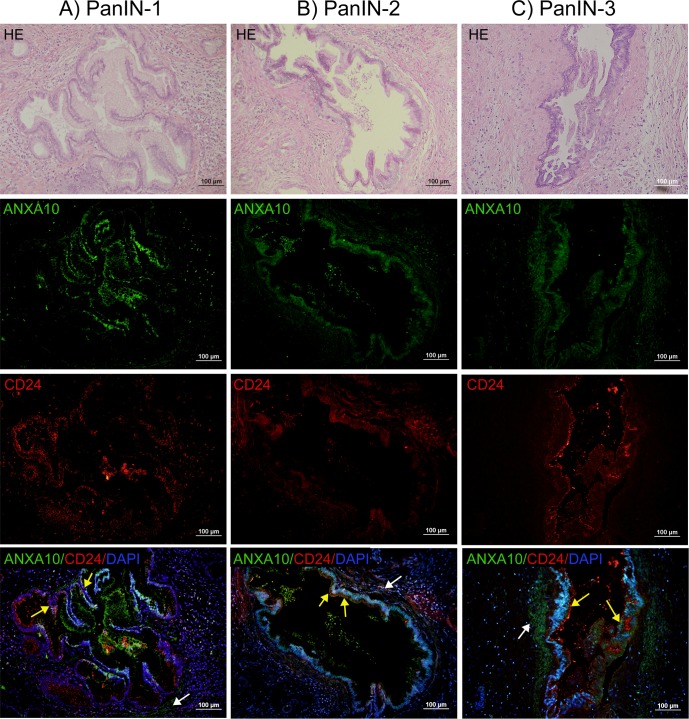
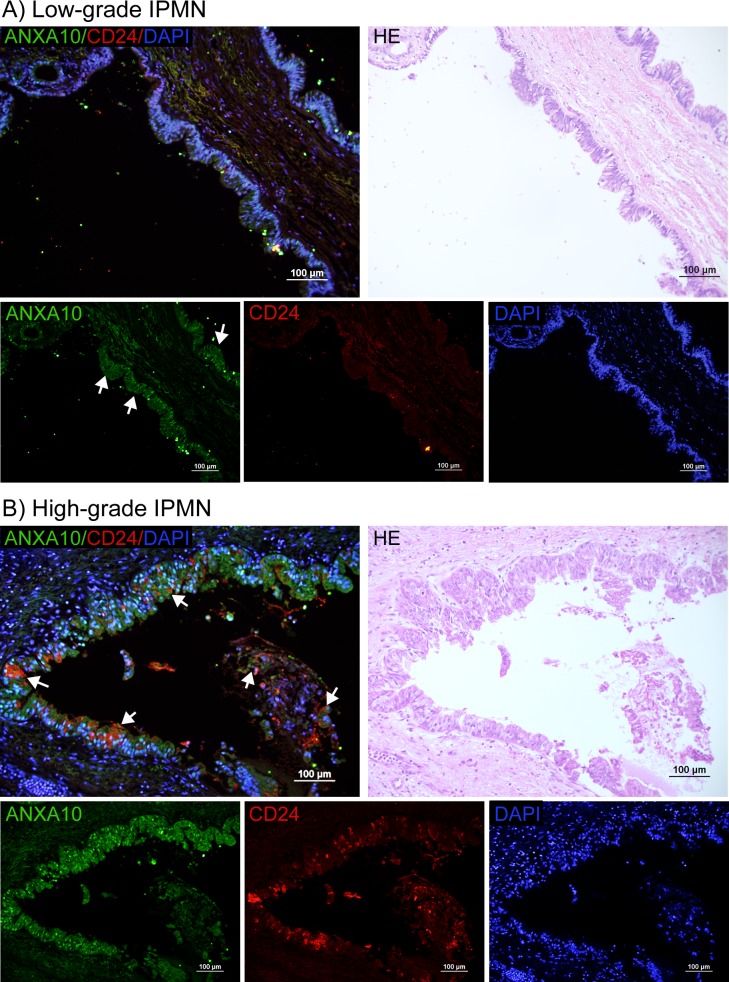
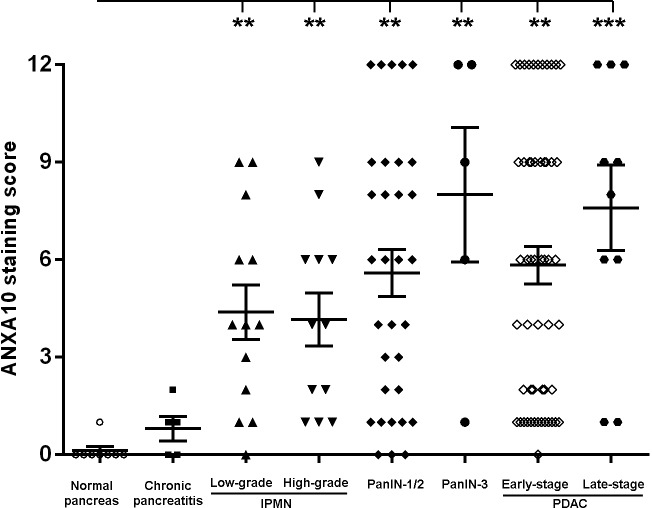
Annexins are a multigene family of calcium and phospholipid-binding proteins that play important roles in calcium signaling, cell motility, differentiation and proliferation. Our previous mass spectrometry-based proteomics study revealed that annexin A10 (ANXA10) was uniquely overexpressed in pancreatic CD24+ adenocarcinoma cells that were dissected from clinical PDAC tissues but was absent in CD24- adjacent normal cells. The correlation between ANXA10 expression and the progression of pancreatic cancer remains unknown. In this study, we performed an immunostaining assay to evaluate ANXA10 expression in 155 primary human tissue specimens, including normal pancreas, chronic pancreatitis (CP), pancreatic adenocarcinoma (PDAC), pancreatic intraepithelial neoplasia (PanIN, the most important precursor of PDAC), and intraductal papillary mucinous neoplasm (IPMN). The immunostaining result showed that ANXA10 was significantly overexpressed in PanINs, IPMNs, and PDACs but negative in normal pancreas and the majority of chronic pancreatitis tissues. Statistical analysis revealed that ANXA10 expression was significantly associated with PDAC and its precursor lesions (p<0.0001). Abundant ANXA10 expression was predominantly present in pancreatic ductal epithelial cells of PanINs, IPMNs, and tumor cells of PDACs. Since PDAC develops through a series of PanINs which in turn arise from pancreatic ducts, the consistent overexpression of ANXA10 in ductal epithelial cells in PanINs and PDACs but negative in normal pancreatic ducts suggests that ANXA10 could serve as a potential marker indicating the presence of PDAC at its earliest precancerous stages. Double immunostaining of ANXA10 and CD24 showed that there was a large overlap between these two markers in PDAC and high-grade neoplasia lesions. The statistical analysis showed that the coexpression of ANXA10 and CD24 was significantly correlated with the progression of pancreatic precursor lesions towards PDACs.
膜联蛋白是一个由钙和磷脂结合蛋白组成的多基因家族,在钙信号传导、细胞运动、分化和增殖中发挥重要作用。我们之前基于质谱的蛋白质组学研究表明,膜联蛋白A10(ANXA10)在从临床胰腺导管腺癌(PDAC)组织中分离出的胰腺CD24+腺癌细胞中独特地过度表达,但在CD24-相邻正常细胞中不存在。ANXA10表达与胰腺癌进展之间的相关性仍然未知。在本研究中,我们进行了免疫染色分析,以评估155例原发性人类组织标本中ANXA10的表达,这些标本包括正常胰腺、慢性胰腺炎(CP)、胰腺腺癌(PDAC)、胰腺上皮内瘤变(PanIN,PDAC最重要的前体)和导管内乳头状黏液性肿瘤(IPMN)。免疫染色结果显示,ANXA10在PanIN、IPMN和PDAC中显著过度表达,但在正常胰腺和大多数慢性胰腺炎组织中呈阴性。统计分析表明,ANXA10表达与PDAC及其前体病变显著相关(p<0.0001)。丰富的ANXA10表达主要存在于PanIN的胰腺导管上皮细胞、IPMN和PDAC的肿瘤细胞中。由于PDAC通过一系列PanIN发展而来,而PanIN又起源于胰腺导管,因此ANXA10在PanIN和PDAC的导管上皮细胞中持续过度表达,但在正常胰腺导管中呈阴性,这表明ANXA10可能作为一个潜在标志物,指示PDAC在其最早癌前阶段的存在。ANXA10和CD24的双重免疫染色显示,这两种标志物在PDAC和高级别瘤变病变中有很大重叠。统计分析表明,ANXA10和CD24的共表达与胰腺前体病变向PDAC的进展显著相关。