Pascual-Serrano A, Arola-Arnal A, Suárez-García S, Bravo F I, Suárez M, Arola L, Bladé C
Nutrigenomics Research Group, Department of Biochemistry and Biotechnology, Universitat Rovira i Virgili (URV), Tarragona, Spain.
Int J Obes (Lond). 2017 Aug;41(8):1246-1255. doi: 10.1038/ijo.2017.90. Epub 2017 Apr 4.
White adipose tissue (WAT) expands through hypertrophy (increased adipocyte size) and/or hyperplasia (increased adipocyte number). Hypertrophy has been associated with insulin resistance and dyslipidemia independently of body composition and fat distribution. In contrast, hyperplasia protects against metabolic alterations. Proanthocyanidins, which are the most abundant flavonoids in the human diet, improve metabolic disturbances associated with diet-induced obesity without reducing body weight or adiposity. The aim of this study was to determine whether grape seed proanthocyanidin extract (GSPE) can modulate WAT expandability. Because GSPE also contains gallic acid, we also studied the capacity of gallic acid to remodel WAT.
Male Wistar rats were fed a standard chow diet (n=6) or a cafeteria diet (CAF) for 11 weeks. After 8 weeks, the CAF-fed animals were supplemented with 25 mg GSPE/kg body weight (n=6), 7 mg gallic acid/kg body weight (n=6) or the vehicle (n=6) for 3 weeks. Histological analyses were performed in the retroperitoneal (rWAT) and inguinal (iWAT) WAT to determine adipocyte size and number. Specific markers for adipogenesis and WAT functionality were analysed in rWAT using quantitative RT-PCR.
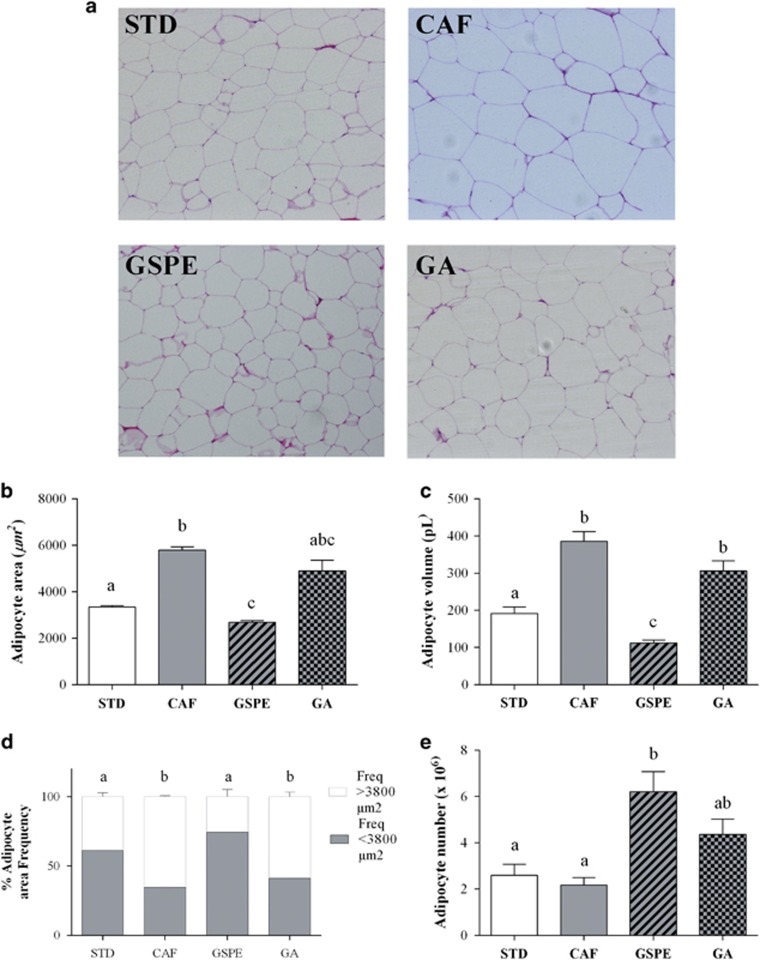
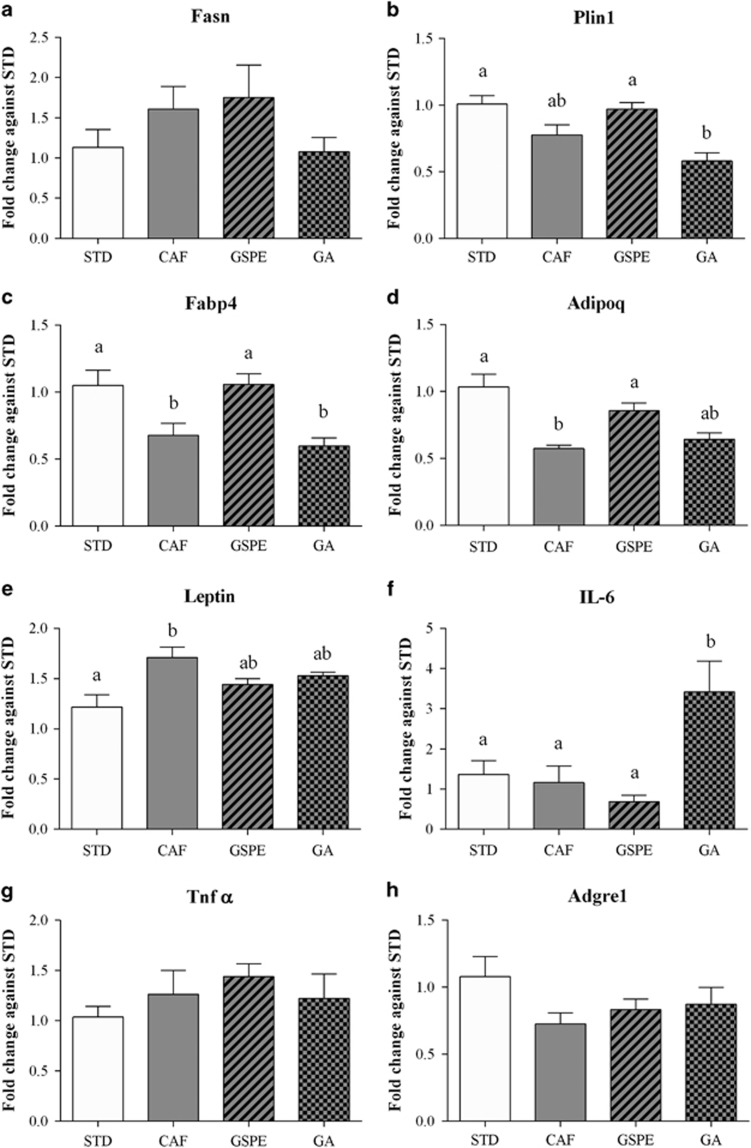
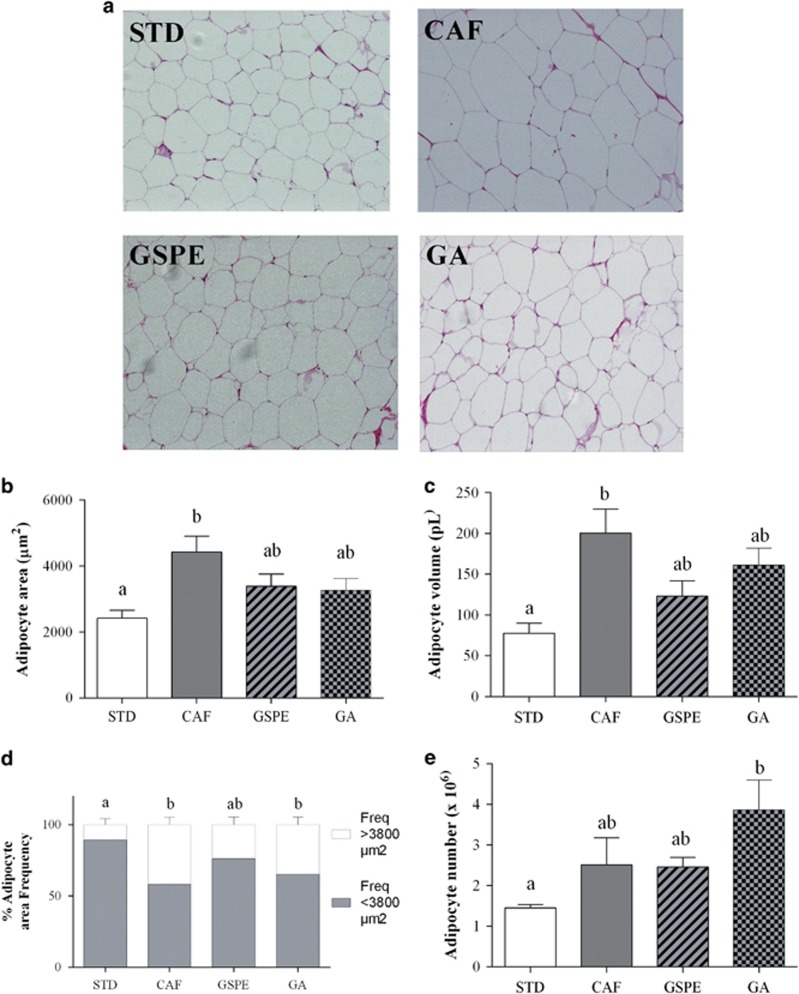
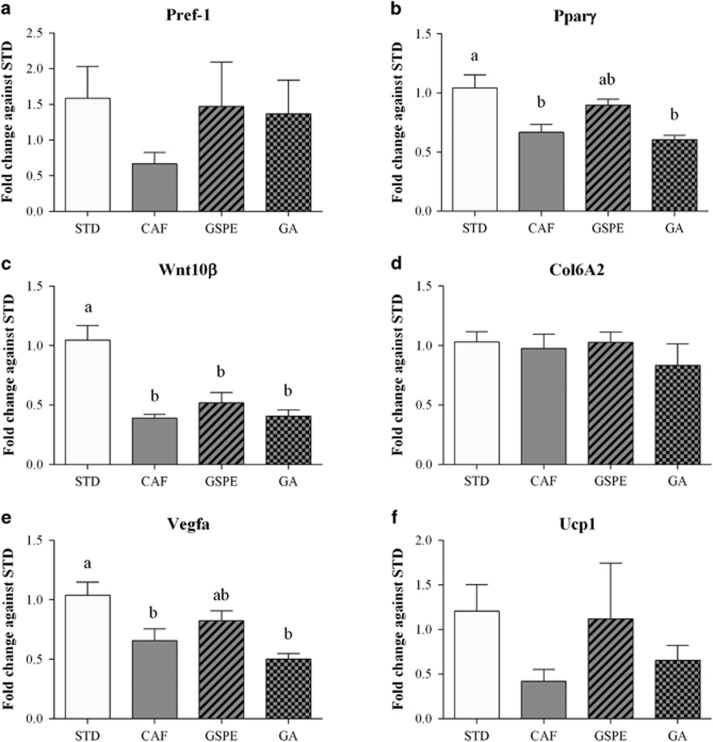
GSPE or gallic acid supplementation did not reduce weight gain or reverse and adiposity. However, GSPE reduced adipocyte size significantly in rWAT and moderately in iWAT and tripled the adipocyte number in rWAT. Gallic acid slightly reduced adipocyte size in rWAT and iWAT and doubled the adipocyte number in both WATs. In accordance with this adipogenic activity, Pref-1 and PPARγ tended to be overexpressed in rWAT of rats supplemented with GSPE. Moreover, GSPE supplementation increased Plin1 and Fabp4 expression and restored adiponectin expression completely, indicating a better functionality of visceral WAT.
GSPE supplementation has anti-hypertrophic and hyperplasic activities in rats with established obesity, mainly in visceral WAT inducing a healthier expansion of WAT to match the surplus energy provided by the cafeteria diet.
白色脂肪组织(WAT)通过肥大(脂肪细胞大小增加)和/或增生(脂肪细胞数量增加)而扩张。肥大与胰岛素抵抗和血脂异常有关,且独立于身体成分和脂肪分布。相比之下,增生可预防代谢改变。原花青素是人类饮食中最丰富的类黄酮,可改善与饮食诱导肥胖相关的代谢紊乱,而不减轻体重或肥胖程度。本研究的目的是确定葡萄籽原花青素提取物(GSPE)是否能调节WAT的扩张能力。由于GSPE还含有没食子酸,我们还研究了没食子酸重塑WAT的能力。
将雄性Wistar大鼠分为两组,一组喂食标准饲料(n = 6),另一组喂食自助餐式饮食(CAF),持续11周。8周后,给喂食CAF的动物补充25 mg GSPE/千克体重(n = 6)、7 mg没食子酸/千克体重(n = 6)或溶剂(n = 6),持续3周。对腹膜后(rWAT)和腹股沟(iWAT)白色脂肪组织进行组织学分析,以确定脂肪细胞的大小和数量。使用定量RT-PCR分析rWAT中脂肪生成和WAT功能的特异性标志物。
补充GSPE或没食子酸并不能减轻体重增加,也不能逆转肥胖。然而,GSPE显著减小了rWAT中的脂肪细胞大小,适度减小了iWAT中的脂肪细胞大小,并使rWAT中的脂肪细胞数量增加了两倍。没食子酸略微减小了rWAT和iWAT中的脂肪细胞大小,并使两个部位的脂肪细胞数量增加了一倍。根据这种脂肪生成活性,Pref-1和PPARγ在补充GSPE的大鼠的rWAT中倾向于过度表达。此外,补充GSPE增加了Plin1和Fabp4的表达,并完全恢复了脂联素的表达,表明内脏WAT的功能更好。
补充GSPE对已患肥胖症的大鼠具有抗肥大和抗增生活性,主要作用于内脏WAT,促使WAT以更健康的方式扩张,以匹配自助餐式饮食提供的多余能量。