Puigvert Marina, Guarischi-Sousa Rodrigo, Zuluaga Paola, Coll Núria S, Macho Alberto P, Setubal João C, Valls Marc
Department of Genetics, University of BarcelonaBarcelona, Spain; Centre for Research in Agricultural Genomics CSIC-IRTA, Autonomous University of BarcelonaBellaterra, Spain.
Department of Biochemistry, University of São Paulo São Paulo, Brazil.
Front Plant Sci. 2017 Mar 20;8:370. doi: 10.3389/fpls.2017.00370. eCollection 2017.
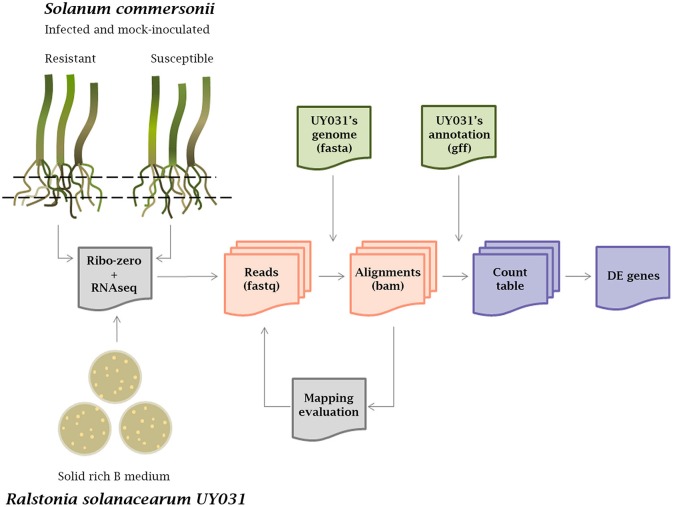
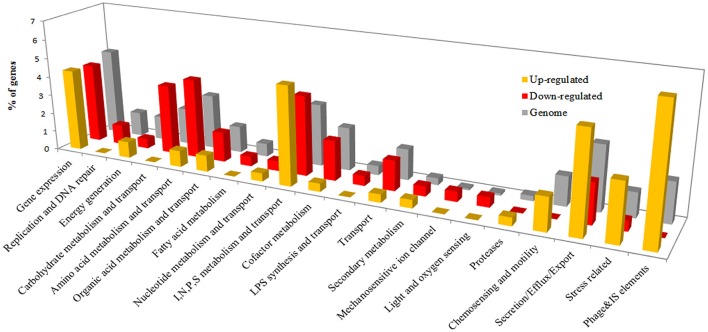
Bacterial wilt of potatoes-also called brown rot-is a devastating disease caused by the vascular pathogen that leads to significant yield loss. As in other plant-pathogen interactions, the first contacts established between the bacterium and the plant largely condition the disease outcome. Here, we studied the transcriptome of UY031 early after infection in two accessions of the wild potato showing contrasting resistance to bacterial wilt. Total RNAs obtained from asymptomatic infected roots were deep sequenced and for 4,609 out of the 4,778 annotated genes in strain UY031 were recovered. Only 2 genes were differentially-expressed between the resistant and the susceptible plant accessions, suggesting that the bacterial component plays a minor role in the establishment of disease. On the contrary, 422 genes were differentially expressed (DE) compared to growth on a synthetic rich medium. Only 73 of these genes had been previously identified as DE in a transcriptome of extracted from infected tomato xylem vessels. Virulence determinants such as the Type Three Secretion System (T3SS) and its effector proteins, motility structures, and reactive oxygen species (ROS) detoxifying enzymes were induced during infection of . On the contrary, metabolic activities were mostly repressed during early root colonization, with the notable exception of nitrogen metabolism, sulfate reduction and phosphate uptake. Several of the genes identified as significantly up-regulated during infection had not been previously described as virulence factors. This is the first report describing the transcriptome directly obtained from infected tissue and also the first to analyze bacterial gene expression in the roots, where plant infection takes place. We also demonstrate that the bacterial transcriptome can be studied when pathogen numbers are low by sequencing transcripts from infected tissue avoiding prokaryotic RNA enrichment.
马铃薯青枯病——也称为褐腐病——是一种由维管束病原体引起的毁灭性病害,会导致严重的产量损失。与其他植物 - 病原体相互作用一样,细菌与植物之间建立的首次接触在很大程度上决定了病害的结果。在此,我们研究了野生马铃薯两个品系在感染UY031后早期的转录组,这两个品系对青枯病的抗性表现出差异。从无症状感染的根部获得的总RNA进行了深度测序,在菌株UY031的4778个注释基因中,有4609个被找回。在抗性和感病植物品系之间只有2个基因差异表达,这表明细菌成分在病害发生过程中起次要作用。相反,与在合成丰富培养基上生长相比,有422个基因差异表达(DE)。这些基因中只有73个先前在从感染番茄木质部导管中提取的转录组中被鉴定为差异表达。毒力决定因素,如三型分泌系统(T3SS)及其效应蛋白、运动结构和活性氧(ROS)解毒酶在感染期间被诱导。相反,在早期根部定殖期间,代谢活动大多受到抑制,但氮代谢、硫酸盐还原和磷酸盐吸收是明显的例外。几个在感染期间被鉴定为显著上调的基因以前没有被描述为毒力因子。这是第一份描述直接从感染组织获得的转录组的报告,也是第一份分析根部细菌基因表达的报告,植物感染发生在根部。我们还证明,当病原体数量较低时,可以通过对感染组织的转录本进行测序来研究细菌转录组,而无需进行原核RNA富集。