Ailloud Florent, Lowe Tiffany M, Robène Isabelle, Cruveiller Stéphane, Allen Caitilyn, Prior Philippe
UMR Peuplements Végétaux et Bioagresseurs en Milieu Tropical, Centre de coopération International en Recherche Agronomique pour le Développement, Saint-Pierre, France; Laboratoire de la Santé des Végétaux, Agence Nationale Sécurité Sanitaire Alimentaire Nationale, Saint-Pierre, France.
Department of Plant Pathology, University of Wisconsin-Madison , Madison, WI , United States.
PeerJ. 2016 Jan 5;4:e1549. doi: 10.7717/peerj.1549. eCollection 2016.
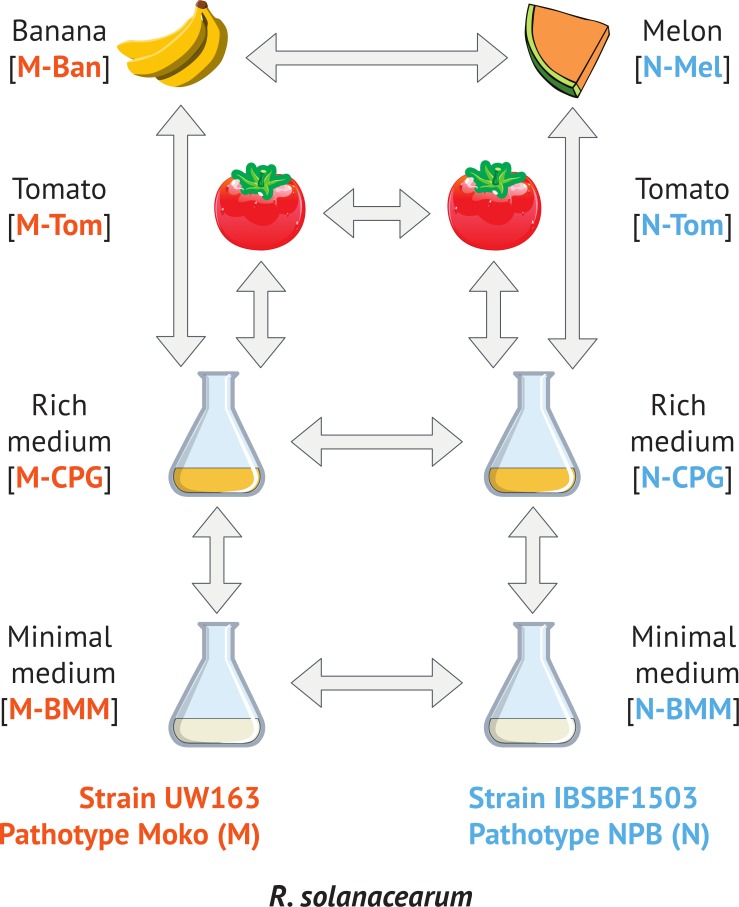
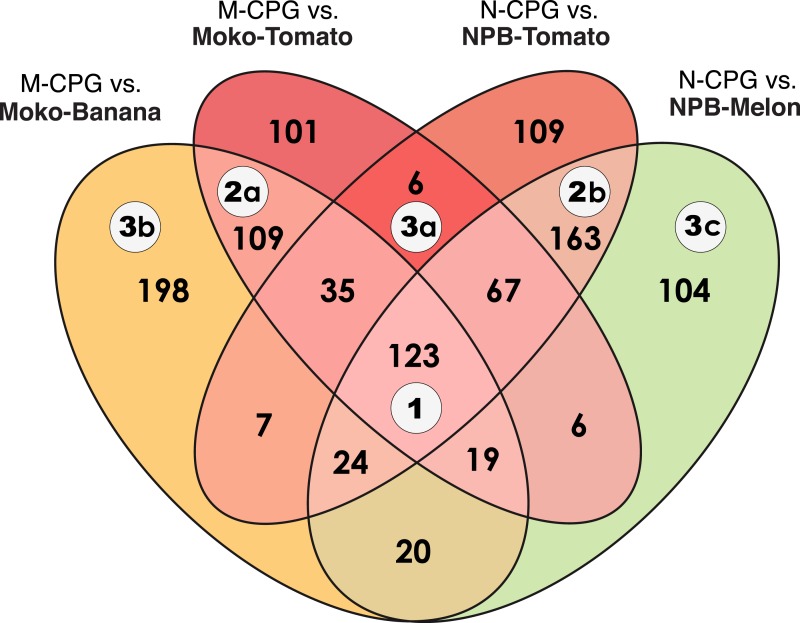
Background. Ralstonia solanacearum is an economically important plant pathogen with an unusually large host range. The Moko (banana) and NPB (not pathogenic to banana) strain groups are closely related but are adapted to distinct hosts. Previous comparative genomics studies uncovered very few differences that could account for the host range difference between these pathotypes. To better understand the basis of this host specificity, we used RNAseq to profile the transcriptomes of an R. solanacearum Moko strain and an NPB strain under in vitro and in planta conditions. Results. RNAs were sequenced from bacteria grown in rich and minimal media, and from bacteria extracted from mid-stage infected tomato, banana and melon plants. We computed differential expression between each pair of conditions to identify constitutive and host-specific gene expression differences between Moko and NPB. We found that type III secreted effectors were globally up-regulated upon plant cell contact in the NPB strain compared with the Moko strain. Genes encoding siderophore biosynthesis and nitrogen assimilation genes were highly up-regulated in the NPB strain during melon pathogenesis, while denitrification genes were up-regulated in the Moko strain during banana pathogenesis. The relatively lower expression of oxidases and the denitrification pathway during banana pathogenesis suggests that R. solanacearum experiences higher oxygen levels in banana pseudostems than in tomato or melon xylem. Conclusions. This study provides the first report of differential gene expression associated with host range variation. Despite minimal genomic divergence, the pathogenesis of Moko and NPB strains is characterized by striking differences in expression of virulence- and metabolism-related genes.
背景。青枯雷尔氏菌是一种具有重要经济意义的植物病原菌,其寄主范围异常广泛。莫科(香蕉)菌株组和NPB(对香蕉无致病性)菌株组关系密切,但适应不同的寄主。先前的比较基因组学研究发现,能够解释这些致病型寄主范围差异的差异非常少。为了更好地理解这种寄主特异性的基础,我们使用RNA测序技术对青枯雷尔氏菌莫科菌株和NPB菌株在体外和植物体内条件下的转录组进行了分析。结果。对在丰富培养基和基本培养基中生长的细菌,以及从感染中期的番茄、香蕉和甜瓜植株中提取的细菌进行了RNA测序。我们计算了每对条件之间的差异表达,以确定莫科菌株和NPB菌株之间组成型和寄主特异性的基因表达差异。我们发现,与莫科菌株相比,NPB菌株在与植物细胞接触后,III型分泌效应子整体上调。在甜瓜致病过程中,编码铁载体生物合成的基因和氮同化基因在NPB菌株中高度上调,而在香蕉致病过程中,反硝化基因在莫科菌株中上调。香蕉致病过程中氧化酶和反硝化途径的相对较低表达表明,青枯雷尔氏菌在香蕉假茎中经历的氧气水平高于番茄或甜瓜木质部。结论。本研究首次报道了与寄主范围变异相关的差异基因表达。尽管基因组差异很小,但莫科菌株和NPB菌株的致病机制在毒力和代谢相关基因的表达上存在显著差异。