University of California - San Diego, Materials Science and Engineering Program, La Jolla, CA 92093, USA.
University of California - San Diego, Department of Electrical and Computer Engineering, La Jolla, CA 92093, USA.
Sci Rep. 2017 Apr 4;7:45493. doi: 10.1038/srep45493.
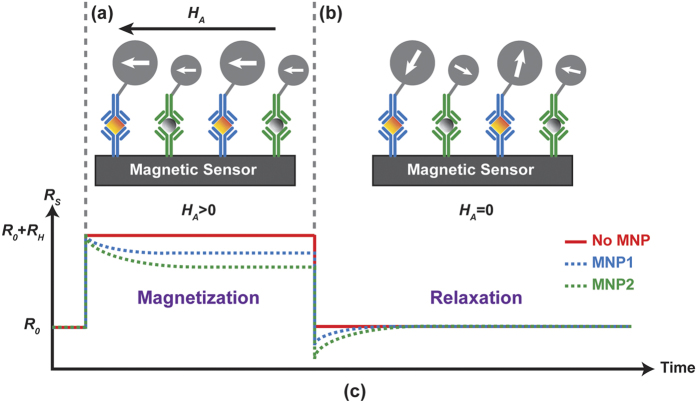
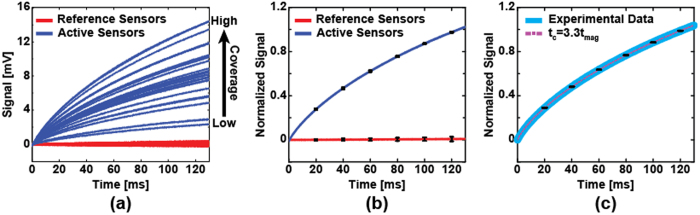
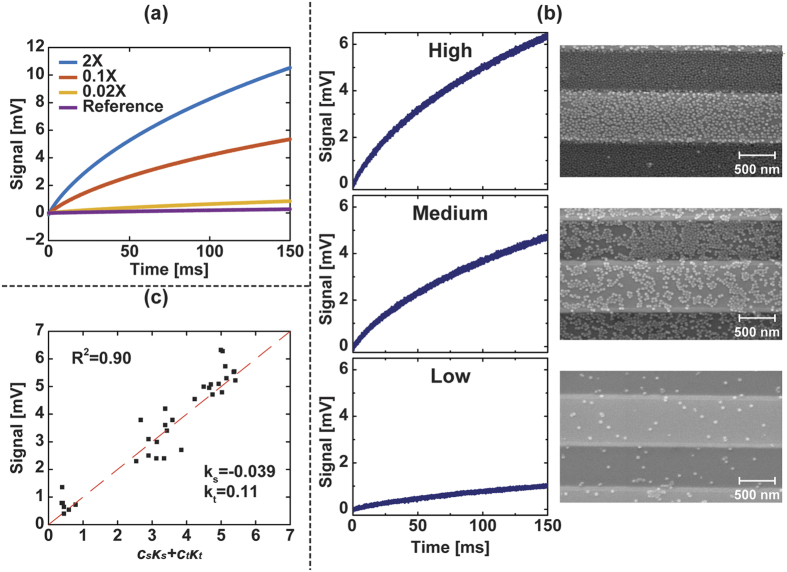
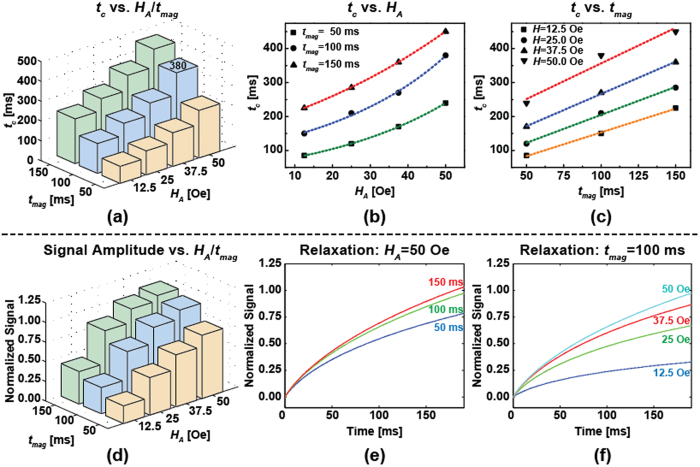
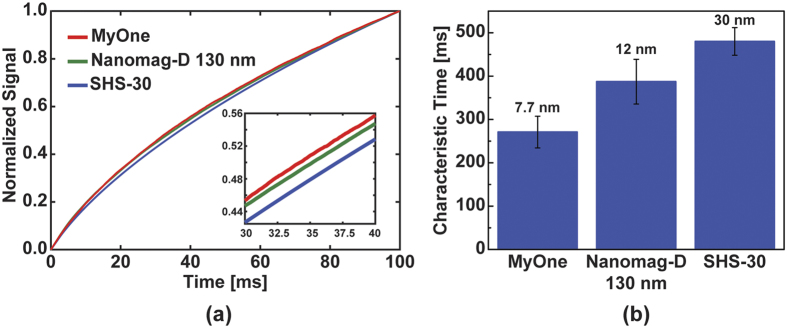
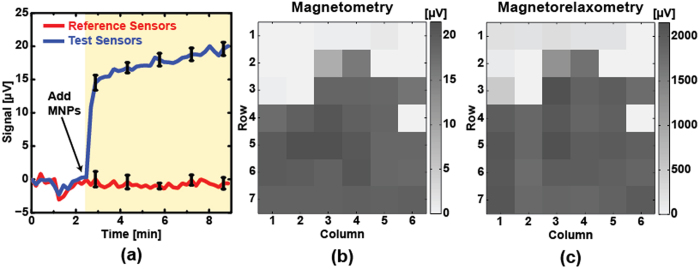
Magnetorelaxometry (MRX) is a promising new biosensing technique for point-of-care diagnostics. Historically, magnetic sensors have been primarily used to monitor the stray field of magnetic nanoparticles bound to analytes of interest for immunoassays and flow cytometers. In MRX, the magnetic nanoparticles (MNPs) are first magnetized and then the temporal response is monitored after removing the magnetic field. This new sensing modality is insensitive to the magnetic field homogeneity making it more amenable to low-power portable applications. In this work, we systematically investigated time-domain MRX by measuring the signal dependence on the applied field, magnetization time, and magnetic core size. The extracted characteristic times varied for different magnetic MNPs, exhibiting unique magnetic signatures. We also measured the signal contribution based on the MNP location and correlated the coverage with measured signal amplitude. Lastly, we demonstrated, for the first time, a GMR-based time-domain MRX bioassay. This approach validates the feasibility of immunoassays using GMR-based MRX and provides an alternative platform for point-of-care diagnostics.
磁弛豫测量法(MRX)是一种有前途的新的即时诊断生物传感技术。从历史上看,磁传感器主要用于监测与免疫分析和流式细胞仪中感兴趣的分析物结合的磁性纳米粒子的杂散场。在 MRX 中,首先对磁性纳米粒子(MNPs)进行磁化,然后在去除磁场后监测其时间响应。这种新的传感模式对磁场均匀性不敏感,因此更适合低功率便携式应用。在这项工作中,我们通过测量信号对施加磁场、磁化时间和磁芯尺寸的依赖关系,系统地研究了时域 MRX。提取的特征时间因不同的磁性 MNPs 而变化,表现出独特的磁性特征。我们还根据 MNP 的位置测量了信号贡献,并将覆盖率与测量的信号幅度相关联。最后,我们首次展示了基于 GMR 的时域 MRX 生物测定法。该方法验证了基于 GMR 的 MRX 免疫测定的可行性,并为即时诊断提供了替代平台。