Storheim Kjersti, Berg Linda, Hellum Christian, Gjertsen Øivind, Neckelmann Gesche, Espeland Ansgar, Keller Anne
Research and Communication unit for musculoskeletal disorders (FORMI), Oslo University Hospital Ullevål, Postbox 4956, Nydalen, 0424, Oslo, Norway.
Faculty of Medicine, University of Oslo, Postbox 1078, Blindern, 0316, Oslo, Norway.
BMC Musculoskelet Disord. 2017 Apr 4;18(1):145. doi: 10.1186/s12891-017-1505-5.
Evidence is lacking on whether fat infiltration in the multifidus muscles affects outcomes after total disc replacement (TDR) surgery and if it develops after surgery. The aims of this study were 1) to investigate whether pre-treatment multifidus muscle fat infiltration predicts outcome 2 years after treatment with TDR surgery or multidisciplinary rehabilitation, and 2) to compare changes in multifidus muscle fat infiltration from pre-treatment to 2-year follow-up between the two treatment groups.
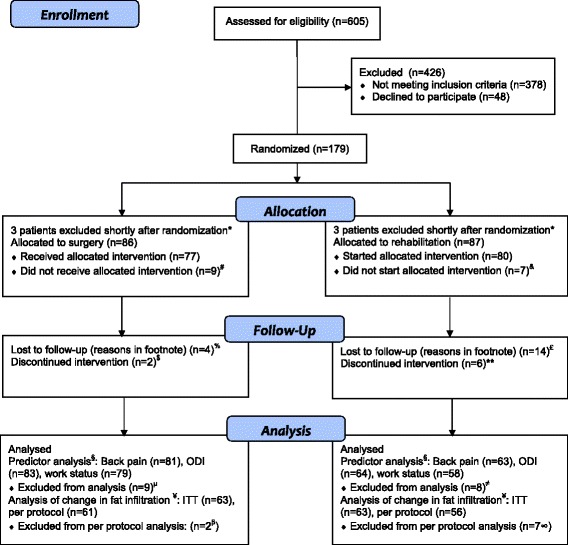
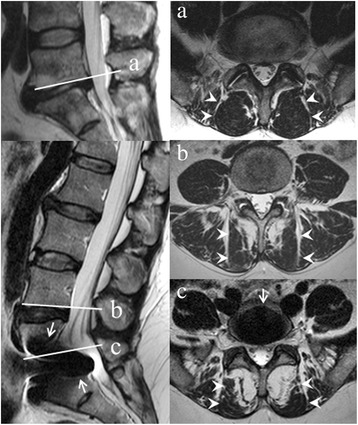
The study is secondary analysis of data from a trial with 2-year follow-up of patients with chronic low back pain (LBP) and degenerative disc randomized to TDR surgery or multidisciplinary rehabilitation. We analyzed (aim 1) patients with both magnetic resonance imaging (MRI) at pre-treatment and valid data on outcome measures at 2-year follow-up (predictor analysis), and (aim 2) patients with MRI at both pre-treatment and 2-year follow-up. Outcome measures were visual analogue scale (VAS) for LBP, Oswestry Disability Index (ODI), work status and muscle fat infiltration on MRI. Patients with pre-treatment MRI and 2-year outcome data on VAS for LBP (n = 144), ODI (n = 147), and work status (n = 137) were analyzed for prediction purposes. At 2-year follow-up, 126 patients had another MRI scan, and change in muscle fat infiltration was compared between the two treatment groups. Three radiologists visually quantified multifidus muscle fat in the three lower lumbar levels on MRI as <20% (grade 0), 20-50% (grade 1), or >50% (grade 2) of the muscle cross-section containing fat. Regression analysis and a mid-P exact test were carried out.
Grade 0 pre-treatment multifidus muscle fat predicted better clinical results at 2-year follow-up after TDR surgery (all outcomes) but not after rehabilitation. At 2-year follow-up, increased fat infiltration was more common in the surgery group (intention-to-treat p = 0.03, per protocol p = 0.08) where it was related to worse pain and ODI.
Patients with less fat infiltration of multifidus muscles before TDR surgery had better outcomes at 2-year follow-up, but findings also indicated a negative influence of TDR surgery on back muscle morphology in some patients. The rehabilitation group maintained their muscular morphology and were unaffected by pre-treatment multifidus muscle fat.
NCT 00394732 (retrospectively registered October 31, 2006).
关于多裂肌脂肪浸润是否会影响全椎间盘置换(TDR)手术后的疗效以及是否在术后发生,目前缺乏相关证据。本研究的目的是:1)调查TDR手术或多学科康复治疗前多裂肌脂肪浸润情况能否预测治疗2年后的疗效;2)比较两个治疗组从治疗前到2年随访期间多裂肌脂肪浸润的变化。
本研究是对一项试验数据的二次分析,该试验对慢性下腰痛(LBP)和椎间盘退变患者进行了2年随访,这些患者被随机分为TDR手术组或多学科康复组。我们分析了(目的1)治疗前进行磁共振成像(MRI)且2年随访时有有效疗效测量数据的患者(预测分析),以及(目的2)治疗前和2年随访时均进行MRI检查的患者。疗效指标包括LBP视觉模拟评分(VAS)、Oswestry功能障碍指数(ODI)、工作状态以及MRI上的肌肉脂肪浸润情况。为了进行预测分析,对治疗前有MRI且有LBP的VAS(n = 144)、ODI(n = 147)和工作状态(n = 137)的2年疗效数据的患者进行了分析。在2年随访时,126例患者进行了另一次MRI扫描,并比较了两个治疗组之间肌肉脂肪浸润的变化。三位放射科医生通过视觉对MRI上三个下腰椎节段的多裂肌脂肪进行定量,将其分为肌肉横截面含脂肪量<20%(0级)、20 - 50%(1级)或>50%(2级)。进行了回归分析和双侧精确检验。
TDR手术前多裂肌脂肪0级的患者在2年随访时临床疗效更好(所有疗效指标),但康复治疗后并非如此。在2年随访时,手术组脂肪浸润增加更为常见(意向性分析p = 0.03,符合方案分析p = 0.08),且与更严重的疼痛和ODI相关。
TDR手术前多裂肌脂肪浸润较少的患者在2年随访时疗效更好,但研究结果也表明TDR手术对部分患者的背部肌肉形态有负面影响。康复组维持了其肌肉形态,且不受治疗前多裂肌脂肪情况的影响。
NCT 00394732(2006年10月31日追溯注册)。