Klonizakis Markos, Crank Helen, Gumber Anil, Brose Leonie S
Centre for Sport and Exercise Science, Collegiate Hall, Collegiate Crescent, Sheffield Hallam University, Sheffield, S10 2BP, UK.
Centre for Health and Social Care Research, Sheffield Hallam University, Sheffield, UK.
BMC Public Health. 2017 Apr 4;17(1):293. doi: 10.1186/s12889-017-4206-y.
The estimated number of cigarette smokers in the world is 1.3 billion, expected to rise to 1.7 billion by 2025, with 10 million smokers living in the U.K. Smoking is the leading, preventable death-cause worldwide, being responsible for almost 650,000 deaths in the E.U. annually. A combination of pharmacological interventions, including nicotine replacement therapy, bupropion and varenicline, and behavioural support is the most effective approach to smoking cessation. However, even the best methods have high relapse rates of approximately 75% within 6 months. Electronic (or "e-") cigarettes use battery power to disperse a solution that usually contains propylene glycol or glycerine, water, flavouring and nicotine. E-cigarettes have become the most popular smoking cessation aid in England, however, information on their effects on cardiovascular function is limited and contradictory. As e-cigarettes are not solely nicotine-based products, existing research exploring the effects of nicotine on the cardio-vasculature provides only limited information, while their extensive uptake urges the need of evidence to inform the general public, smokers and policy-makers.
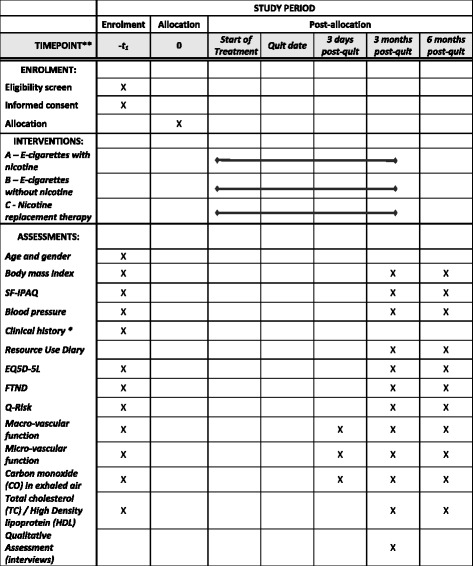
This is a pragmatic, 3-group, randomised, assessor-blinded, single-centre trial exploring the cardiovascular physiological effects of the use of e-cigarettes (nicotine-free and nicotine-inclusive, assessed separately) combined with behavioural support as a smoking cessation method in comparison to the combination of NRT and behavioural support. The primary outcome will be macro-vascular function, determined by a Flow Mediated Dilatation ultrasound assessment, 6 months following participants' "quit date".
Participants will be assessed at baseline, 3 days following their self-determined "quit date", at intervention end (3 months) and 6 months following their "quite date". Findings are expected to give an indication of the cardiovascular effects of e-cigarettes both in the short- and in the medium-term period, informing the general public, policy holders and researchers, helping to define the future role of e-cigarettes as a smoking cessation aid.
Clinicaltrials.gov NCT03061253 . Registered 17th February 2017.
全球估计有13亿吸烟者,预计到2025年将增至17亿,其中1000万吸烟者生活在英国。吸烟是全球首要的可预防死因,在欧盟每年导致近65万人死亡。包括尼古丁替代疗法、安非他酮和伐尼克兰在内的药物干预措施与行为支持相结合,是戒烟最有效的方法。然而,即便采用最佳方法,6个月内的复发率仍高达约75%。电子烟利用电池供电来分散一种溶液,该溶液通常含有丙二醇或甘油、水、调味剂和尼古丁。电子烟已成为英国最受欢迎的戒烟辅助工具,然而,关于其对心血管功能影响的信息有限且相互矛盾。由于电子烟并非单纯基于尼古丁的产品,现有探索尼古丁对心血管系统影响的研究仅提供了有限信息,而电子烟的广泛使用促使我们需要证据来告知公众、吸烟者和政策制定者。
这是一项务实的三臂随机、评估者盲法、单中心试验,探讨将使用电子烟(分别评估不含尼古丁和含尼古丁的情况)与行为支持相结合作为戒烟方法时,相较于尼古丁替代疗法与行为支持相结合,对心血管生理的影响。主要结局将是在参与者“戒烟日”6个月后,通过血流介导的血管扩张超声评估来确定的大血管功能。
将在基线、参与者自行确定的“戒烟日”后3天、干预结束时(3个月)以及“戒烟日”后6个月对参与者进行评估。预计研究结果将表明电子烟在短期和中期对心血管的影响,为公众、政策制定者和研究人员提供信息,有助于确定电子烟作为戒烟辅助工具的未来作用。
Clinicaltrials.gov NCT03061253。于2017年2月17日注册。