Neuroeconomics, Reward and Decision-making Team, Institut des Sciences Cognitives Marc Jeannerod, Centre National de la Recherche Scientifique, 69675 Bron, France.
University Claude Bernard Lyon, Lyon 1, France.
Sci Rep. 2017 Apr 5;7:45920. doi: 10.1038/srep45920.
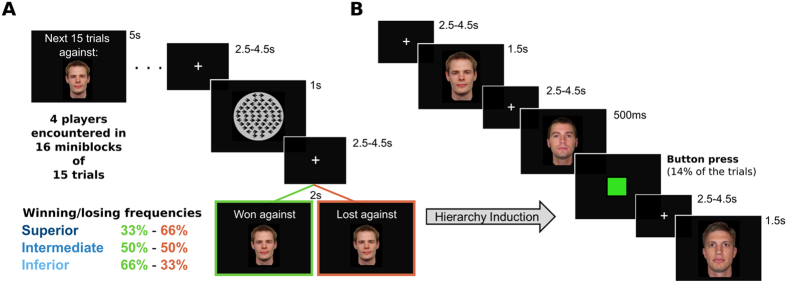
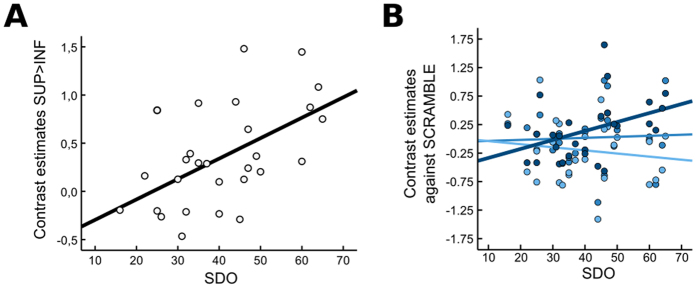
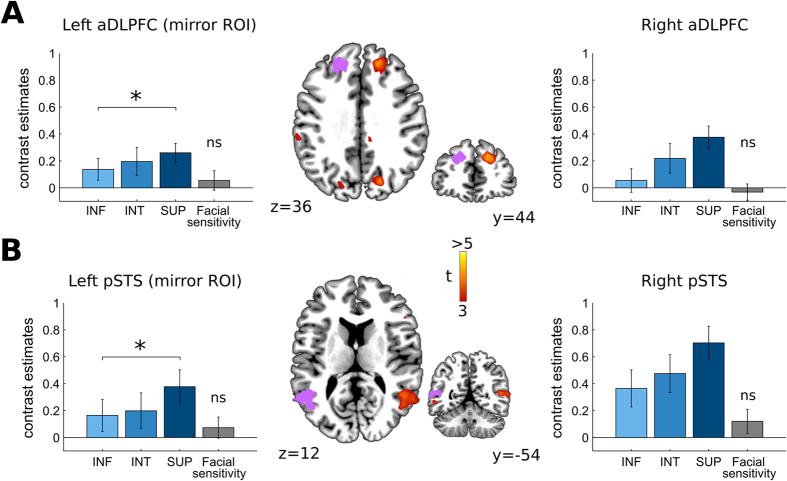
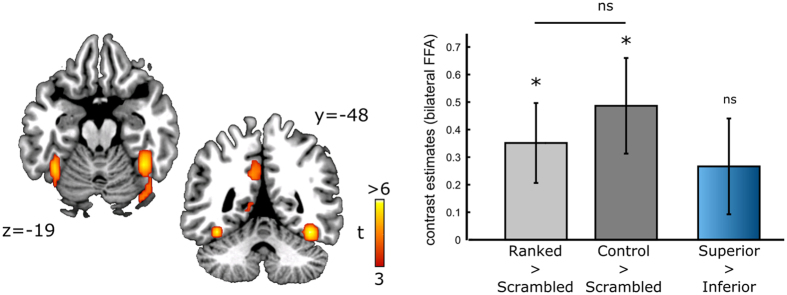
Ubiquitous in the animal kingdom, dominance hierarchies emerge through social competition and underlie the control of resources. Confronting the disruptive influence of socioeconomic inequalities, human populations tend to split into groups who legitimize existing dominance hierarchies and groups who condemn them. Here, we hypothesized that variations in the neural sensitivity to dominance ranks partly underpins this ideological split, as measured by the social dominance orientation scale (SDO). Following a competitive task used to induce dominance representations about three opponents (superior, equal and inferior), subjects were passively presented the faces of these opponents while undergoing fMRI. Analyses demonstrated that two key brain regions, the superior temporal sulcus (STS) and anterior dorsolateral prefrontal cortex (aDLPFC) were sensitive to social ranks. Confirming our hypothesis, the sensitivity of the right aDLPFC to social ranks correlated positively with the SDO scale, which is known to predict behaviors and political attitudes associated with the legitimization of dominance hierarchies. This study opens new perspectives for the neurosciences of political orientation and social dominance.
在动物王国中普遍存在,统治等级通过社会竞争出现,并构成对资源的控制。面对社会经济不平等的破坏性影响,人类倾向于分裂为两个群体,一个群体为现有的统治等级制度辩护,另一个群体则谴责它们。在这里,我们假设,神经对统治等级的敏感性的变化部分支持了这种意识形态上的分裂,这种变化通过社会统治取向量表(SDO)来衡量。在一项用于诱导对三个对手(优越、平等和劣势)的统治表现的竞争任务之后,被试者在接受 fMRI 检查时被动地呈现这些对手的面孔。分析表明,两个关键的大脑区域,即颞上沟(STS)和前背外侧前额叶皮层(aDLPFC)对社会等级敏感。证实了我们的假设,右侧 aDLPFC 对社会等级的敏感性与 SDO 量表呈正相关,SDO 量表已知可以预测与统治等级合法化相关的行为和政治态度。这项研究为政治倾向和社会统治的神经科学开辟了新的视角。