Xie Fangqing, Kavalenka Maryna N, Röger Moritz, Albrecht Daniel, Hölscher Hendrik, Leuthold Jürgen, Schimmel Thomas
Institute of Applied Physics, Karlsruhe Institute of Technology, Campus South, 76128 Karlsruhe, Germany.
Institute of Microstructure Technology, Karlsruhe Institute of Technology, Campus North, 76021 Karlsruhe, Germany.
Beilstein J Nanotechnol. 2017 Mar 1;8:530-538. doi: 10.3762/bjnano.8.57. eCollection 2017.
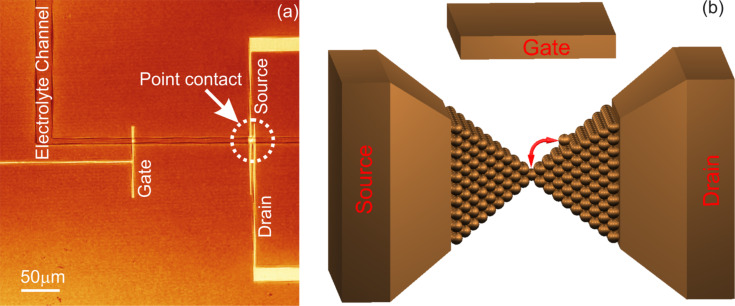
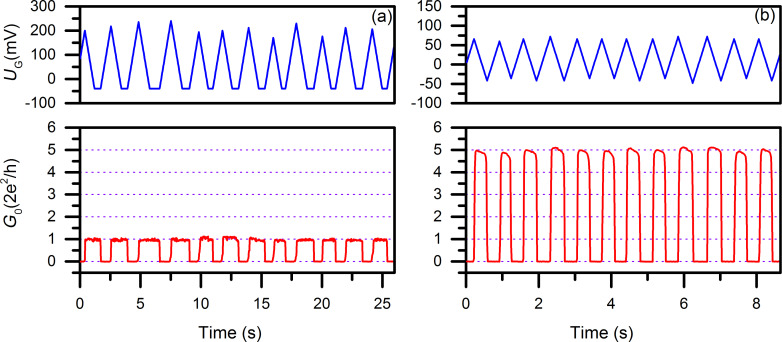
We investigated copper as a working material for metallic atomic-scale transistors and confirmed that copper atomic-scale transistors can be fabricated and operated electrochemically in a copper electrolyte (CuSO + HSO) in bi-distilled water under ambient conditions with three microelectrodes (source, drain and gate). The electrochemical switching-on potential of the atomic-scale transistor is below 350 mV, and the switching-off potential is between 0 and -170 mV. The switching-on current is above 1 μA, which is compatible with semiconductor transistor devices. Both sign and amplitude of the voltage applied across the source and drain electrodes () influence the switching rate of the transistor and the copper deposition on the electrodes, and correspondingly shift the electrochemical operation potential. The copper atomic-scale transistors can be switched using a function generator without a computer-controlled feedback switching mechanism. The copper atomic-scale transistors, with only one or two atoms at the narrowest constriction, were realized to switch between 0 and 1 ( = 2e/h; with being the electron charge, and being Planck's constant) or 2 by the function generator. The switching rate can reach up to 10 Hz. The copper atomic-scale transistor demonstrates volatile/non-volatile dual functionalities. Such an optimal merging of the logic with memory may open a perspective for processor-in-memory and logic-in-memory architectures, using copper as an alternative working material besides silver for fully metallic atomic-scale transistors.
我们研究了铜作为金属原子尺度晶体管的工作材料,并证实了在环境条件下,使用三微电极(源极、漏极和栅极),可在双蒸水中的铜电解质(CuSO₄ + H₂SO₄)中通过电化学方法制造和操作铜原子尺度晶体管。原子尺度晶体管的电化学开启电位低于350 mV,关断电位在0至 -170 mV之间。开启电流高于1 μA,这与半导体晶体管器件兼容。施加在源极和漏极电极两端的电压的符号和幅度()都会影响晶体管的开关速率以及电极上的铜沉积,相应地会改变电化学操作电位。铜原子尺度晶体管可使用函数发生器进行切换,无需计算机控制的反馈切换机制。在最窄处仅有一个或两个原子的铜原子尺度晶体管,通过函数发生器可实现0和1(I = 2e/h;其中e为电子电荷,h为普朗克常数)或2之间的切换。开关速率可达10 Hz。铜原子尺度晶体管展现出易失性/非易失性双重功能。这种逻辑与存储的最佳融合可能为处理器内置内存和逻辑内置内存架构开辟前景,除了银之外,铜可作为全金属原子尺度晶体管的替代工作材料。