Liu Xianbao, Hu Dexing, Zeng Zhiru, Zhu Wei, Zhang Na, Yu Hong, Chen Han, Wang Kan, Wang Yingchao, Wang Lengmei, Zhao Jing, Zhang Ling, Wu Rongrong, Hu Xinyang, Wang Jian'an
Department of Cardiology, Second Affiliated Hospital, Zhejiang University School of Medicine, Hangzhou, Zhejiang, China.
Provincial Key Laboratory of Cardiovascular Research, Hangzhou, Zhejiang, China.
Cell Death Dis. 2017 Apr 6;8(4):e2731. doi: 10.1038/cddis.2017.107.
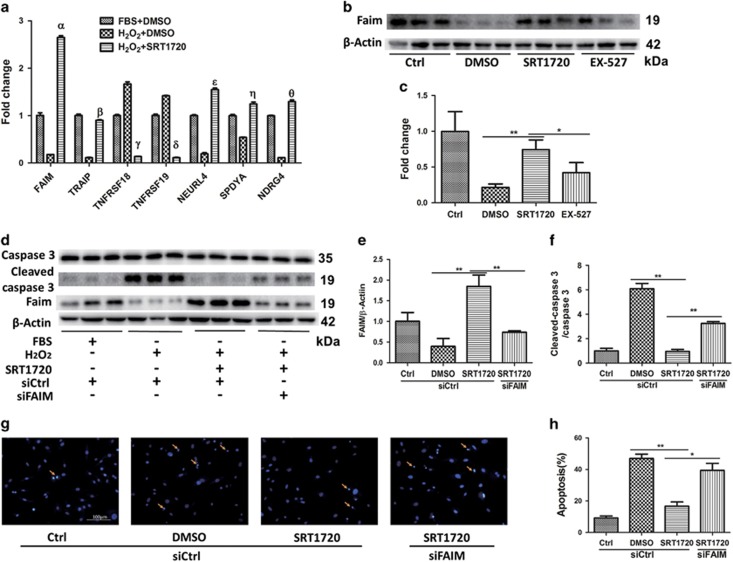
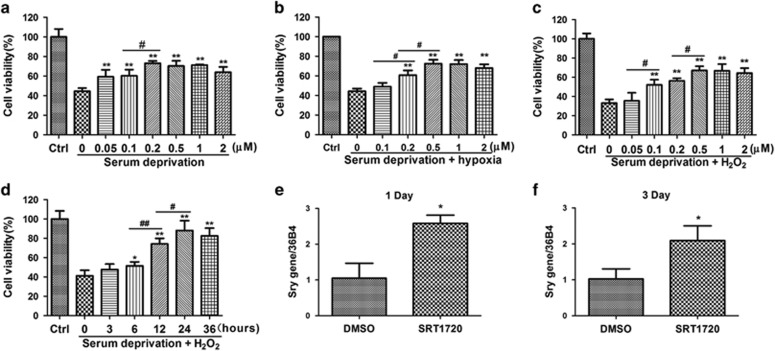
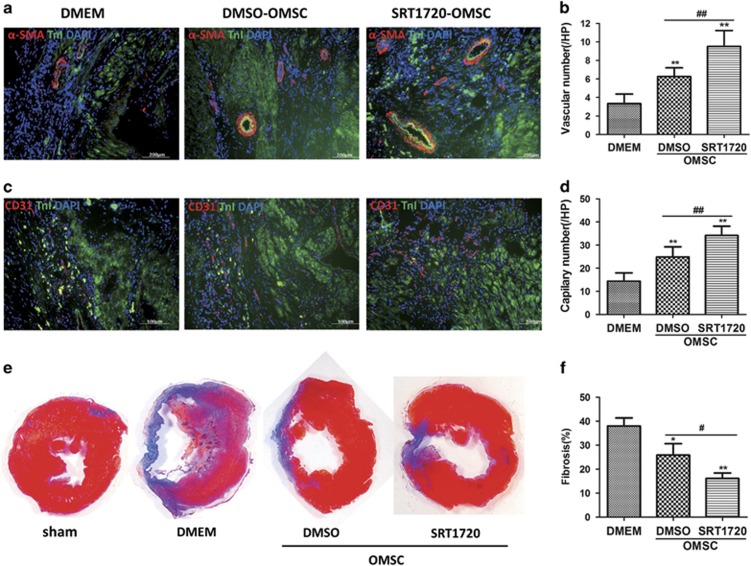
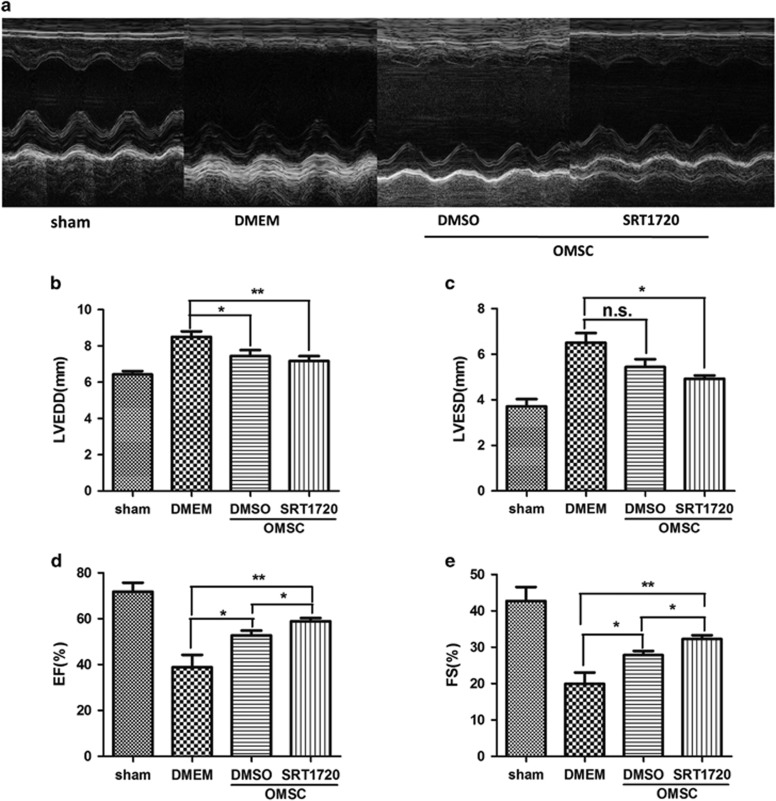
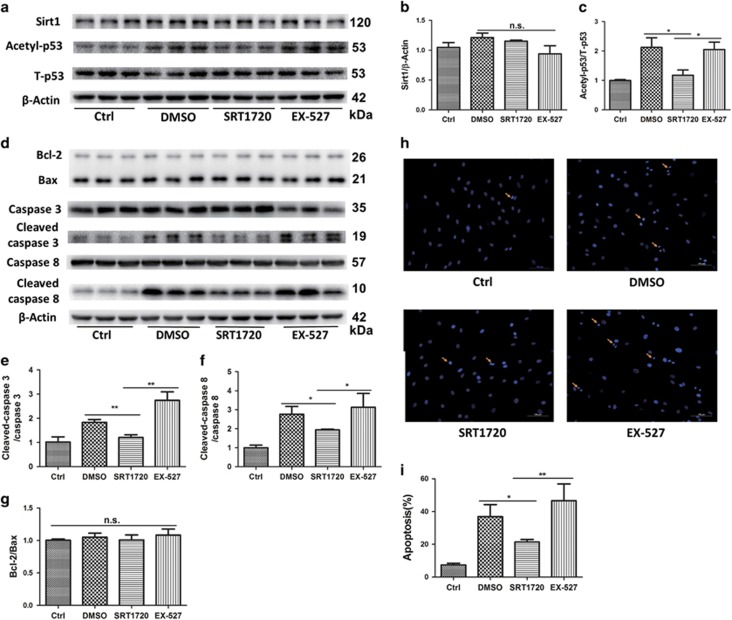
SIRT1 has been proved to rejuvenate and improve the therapeutic efficacy of aged rat mesenchymal stem cells (MSCs). Herein, we investigate the protective effect of pretreatment with SIRT1 activator SRT1720 on aged human MSCs (hMSCs). The optimized pretreatment condition for aged hMSCs was determined to be 0.5 μM SRT1720 for 24 h by monitoring the survival of aged hMSCs subjected to serum deprivation±hypoxia and±500 μM hydrogen peroxide (HO). Pretreatment with these conditions increased the survival of aged hMSCs 1 day (2.7-fold) and 3 days (1.9-fold) after being transplanted into a rat myocardial infarction (MI) model created by ligation of the left anterior descending (LAD) coronary artery. Transplantation with SRT1720 pretreated aged hMSCs achieved increased left ventricular ejection fraction (58.9±3.6 versus 52.8±5%) and angiogenesis with reduced fibrosis of rat hearts as compared to DMSO pretreated group 28 days following MI. Unbiased transcriptome analysis conducted on aged hMSCs under oxidative stress indicated the Fas apoptosis inhibitory molecule (FAIM) was significantly upregulated following SRT1720 pretreatment (14.9±0.2-folds). Moreover, the anti-apoptotic effect of SRT1720 was mitigated by FAIM knockdown with a small interfering RNA-targeted FAIM. These results indicated that pretreatment with SRT1720 improves survival of aged hMSCs, and enhances their therapeutic efficacy for rat myocardial infarction (MI). Upregulation of FAIM possibly involves in the mechanisms of the protective effects.
SIRT1已被证明可使衰老的大鼠间充质干细胞(MSCs)恢复活力并提高其治疗效果。在此,我们研究SIRT1激活剂SRT1720预处理对衰老的人MSCs(hMSCs)的保护作用。通过监测经历血清剥夺±缺氧和±500μM过氧化氢(HO)的衰老hMSCs的存活情况,确定衰老hMSCs的最佳预处理条件为0.5μM SRT1720处理24小时。在这些条件下进行预处理,可提高衰老hMSCs在移植到通过结扎左冠状动脉前降支(LAD)创建的大鼠心肌梗死(MI)模型后1天(2.7倍)和3天(1.9倍)的存活率。与MI后28天的二甲基亚砜预处理组相比,用SRT1720预处理的衰老hMSCs进行移植可提高大鼠心脏的左心室射血分数(58.9±3.6对52.8±5%)并促进血管生成,同时减少纤维化。对氧化应激下的衰老hMSCs进行无偏转录组分析表明,SRT1720预处理后Fas凋亡抑制分子(FAIM)显著上调(14.9±0.2倍)。此外,用靶向FAIM的小干扰RNA敲低FAIM可减轻SRT1720的抗凋亡作用。这些结果表明,SRT1720预处理可提高衰老hMSCs的存活率,并增强其对大鼠心肌梗死(MI)的治疗效果。FAIM的上调可能参与了保护作用的机制。