Peyroux Elodie, Santaella Nelly, Broussolle Emmanuel, Rigard Caroline, Favre Emilie, Brunet Anne-Sophie, Bost Muriel, Lachaux Alain, Demily Caroline
Genopsy-Center for the Diagnosis and Management of Genetic Psychiatric Disorders, Le Vinatier Hospital, Lyon, France.
University Department of Rehabilitation (SUR/CL3R), Le Vinatier Hospital, Lyon, France.
PLoS One. 2017 Apr 6;12(4):e0173467. doi: 10.1371/journal.pone.0173467. eCollection 2017.
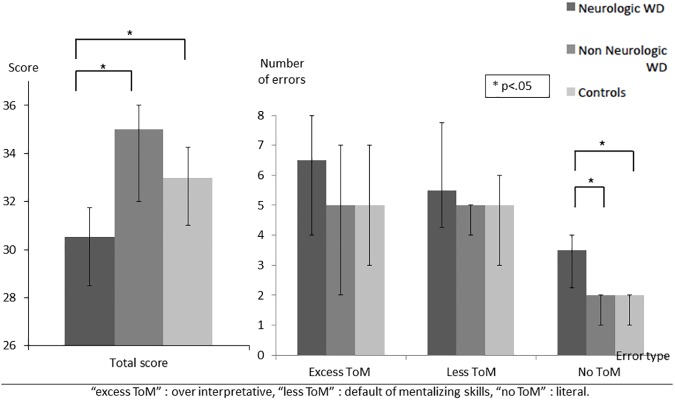
Studies focusing on neuropsychological impairments in Wilson's disease (WD) have highlighted that patients showing neurological signs present significant deficits in a wide range of cognitive domains. Attentional and executive impairments have also been described in people with hepatic WD. However, social cognition abilities, i.e. cognitive processes required to perceive the emotions, intentions and dispositions of other people, have not been clearly investigated in WD. In this study we examined the social cognitive functioning in 19 patients with WD depending on their clinical status-Neurological versus Non-Neurological ("hepatic") forms-compared to 20 healthy controls. For the very first time, results highlighted that patients with WD had significant impairments in the three major components of social cognition: emotion recognition, Theory of Mind and attributional style. However, these deficits differ depending on the form of the disease: patients with neurological signs showed a wide range of deficits in the three components that were assessed-results notably revealed impairments in recognizing "fear", "anger", and "disgust", a significant Theory of Mind deficit and an "aggression bias"-whereas Non-Neurological patients only showed deficits on test assessing attributional bias, with a trend to react more "aggressively" to ambiguous social situations than healthy controls, as observed in Neurological WD patients, and a specific impairment in "anger" recognition. Our findings are discussed in the light of both neurocognitive impairments and brain damages, and especially those affecting the basal ganglia, as observed in people with WD.
针对威尔逊病(WD)神经心理损伤的研究强调,出现神经学体征的患者在广泛的认知领域存在显著缺陷。肝豆状核变性患者也存在注意力和执行功能损伤。然而,社交认知能力,即感知他人情绪、意图和性格所需的认知过程,在WD中尚未得到明确研究。在本研究中,我们根据19例WD患者的临床状态——神经型与非神经型(“肝型”)——与20名健康对照进行比较,研究了他们的社交认知功能。首次有研究结果表明,WD患者在社交认知的三个主要组成部分存在显著损伤:情绪识别、心理理论和归因方式。然而,这些缺陷因疾病类型而异:有神经学体征的患者在评估的三个组成部分均表现出广泛的缺陷——结果尤其显示在识别“恐惧”、“愤怒”和“厌恶”方面存在损伤、显著的心理理论缺陷以及“攻击倾向”——而非神经型患者仅在评估归因偏差的测试中表现出缺陷,与神经型WD患者一样,他们在面对模糊社交情境时比健康对照更倾向于做出更“攻击性”的反应,并且在“愤怒”识别方面存在特定损伤。我们根据神经认知损伤和脑损伤,尤其是WD患者中观察到的影响基底神经节的损伤,对我们的研究结果进行了讨论。