Kim Ji Hyun, Hwang Jinah, Shim Eugene, Chung Eun-Jung, Jang Sung Hee, Koh Seong-Beom
Department of Neurology, Korea University Guro Hospital, Korea University College of Medicine, 148 Guro-dong Road, Guro-gu, Seoul 08308, Korea.
Department of Food and Nutrition, College of Natural Sciences, Myongji University, Yongin, Gyeonggi 17058, Korea.
Nutr Res Pract. 2017 Apr;11(2):114-120. doi: 10.4162/nrp.2017.11.2.114. Epub 2016 Dec 15.
BACKGROUND/OBJECTIVES: A pivotal role of oxidative stress has been emphasized in the pathogenesis as well as in the disease progression of Parkinson's disease (PD). We aimed at investigating serum levels of antioxidant vitamins and elucidating whether they could be associated with the pathogenesis and progression of PD.
MATERIALS/METHODS: Serum levels of retinol, α- and γ-tocopherols, α- and β-carotenes, lutein, lycopene, zeaxanthin and β-cryptoxanthin were measured and compared between 104 patients with idiopathic PD and 52 healthy controls matched for age and gender. In order to examine the relationship between antioxidant vitamins and the disease progression, multiple group comparisons were performed among the early PD (Hoehn and Yahr stage I and II, N = 47), advanced PD (stage III and IV, N = 57) and control groups. Separate correlation analyses were performed between the measured antioxidant vitamins and clinical variables, such as Hoehn and Yahr stage and Unified Parkinson's Disease Rating Scale (UPDRS) motor score.
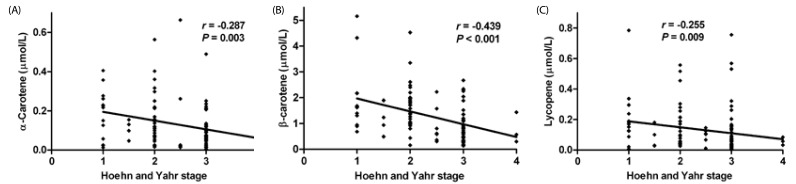
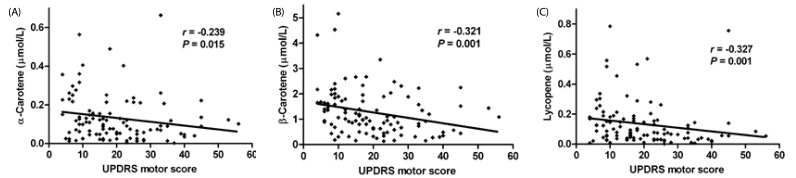
Compared to controls, PD patients had lower levels of α- and β-carotenes and lycopene. α-carotene, β-carotene and lycopene levels were significantly reduced in advanced PD patients relative to early PD patients and were negatively correlated with Hoehn and Yahr stage and UPDRS motor score in PD patients. No significant differences were found in serum levels of retinol, α- and γ-tocopherols, and other carotenoids between PD patients and controls. No significant correlations were found between these vitamin levels and clinical variables in PD patients.
We found that serum levels of some carotenoids, α-carotene, β-carotene and lycopene, were lower in PD patients, and that these carotenoids inversely correlated with clinical variables representing disease progression. Our findings suggest that decreases in serum α-carotene, β-carotene and lycopene may be associated with the pathogenesis as well as progression of PD.
背景/目的:氧化应激在帕金森病(PD)的发病机制及疾病进展中所起的关键作用已得到强调。我们旨在研究血清中抗氧化维生素的水平,并阐明它们是否与PD的发病机制和进展相关。
材料/方法:测量并比较了104例特发性PD患者和52例年龄及性别相匹配的健康对照者血清中视黄醇、α-和γ-生育酚、α-和β-胡萝卜素、叶黄素、番茄红素、玉米黄质和β-隐黄质的水平。为了研究抗氧化维生素与疾病进展之间的关系,对早期PD(Hoehn和Yahr分期I和II,n = 47)、晚期PD(分期III和IV,n = 57)及对照组进行了多组比较。对所测抗氧化维生素与临床变量,如Hoehn和Yahr分期及统一帕金森病评定量表(UPDRS)运动评分,进行了单独的相关性分析。
与对照组相比,PD患者的α-和β-胡萝卜素以及番茄红素水平较低。晚期PD患者的α-胡萝卜素、β-胡萝卜素和番茄红素水平相对于早期PD患者显著降低,且与PD患者的Hoehn和Yahr分期及UPDRS运动评分呈负相关。PD患者与对照组血清中视黄醇、α-和γ-生育酚以及其他类胡萝卜素水平无显著差异。这些维生素水平与PD患者的临床变量之间未发现显著相关性。
我们发现PD患者血清中某些类胡萝卜素,即α-胡萝卜素、β-胡萝卜素和番茄红素水平较低,且这些类胡萝卜素与代表疾病进展的临床变量呈负相关。我们的研究结果表明,血清α-胡萝卜素、β-胡萝卜素和番茄红素水平降低可能与PD的发病机制及进展相关。