Lin Tsen-Hsuan, Chiang Chia-Wen, Perez-Torres Carlos J, Sun Peng, Wallendorf Michael, Schmidt Robert E, Cross Anne H, Song Sheng-Kwei
Radiology, Washington University School of Medicine, 660 S Euclid Ave, St. Louis, MO, 63110, USA.
Current Address: Institute of Biomedical Engineering and Nanomedicine, National Health Research Institute, 35 Keyan Road, Zhunan, Miaoli County, 35053, Taiwan.
J Neuroinflammation. 2017 Apr 7;14(1):78. doi: 10.1186/s12974-017-0852-3.
Magnetic resonance imaging markers have been widely used to detect and quantify white matter pathologies in multiple sclerosis. We have recently developed a diffusion basis spectrum imaging (DBSI) to distinguish and quantify co-existing axonal injury, demyelination, and inflammation in multiple sclerosis patients and animal models. It could serve as a longitudinal marker for axonal loss, a primary cause of permanent neurological impairments and disease progression.
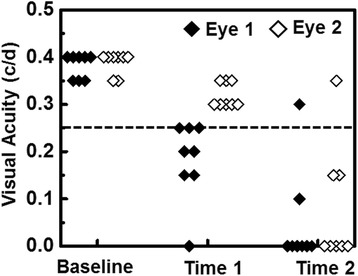
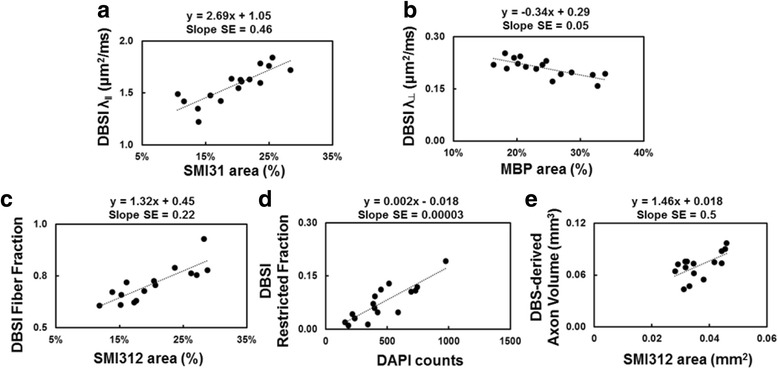
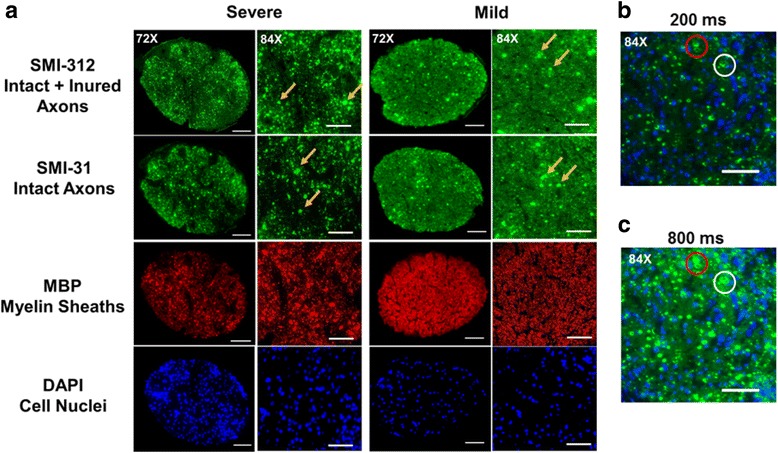
Eight 10-week-old female C57BL/6 mice underwent optic nerve DBSI, followed by a week-long recuperation prior to active immunization for experimental autoimmune encephalomyelitis (EAE). Visual acuity of all mice was assessed daily. Longitudinal DBSI was performed in mouse optic nerves at baseline (naïve, before immunization), before, during, and after the onset of optic neuritis. Tissues were perfusion fixed after final in vivo scans. The correlation between DBSI detected pathologies and corresponding immunohistochemistry markers was quantitatively assessed.
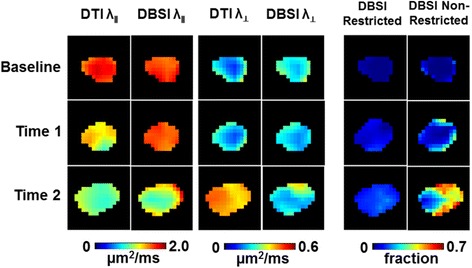
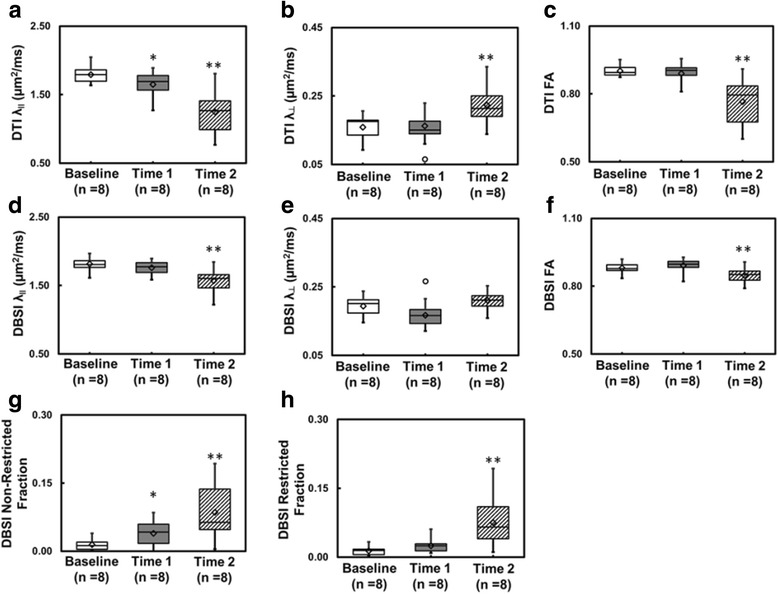
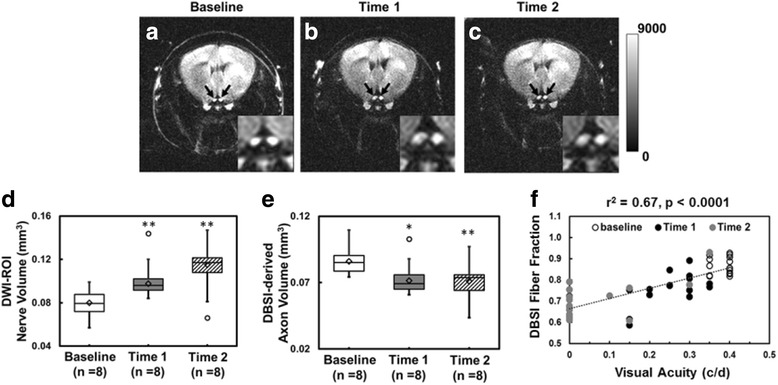
In this cohort of EAE mice, monocular vision impairment occurred in all animals. In vivo DBSI detected, differentiated, and quantified optic nerve inflammation, demyelination, and axonal injury/loss, correlating nerve pathologies with visual acuity at different time points of acute optic neuritis. DBSI quantified, in the presence of optic nerve swelling, ~15% axonal loss at the onset of optic neuritis in EAE mice.
Our findings support the notion that axonal loss could occur early in EAE mice. DBSI detected pathologies in the posterior visual pathway unreachable by optical coherence tomography and without confounding inflammation induced optic nerve swelling. DBSI could thus decipher the interrelationship among various pathological components and the role each plays in disease progression. Quantification of the rate of axonal loss could potentially serve as the biomarker to predict treatment outcome and to determine when progressive disease starts.
磁共振成像标记物已被广泛用于检测和量化多发性硬化症中的白质病变。我们最近开发了一种扩散基谱成像(DBSI)技术,用于区分和量化多发性硬化症患者及动物模型中并存的轴突损伤、脱髓鞘和炎症。它可作为轴突丢失的纵向标记物,轴突丢失是永久性神经功能障碍和疾病进展的主要原因。
八只10周龄雌性C57BL/6小鼠接受视神经DBSI检查,随后在主动免疫诱导实验性自身免疫性脑脊髓炎(EAE)前进行为期一周的恢复。每天评估所有小鼠的视力。在基线(未免疫、免疫前)、视神经炎发作前、发作期间和发作后,对小鼠视神经进行纵向DBSI检查。在最后一次体内扫描后对组织进行灌注固定。定量评估DBSI检测到的病变与相应免疫组化标记物之间的相关性。
在这组EAE小鼠中,所有动物均出现单眼视力损害。体内DBSI检测、区分并量化了视神经炎症、脱髓鞘和轴突损伤/丢失,将神经病变与急性视神经炎不同时间点的视力相关联。在视神经肿胀的情况下,DBSI量化了EAE小鼠视神经炎发作时约15%的轴突丢失。
我们的研究结果支持轴突丢失可能在EAE小鼠早期发生的观点。DBSI检测到光学相干断层扫描无法到达的后视觉通路中的病变,且不受炎症引起的视神经肿胀的干扰。因此,DBSI可以解读各种病理成分之间的相互关系以及它们在疾病进展中各自所起的作用。轴突丢失率的量化可能作为预测治疗结果和确定疾病何时开始进展的生物标志物。