CopenRehab, Department of Public Health, Section of Social Medicine, Henrik Pontoppidans Vej 6, University of Copenhagen, Copenhagen, Denmark.
Department of Infectious Diseases, Center for Physical Activity Research, Rigshospitalet, University of Copenhagen, Copenhagen, Denmark.
BMJ Open. 2017 Apr 7;7(4):e014036. doi: 10.1136/bmjopen-2016-014036.
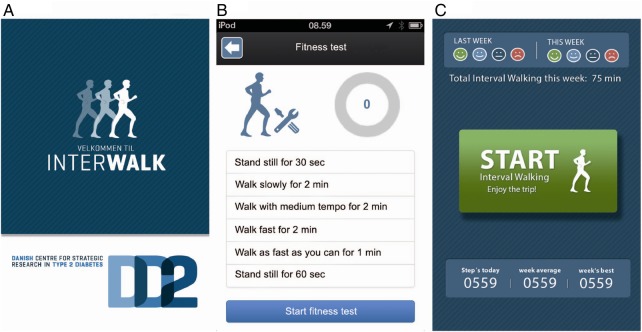
Physical activity is a cornerstone in type 2 diabetes (T2D) rehabilitation. Effective long-term and low-cost strategies to keep these patients' physically active are needed. However, maintaining physical activity behaviour is difficult once formalised interventions end. Structured exercise training supported by mobile technology and remote feedback is potentially an effective strategy. The objective of the trial is to investigate whether mobile health support using the InterWalk application for smartphones is effective in increasing physical activity levels in persons with T2D over time compared with standard care. We investigate whether Interval Walking Training using the InterWalk application is superior to Danish municipality-based rehabilitation in increasing moderate-and-vigorous physical activity levels in patients with T2D across 52 weeks. Secondary, we hypothesise that a motivational programme added from end of intervention to 52 weeks further increases level of physical activity in everyday life in patients with T2D.
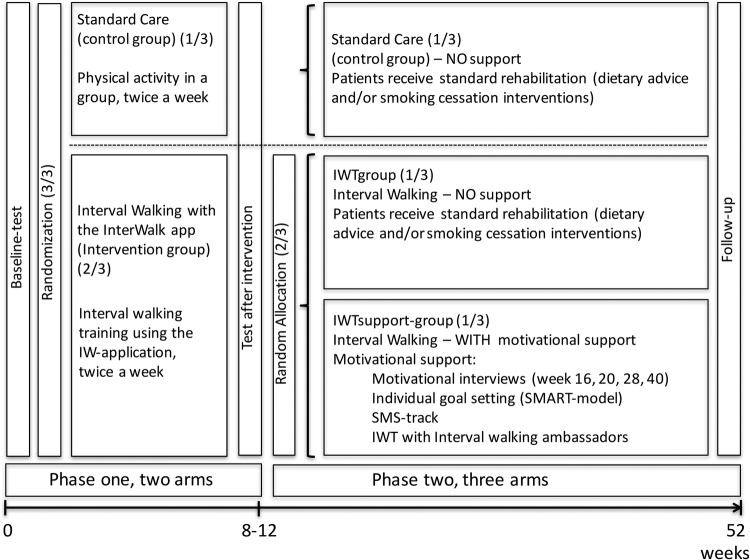
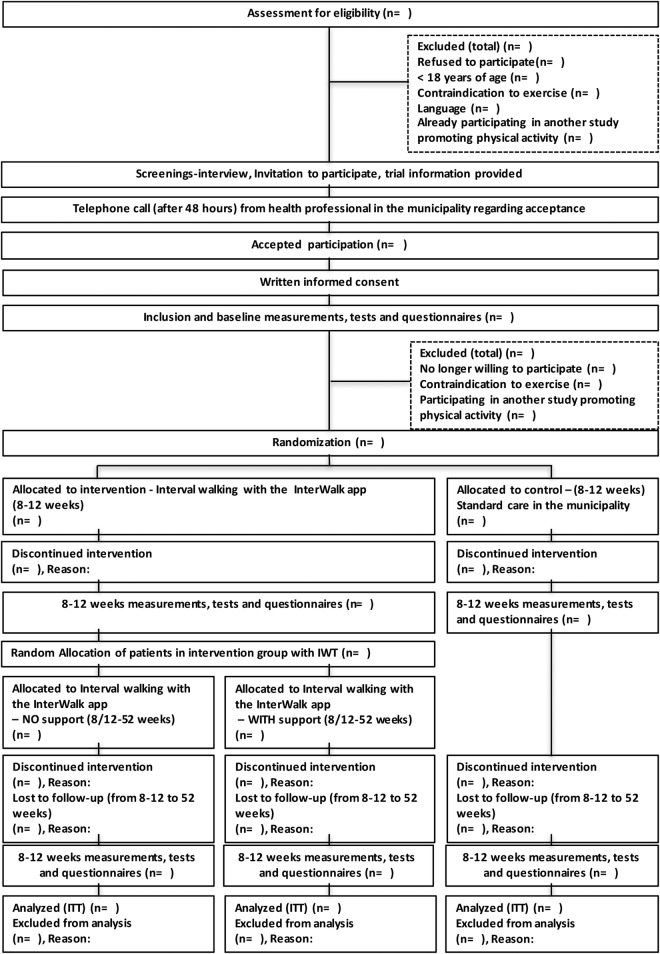
The trial is a parallel-group, open-labelled, randomised controlled trial with long-term follow-up at 52 week including patients with T2D. The primary outcome is change in moderate-and-vigorous physical activity. The key secondary outcome includes motivation for physical activity behaviour change. Other secondary outcomes are VO-peak, strength in the lower extremities. Exclusion criterion is medical contraindication to exercise. We include up to 246 patients and randomly allocate them into a control (standard group) or an experimental group (8-12 weeks of IWT supported by the smartphone-based InterWalk application) in a 1:2 fashion. After intervention, the experimental group is randomly allocated into two follow-up conditions with unsupervised IWT with or without motivational support until 52-week follow-up. The intention-to-treat principle is applied.
The local regional Research Ethics Committee in Denmark (H-1-2014-074) and the Danish Data Protection Agency (j.nr. 2014-54-0897) have approved the trial. Positive, negative or inconclusive results will be disseminated in scientific journals and conferences.
NCT02341690.
身体活动是 2 型糖尿病(T2D)康复的基石。需要有效的长期和低成本策略来保持这些患者的身体活跃。然而,一旦正式干预结束,保持身体活动行为是困难的。使用移动技术和远程反馈支持的结构化运动训练可能是一种有效的策略。本试验的目的是研究使用智能手机上的 InterWalk 应用程序进行移动健康支持是否能随着时间的推移有效增加 T2D 患者的身体活动水平,与标准护理相比。我们研究使用 InterWalk 应用程序进行间隔步行训练是否优于丹麦市基于康复,以增加 T2D 患者在 52 周内的中高强度身体活动水平。其次,我们假设从干预结束到 52 周的动机计划进一步增加 T2D 患者日常生活中的身体活动水平。
该试验是一项平行组、开放标签、随机对照试验,包括 52 周的长期随访,包括 T2D 患者。主要结局是中高强度身体活动的变化。关键次要结局包括身体活动行为改变的动机。其他次要结局包括 VO-峰值、下肢力量。排除标准是运动的医学禁忌症。我们纳入了最多 246 名患者,并将他们随机分为对照组(标准组)或实验组(8-12 周的 IWT 支持智能手机的 InterWalk 应用程序),比例为 1:2。干预后,实验组随机分为两种随访条件,即不监督的 IWT 加或不加动机支持,直到 52 周随访。采用意向治疗原则。
丹麦地方区域伦理委员会(H-1-2014-074)和丹麦数据保护局(j.nr. 2014-54-0897)已批准该试验。阳性、阴性或不确定结果将在科学期刊和会议上传播。
NCT02341690。