Vaseghi Haley, Liu Jiandong, Qian Li
Department of Pathology and Laboratory Medicine, McAllister Heart Institute, University of North Carolina, Chapel Hill, NC, 27599, USA.
Protein Cell. 2017 Oct;8(10):724-734. doi: 10.1007/s13238-017-0402-x. Epub 2017 Apr 7.
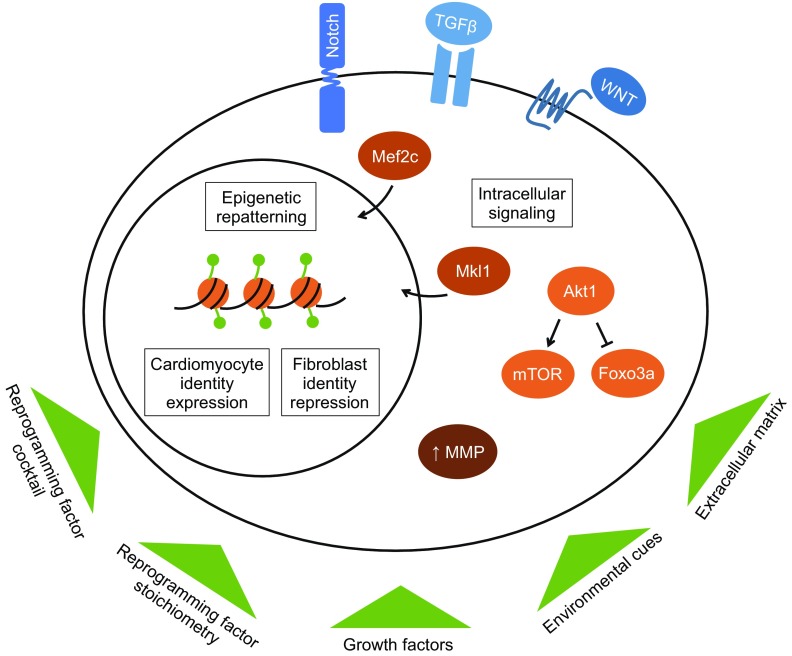
Myocardial infarction afflicts close to three quarters of a million Americans annually, resulting in reduced heart function, arrhythmia, and frequently death. Cardiomyocyte death reduces the heart's pump capacity while the deposition of a non-conductive scar incurs the risk of arrhythmia. Direct cardiac reprogramming emerged as a novel technology to simultaneously reduce scar tissue and generate new cardiomyocytes to restore cardiac function. This technology converts endogenous cardiac fibroblasts directly into induced cardiomyocyte-like cells using a variety of cocktails including transcription factors, microRNAs, and small molecules. Although promising, direct cardiac reprogramming is still in its fledging phase, and numerous barriers have to be overcome prior to its clinical application. This review discusses current findings to optimize reprogramming efficiency, including reprogramming factor cocktails and stoichiometry, epigenetic barriers to cell fate reprogramming, incomplete conversion and residual fibroblast identity, requisite growth factors, and environmental cues. Finally, we address the current challenges and future directions for the field.
心肌梗死每年折磨着近75万美国人,导致心脏功能下降、心律失常,并常常导致死亡。心肌细胞死亡会降低心脏的泵血能力,而非传导性瘢痕的形成则会引发心律失常的风险。直接心脏重编程作为一种新技术出现,可同时减少瘢痕组织并生成新的心肌细胞以恢复心脏功能。该技术使用包括转录因子、微小RNA和小分子在内的多种混合物,将内源性心脏成纤维细胞直接转化为诱导性心肌样细胞。尽管前景广阔,但直接心脏重编程仍处于起步阶段,在临床应用之前必须克服众多障碍。本综述讨论了当前为优化重编程效率的研究结果,包括重编程因子混合物及其化学计量、细胞命运重编程的表观遗传障碍、不完全转化和残留的成纤维细胞特性、必需的生长因子以及环境线索。最后,我们阐述了该领域当前面临的挑战和未来的发展方向。