Shakir Shakir, Vinh Joelle, Chiappetta Giovanni
ESPCI Paris, PSL Research University, Spectrométrie de Masse Biologique et Protéomique (SMPB), CNRS USR 3149, 10 rue Vauquelin, 75231, Paris cedex 05, France.
Anal Bioanal Chem. 2017 Jun;409(15):3821-3830. doi: 10.1007/s00216-017-0326-6. Epub 2017 Apr 7.
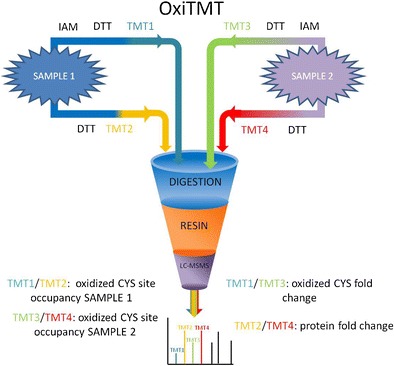
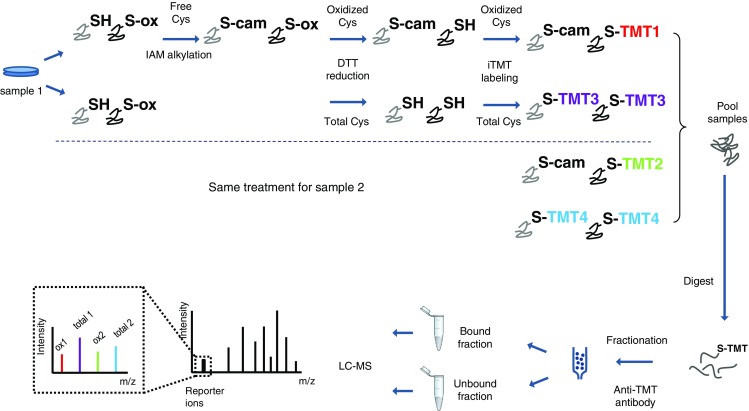
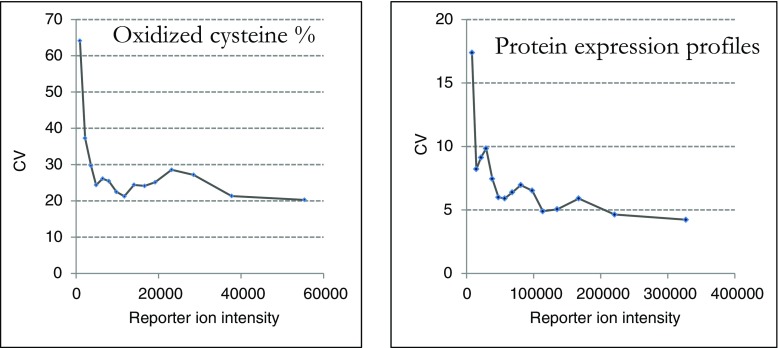
The redox conditions that reign inside a cell have a determining effect on a number of biological processes. Reactive oxygen species (ROS) and reactive nitrogen species (RNS) are key redox players and have been linked to a number of pathologies. They have also been shown to play an important regulating role in cell signaling events. On the proteome level, thiol groups of cysteinyl side chains constitute the major targets of ROS and RNS. A number of analytical techniques based on mass spectrometry have been developed to characterize the cysteine redoxome, often facing a number of technical challenges, mostly related to the lability, heterogeneity, and low abundance of the oxidized forms. Furthermore, any posttranslational modification (PTM) quantification method needs to take the parent protein's expression level into account. While taking all these limitations into consideration, we have developed a quantitative analytical strategy named OxiTMT, based on chemical labeling with iodoacetyl isobaric tandem mass tags (iodoTMT). OxiTMT allowed the generation of quantitative redox data that could be normalized by the protein's expression profile in up to three different conditions. The method was tested on Escherichia coli with or without an oxidative treatment. Results showed the method to be adequate for the analysis of cysteine PTMs with a good coverage of the cysteine redoxome, especially for the low abundant oxidized species. Some of the challenges that face reporter ion quantification of PTMs by mass spectrometry were also assessed. This study serves as a proof of concept of the established protocol and consequent data treatment step. The use of tandem mass tags opens the ways towards the application of the method to the study of tissues and sera. Graphical abstract OxiTMT workflow.
细胞内的氧化还原状态对许多生物过程具有决定性影响。活性氧(ROS)和活性氮(RNS)是关键的氧化还原参与者,并与多种病理状况相关。它们还在细胞信号转导事件中发挥重要的调节作用。在蛋白质组水平上,半胱氨酸侧链的巯基是ROS和RNS的主要作用靶点。已经开发了许多基于质谱的分析技术来表征半胱氨酸氧化还原组,但通常面临一些技术挑战,主要与氧化形式的不稳定性、异质性和低丰度有关。此外,任何翻译后修饰(PTM)定量方法都需要考虑亲本蛋白质的表达水平。在考虑到所有这些限制的情况下,我们开发了一种名为OxiTMT的定量分析策略,该策略基于用碘乙酰等压串联质量标签(iodoTMT)进行化学标记。OxiTMT能够生成定量的氧化还原数据,这些数据可以在多达三种不同条件下通过蛋白质的表达谱进行归一化。该方法在经过或未经过氧化处理的大肠杆菌上进行了测试。结果表明,该方法适用于分析半胱氨酸PTM,对半胱氨酸氧化还原组具有良好的覆盖范围,特别是对于低丰度的氧化物种。还评估了通过质谱对PTM进行报告离子定量时面临的一些挑战。这项研究作为既定方案及后续数据处理步骤的概念验证。串联质量标签的使用为该方法应用于组织和血清研究开辟了道路。图形摘要:OxiTMT工作流程。