Di Xiaotang, Gomila Jo, Takken Frank L W
Molecular Plant Pathology, Faculty of Science, Swammerdam Institute for Life Sciences, University of Amsterdam, PO Box 94215, 1090GE, Amsterdam, the Netherlands.
Mol Plant Pathol. 2017 Sep;18(7):1024-1035. doi: 10.1111/mpp.12559. Epub 2017 May 23.
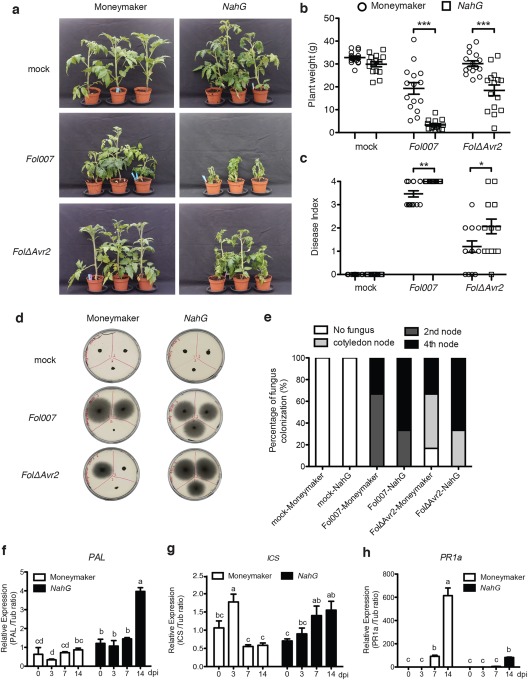
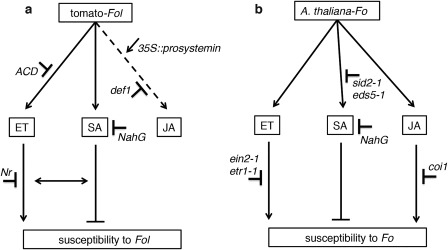
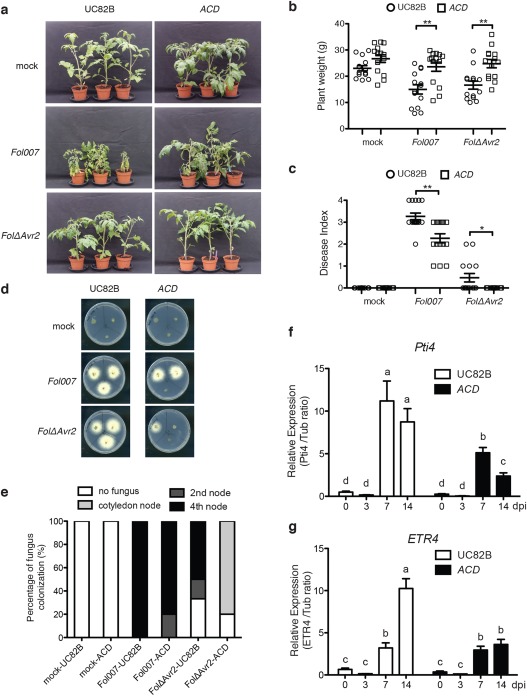
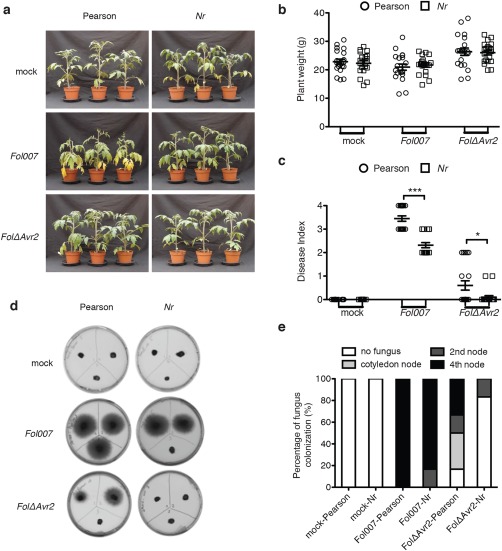
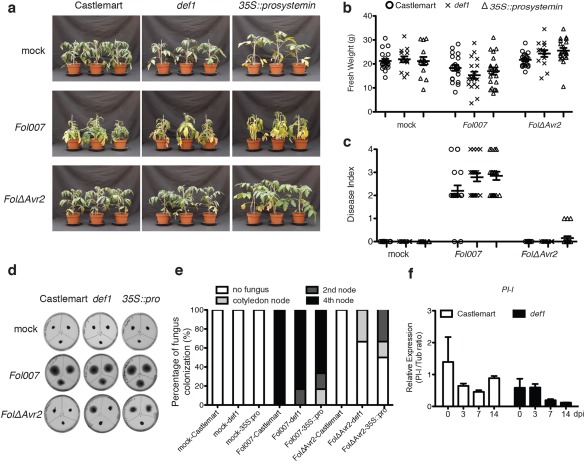
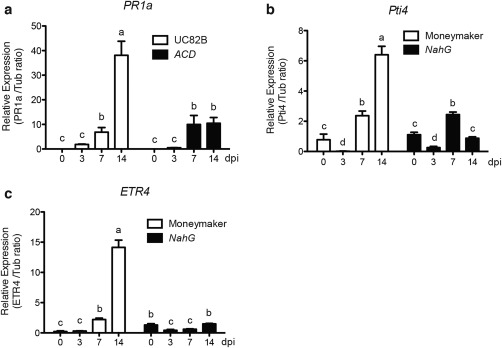
Phytohormones, such as salicylic acid (SA), ethylene (ET) and jasmonic acid (JA), play key roles in plant defence following pathogen attack. The involvement of these hormones in susceptibility following Fusarium oxysporum (Fo) infection has mostly been studied in Arabidopsis thaliana. However, Fo causes vascular wilt disease in a broad range of crops, including tomato (Solanum lycopersicum). Surprisingly little is known about the involvement of these phytohormones in the susceptibility of tomato towards Fo f. sp. lycopersici (Fol). Here, we investigate their involvement by the analysis of the expression of ET, JA and SA marker genes following Fol infection, and by bioassays of tomato mutants affected in either hormone production or perception. Fol inoculation triggered the expression of SA and ET marker genes, showing the activation of these pathways. NahG tomato, in which SA is degraded, became hypersusceptible to Fol infection and showed stronger disease symptoms than wild-type. In contrast, ACD and Never ripe (Nr) mutants, in which ET biosynthesis and perception, respectively, are impaired, showed decreased disease symptoms and reduced fungal colonization on infection. The susceptibility of the def1 tomato mutant, and a prosystemin over-expressing line, in which JA signalling is compromised or constitutively activated, respectively, was unaltered. Our results show that SA is a negative and ET a positive regulator of Fol susceptibility. The SA and ET signalling pathways appear to act synergistically, as an intact ET pathway is required for the induction of an SA marker gene, and vice versa.
植物激素,如水杨酸(SA)、乙烯(ET)和茉莉酸(JA),在病原体攻击后的植物防御中发挥关键作用。这些激素在尖孢镰刀菌(Fo)感染后的易感性中的作用大多是在拟南芥中进行研究的。然而,Fo会在包括番茄(Solanum lycopersicum)在内的多种作物中引起维管束萎蔫病。令人惊讶的是,对于这些植物激素在番茄对番茄尖孢镰刀菌(Fol)的易感性中的作用知之甚少。在这里,我们通过分析Fol感染后ET、JA和SA标记基因的表达,以及通过对激素产生或感知受到影响的番茄突变体进行生物测定,来研究它们的作用。Fol接种引发了SA和ET标记基因的表达,表明这些途径被激活。SA被降解的NahG番茄对Fol感染变得高度敏感,并且比野生型表现出更强的病害症状。相比之下,ET生物合成受损的ACD突变体和ET感知受损的Never ripe(Nr)突变体在感染时病害症状减轻,真菌定殖减少。JA信号分别受损或组成型激活的def1番茄突变体和过表达系统素的株系的易感性没有改变。我们的结果表明,SA是Fol易感性的负调节因子,而ET是正调节因子。SA和ET信号通路似乎协同作用,因为诱导SA标记基因需要完整的ET通路,反之亦然。