Kasmi Leila, Bonnet Damien, Montreuil Michèle, Kalfa David, Geronikola Nikoletta, Bellinger David C, Calderon Johanna
Laboratory of Psychopathology and Neuropsychology, Department of Psychology, University Paris 8, Paris Lumières - CNRS , Saint-Denis , France.
Referral Center for Complex Congenital Cardiac Malformations, Department of Congenital and Pediatric Cardiology, Necker Hospital, University Paris Descartes, Sorbonne Paris Cité , Paris , France.
Front Pediatr. 2017 Mar 24;5:59. doi: 10.3389/fped.2017.00059. eCollection 2017.
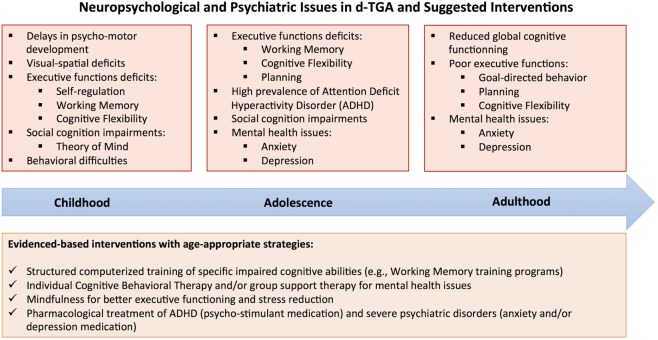
Advances in prenatal diagnosis, perioperative management, and postoperative care have dramatically increased the population of survivors of neonatal and infant heart surgery. The high survival rate of these patients into adulthood has exposed the alarming prevalence of long-term neuropsychological and psychiatric morbidities. Dextro-transposition of the great arteries (d-TGA) is one of the most extensively studied cyanotic congenital heart defect (CHD) with regard to neurodevelopmental outcomes. Landmark studies have described a common neurodevelopmental and behavioral phenotype associated with d-TGA. Children with d-TGA display impairments in key neurocognitive areas, including visual-spatial and fine motor abilities, executive functioning, processing speed, and social cognition. As they grow older, they may face additional challenges with a worsening of deficits in higher order cognitive skills, problems in psychosocial adjustment and a higher-than-expected rate of psychiatric disorders, such as attention-deficit hyperactivity disorder, depression, and anxiety. The aim of this review is to summarize the available recent data on neuropsychological and psychiatric outcomes in individuals with d-TGA after the arterial switch operation. We present findings within a life-span perspective, with a particular emphasis on the emerging literature on adolescent and young adult outcomes. Finally, we propose avenues for future research in the CHD adult neuropsychology field. Among these avenues, we explore the potential mechanisms by which pediatric neurodevelopmental impairments may have lifelong adverse effects as well as alternative interventions that could optimize outcomes.
产前诊断、围手术期管理和术后护理方面的进展显著增加了新生儿和婴儿心脏手术幸存者的数量。这些患者成年后的高存活率揭示了长期神经心理和精神疾病令人担忧的患病率。大动脉右位转位(d-TGA)是在神经发育结局方面研究最为广泛的青紫型先天性心脏病(CHD)之一。具有里程碑意义的研究描述了一种与d-TGA相关的常见神经发育和行为表型。患有d-TGA的儿童在关键神经认知领域存在缺陷,包括视觉空间和精细运动能力、执行功能、处理速度和社会认知。随着年龄的增长,他们可能会面临更多挑战,高阶认知技能的缺陷会恶化,心理社会适应出现问题,以及精神疾病的发生率高于预期,如注意力缺陷多动障碍、抑郁症和焦虑症。本综述的目的是总结动脉调转手术后d-TGA患者神经心理和精神结局的最新可用数据。我们从生命跨度的角度呈现研究结果,特别强调关于青少年和青年成人结局的新文献。最后,我们提出了先天性心脏病成人神经心理学领域未来研究的方向。在这些方向中,我们探讨了儿童神经发育损伤可能产生终身不良影响的潜在机制,以及可以优化结局的替代干预措施。