School of Psychology, Cardiff University, Tower Building, Park Place, Cardiff, CF10 3AT, UK.
Eur J Neurosci. 2017 Jun;45(11):1451-1464. doi: 10.1111/ejn.13577. Epub 2017 May 4.
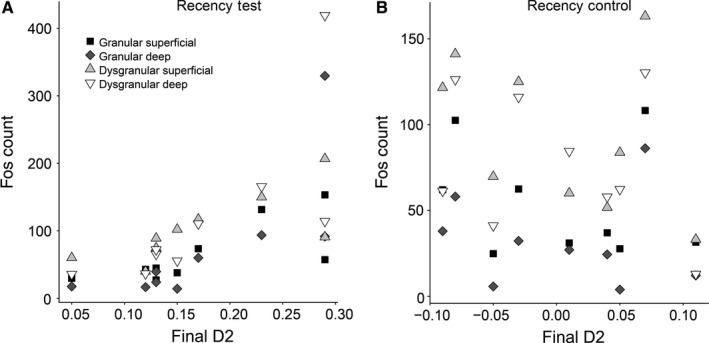
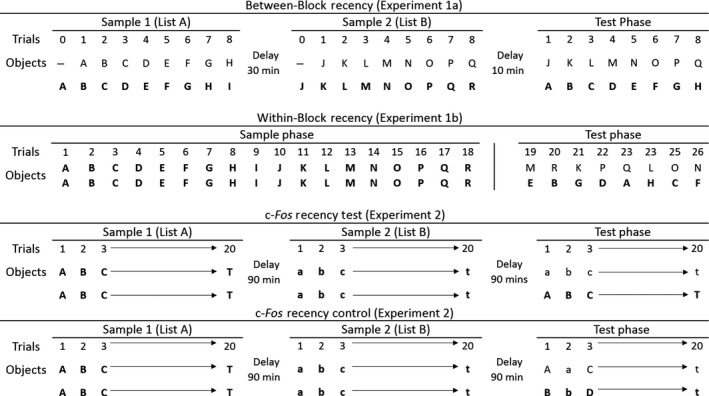
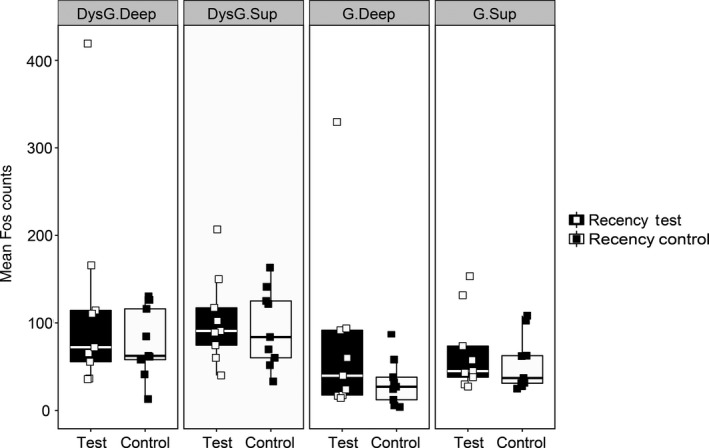
It has been proposed that the retrosplenial cortex forms part of a 'where/when' information network. The present study focussed on the related issue of whether retrosplenial cortex also contributes to 'what/when' information, by examining object recency memory. In Experiment 1, rats with retrosplenial lesions were found to be impaired at distinguishing the temporal order of objects presented in a continuous series ('Within-Block' condition). The same lesioned rats could, however, distinguish between objects that had been previously presented in one of two discrete blocks ('Between-Block' condition). Experiment 2 used intact rats to map the expression of the immediate-early gene c-fos in retrosplenial cortex following performance of a between-block, recency discrimination. Recency performance correlated positively with levels of c-fos expression in both granular and dysgranular retrosplenial cortex (areas 29 and 30). Expression of c-fos in the granular retrosplenial cortex also correlated with prelimbic cortex and ventral subiculum c-fos activity, the latter also correlating with recency memory performance. The combined findings from both experiments reveal an involvement of the retrosplenial cortex in temporal order memory, which includes both between-block and within-block problems. The current findings also suggest that the rat retrosplenial cortex comprises one of a group of closely interlinked regions that enable recency memory, including the hippocampal formation, medial diencephalon and medial frontal cortex. In view of the well-established importance of the retrosplenial cortex for spatial learning, the findings support the notion that, with its frontal and hippocampal connections, retrosplenial cortex has a key role for both what/when and where/when information.
有人提出,后扣带回皮层形成了“何时/何地”信息网络的一部分。本研究通过检查物体近事记忆,关注后扣带回皮层是否也有助于“什么/何时”信息,集中研究了相关问题。在实验 1 中,发现后扣带回皮层损伤的大鼠在区分连续呈现的物体的时间顺序时(“在块内”条件)存在障碍。然而,相同损伤的大鼠可以区分以前在两个离散块之一中呈现的物体(“在块间”条件)。实验 2 使用完整的大鼠,在执行块间近事辨别任务后,映射即刻早期基因 c-fos 在后扣带回皮层中的表达。近事表现与颗粒状和颗粒下后扣带回皮层(区域 29 和 30)中的 c-fos 表达水平呈正相关。颗粒状后扣带回皮层中的 c-fos 表达也与边缘前皮质和腹侧下丘脑中的 c-fos 活性相关,后者也与近事记忆表现相关。两项实验的综合结果揭示了后扣带回皮层在时间顺序记忆中的参与,包括块间和块内问题。目前的研究结果还表明,大鼠后扣带回皮层包括一组紧密相连的区域之一,这些区域使近事记忆成为可能,包括海马结构、内侧间脑和内侧前额皮质。鉴于后扣带回皮层在空间学习中的重要性已经得到充分证实,这些发现支持了这样的观点,即由于其与前额叶皮质和海马的连接,后扣带回皮层在“什么/何时”和“何地/何时”信息方面具有关键作用。