Krishnamurti Tamar, Davis Alexander L, Wong-Parodi Gabrielle, Fischhoff Baruch, Sadovsky Yoel, Simhan Hyagriv N
Department of Engineering and Public Policy, Carnegie Mellon University, Pittsburgh, PA, United States.
Magee-Womens Research Institute, Department of OBGYN and Reproductive Sciences, University of Pittsburgh, Pittsburgh, PA, United States.
JMIR Mhealth Uhealth. 2017 Apr 10;5(4):e42. doi: 10.2196/mhealth.7036.
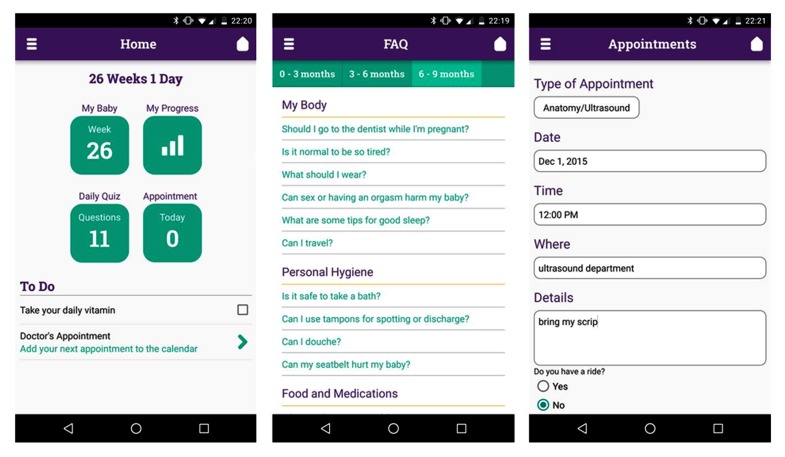
Despite significant advances in medical interventions and health care delivery, preterm births in the United States are on the rise. Existing research has identified important, seemingly simple precautions that could significantly reduce preterm birth risk. However, it has proven difficult to communicate even these simple recommendations to women in need of them. Our objective was to draw on methods from behavioral decision research to develop a personalized smartphone app-based medical communication tool to assess and communicate pregnancy risks related to preterm birth.
A longitudinal, prospective pilot study was designed to develop an engaging, usable smartphone app that communicates personalized pregnancy risk and gathers risk data, with the goal of decreasing preterm birth rates in a typically hard-to-engage patient population.
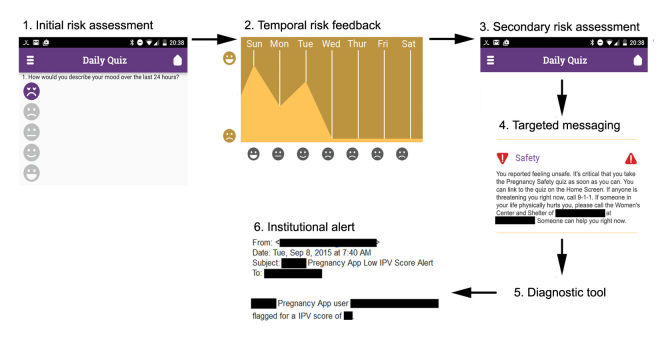
We used semistructured interviews and user testing to develop a smartphone app based on an approach founded in behavioral decision research. For usability evaluation, 16 participants were recruited from the outpatient clinic at a major academic hospital specializing in high-risk pregnancies and provided a smartphone with the preloaded app and a digital weight scale. Through the app, participants were queried daily to assess behavioral risks, mood, and symptomology associated with preterm birth risk. Participants also completed monthly phone interviews to report technical problems and their views on the app's usefulness.
App use was higher among participants at higher risk, as reflected in reporting poorer daily moods (Odds ratio, OR 1.20, 95% CI 0.99-1.47, P=.08), being more likely to smoke (OR 4.00, 95% CI 0.93-16.9, P=.06), being earlier in their pregnancy (OR 1.07, 95% CI 1.02-1.12, P=.005), and having a lower body mass index (OR 1.07, 95% CI 1.00-1.15, P=.05). Participant-reported intention to breastfeed increased from baseline to the end of the trial, t15=-2.76, P=.01. Participants' attendance at prenatal appointments was 84% compared with the clinic norm of 50%, indicating a conservatively estimated cost savings of ~US $450/patient over 3 months.
Our app is an engaging method for assessing and communicating risk during pregnancy in a typically hard-to-reach population, providing accessible and personalized distant obstetrical care, designed to target preterm birth risk, specifically.
尽管医学干预和医疗服务有了显著进步,但美国的早产率仍在上升。现有研究已确定了一些重要且看似简单的预防措施,这些措施可显著降低早产风险。然而,事实证明,即便将这些简单建议传达给有需要的女性都很困难。我们的目标是借鉴行为决策研究的方法,开发一款基于智能手机应用程序的个性化医疗沟通工具,以评估并传达与早产相关的妊娠风险。
设计一项纵向、前瞻性的试点研究,以开发一款引人入胜且易用的智能手机应用程序,该程序能传达个性化的妊娠风险并收集风险数据,目标是降低一个通常难以参与干预的患者群体的早产率。
我们采用半结构化访谈和用户测试,基于行为决策研究的方法开发了一款智能手机应用程序。为进行可用性评估,从一家专门诊治高危妊娠的大型学术医院的门诊招募了16名参与者,并为他们提供了预装有该应用程序的智能手机和一台数字体重秤。通过该应用程序,每天询问参与者,以评估与早产风险相关的行为风险、情绪和症状。参与者还每月完成电话访谈,报告技术问题以及他们对该应用程序有用性的看法。
风险较高参与者的应用程序使用率更高,这体现在他们报告日常情绪较差(优势比,OR 1.20,95%置信区间0.99 - 1.47,P = 0.08)、更有可能吸烟(OR 4.00,95%置信区间0.93 - 16.9,P = 0.06)、怀孕时间更早(OR 1.07,95%置信区间1.02 - 1.12,P = 0.005)以及体重指数较低(OR 1.07,95%置信区间1.00 - 1.15,P = 0.05)。参与者报告的母乳喂养意愿从基线到试验结束有所增加,t15 = -2.76,P = 0.01。参与者产前检查的出勤率为84%,而诊所的正常出勤率为50%,这表明保守估计每位患者在3个月内可节省约450美元。
我们的应用程序是一种在通常难以接触到的人群中评估和传达妊娠期间风险的有效方法,提供了可及且个性化的远程产科护理,专门针对早产风险。