Su Pengxiao, Wang Fengqin, Qi Bin, Wang Ting, Zhang Shaobo
Department of Surgery, Xi'an Red Cross Hospital, Affiliated to School of Medicine, Xi'an Jiao Tong University, Xi'an, Shanxi, China (mainland).
Maternal and Child Care Service Center of Changan District, Xi'an, Shanxi, China (mainland).
Med Sci Monit. 2017 Apr 11;23:1751-1758. doi: 10.12659/msm.900205.
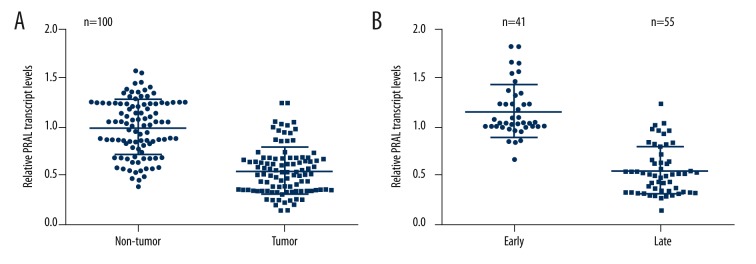
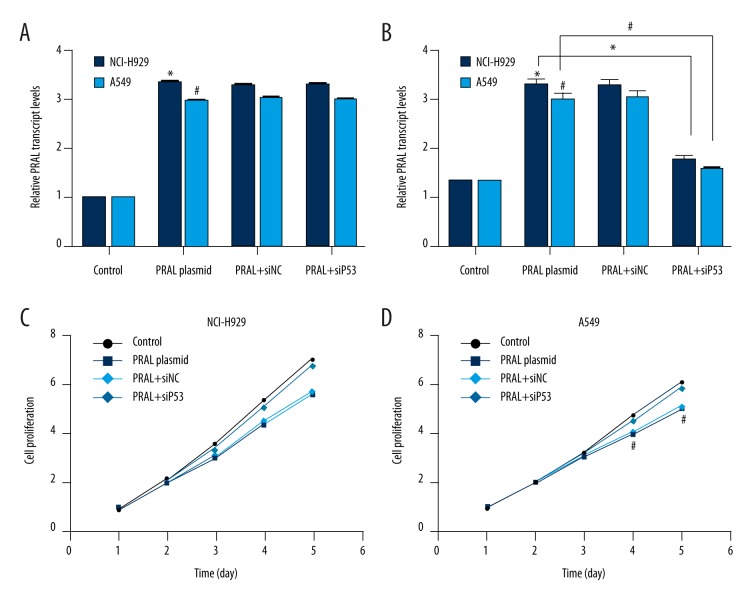
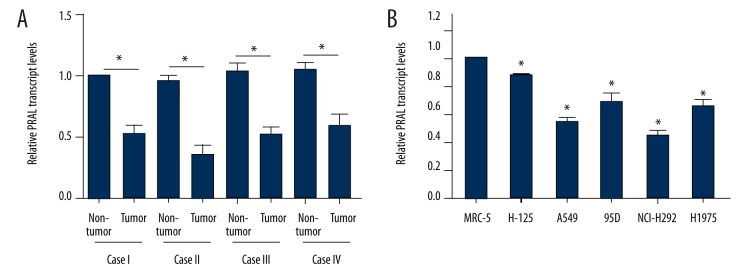
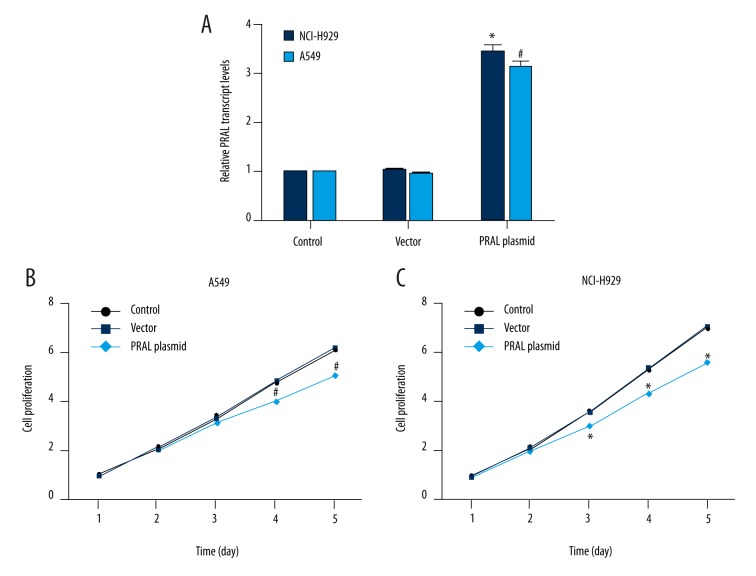
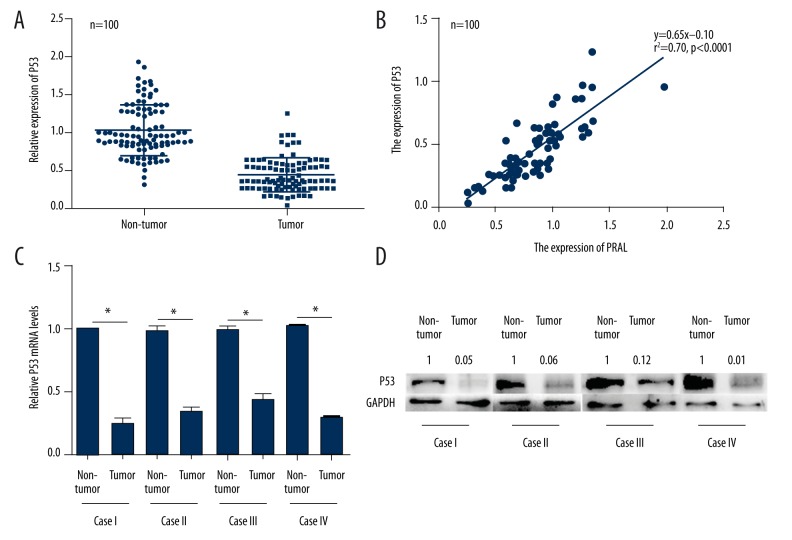
BACKGROUND Lung cancer is among the most common causes of cancer-related deaths worldwide, but its tumorigenic mechanisms are largely unknown. Long non-coding RNAs (LncRNAs) have been shown to have significant roles in multiple cancers. Herein, we aimed to elucidate the detailed effects of a newly-discovered LncRNA, termed PRAL, on cell proliferation in lung cancer. MATERIAL AND METHODS A total of 100 lung cancer patients were subjected to RT-PCR analysis to detect the expressions of PRAL. Western blot analysis was performed to examine P53 protein levels. PRAL plasmid and specific siRNA against P53 was transfected into lung cancer cell lines NCI-H929 and A549. Cell viability assay was conducted in the presence or absence of siP53. RESULTS The transcript level of PRAL in human lung cancer was remarkably decreased in vivo compared with their adjacent non-cancerous counterparts, and the protein levels of P53 were accordingly suppressed. Moreover, the expression of PRAL was also decreased in all of the 5 lung cancer cell lines. Transfection of PRAL plasmid inhibited cell proliferation in NCI-H929 and A549 cells and promoted the transcription of P53; however, knockdown of P53 caused no notable effects on PRAL transcription, but it retarded the inhibitory effects mediated by PRAL. CONCLUSIONS The transcript level of PRAL was decreased in lung cancer in vivo and in vitro. Overexpression of PRAL inhibited cell proliferation by upregulating the expression of P53. Our results indicate that PRAL might be a tumor suppressor in lung cancer and thus provides novel clues for the diagnosis and treatment for lung cancer in clinical practice.
背景 肺癌是全球癌症相关死亡的最常见原因之一,但其致癌机制在很大程度上尚不清楚。长链非编码RNA(LncRNAs)已被证明在多种癌症中发挥重要作用。在此,我们旨在阐明一种新发现的名为PRAL的LncRNA对肺癌细胞增殖的详细影响。
材料与方法 共100例肺癌患者接受逆转录-聚合酶链反应(RT-PCR)分析以检测PRAL的表达。进行蛋白质免疫印迹分析以检测P53蛋白水平。将PRAL质粒和针对P53的特异性小干扰RNA(siRNA)转染至肺癌细胞系NCI-H929和A549中。在有或无siP53的情况下进行细胞活力测定。
结果 与相邻的非癌组织相比,人肺癌组织中PRAL的转录水平显著降低,P53蛋白水平也相应受到抑制。此外,在所有5种肺癌细胞系中PRAL的表达也降低。转染PRAL质粒可抑制NCI-H929和A549细胞的增殖并促进P53的转录;然而,敲低P53对PRAL转录无显著影响,但可削弱PRAL介导的抑制作用。
结论 在体内和体外肺癌中PRAL的转录水平均降低。PRAL的过表达通过上调P53的表达抑制细胞增殖。我们的结果表明PRAL可能是肺癌中的一种肿瘤抑制因子,从而为临床肺癌诊断和治疗提供了新线索。