Jones Jeffrey A, Hillmen Peter, Coutre Steven, Tam Constantine, Furman Richard R, Barr Paul M, Schuster Stephen J, Kipps Thomas J, Flinn Ian W, Jaeger Ulrich, Burger Jan A, Cheng Mei, Ninomoto Joi, James Danelle F, Byrd John C, O'Brien Susan M
Division of Hematology, The Ohio State University, Columbus, OH, USA.
The Leeds Teaching Hospitals, St. James Institute of Oncology, Leeds, UK.
Br J Haematol. 2017 Jul;178(2):286-291. doi: 10.1111/bjh.14660. Epub 2017 Apr 10.
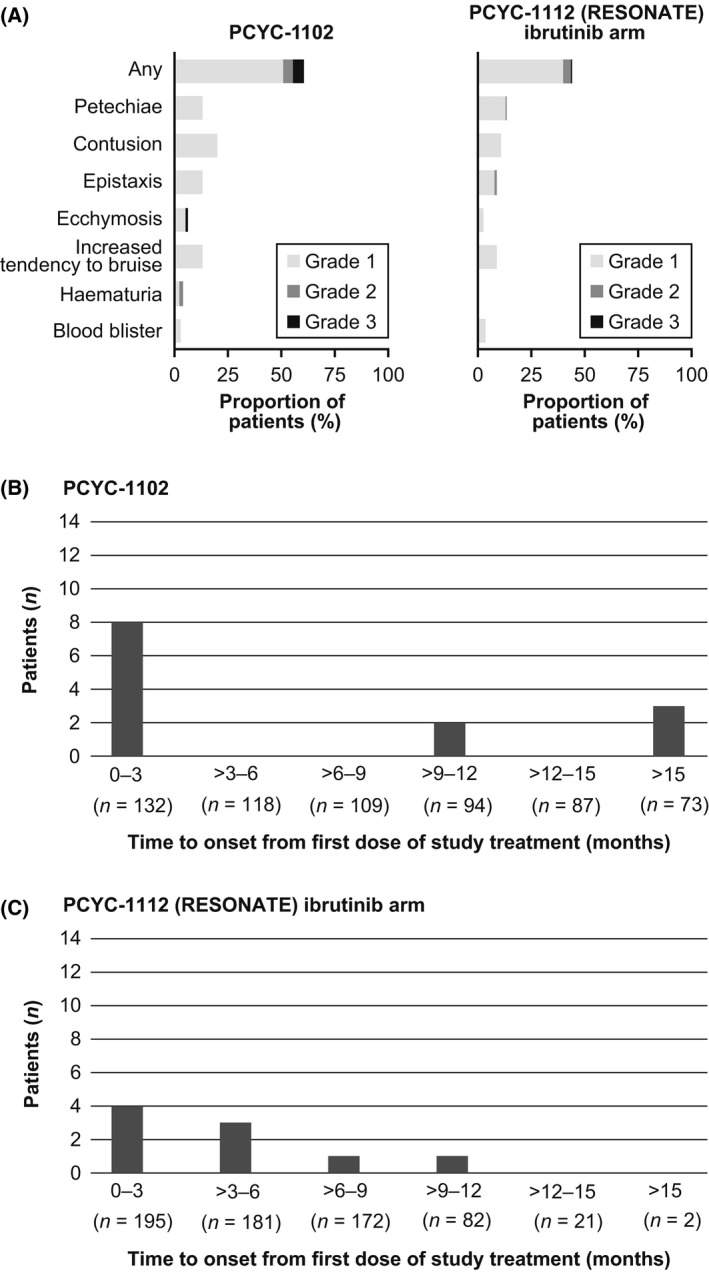
Bleeding events have been observed among a subgroup of chronic lymphocytic leukaemia (CLL) patients treated with ibrutinib. We analysed data from two studies of single-agent ibrutinib to better characterize bleeding events and pattern of anticoagulation and antiplatelet use. Among 327 ibrutinib-treated patients, concomitant anticoagulation (11%) or antiplatelet use (34%) was common, but major bleeding was infrequent (2%). Bleeding events were primarily grade 1, and infrequently (1%) led to discontinuation. Among 175 patients receiving concomitant anticoagulant or antiplatelet agents, 5 had major bleeding events (3%). These events were typically observed in conjunction with other factors, such as coexisting medical conditions and/or concurrent medications.
在接受依鲁替尼治疗的慢性淋巴细胞白血病(CLL)患者亚组中观察到出血事件。我们分析了两项关于单药依鲁替尼研究的数据,以更好地描述出血事件以及抗凝和抗血小板药物的使用模式。在327例接受依鲁替尼治疗的患者中,同时使用抗凝药物(11%)或抗血小板药物(34%)很常见,但严重出血并不常见(2%)。出血事件主要为1级,很少(1%)导致停药。在175例同时接受抗凝或抗血小板药物治疗的患者中,有5例发生严重出血事件(3%)。这些事件通常与其他因素同时出现,如并存的医疗状况和/或同时使用的药物。