
超顺磁性氧化铁纳米颗粒介导的力增强雪旺细胞跨星形胶质细胞 - 雪旺细胞边界的迁移 。
Superparamagnetic Iron Oxide Nanoparticle-Mediated Forces Enhance the Migration of Schwann Cells Across the Astrocyte-Schwann Cell Boundary .
作者信息
Huang Liangliang, Xia Bing, Liu Zhongyang, Cao Quanliang, Huang Jinghui, Luo Zhuojing
机构信息
Department of Orthopaedics, Xijing Hospital, The Fourth Military Medical University Xi'an, China.
State Key Laboratory of Advanced Electromagnetic Engineering and Technology, Wuhan National High Magnetic Field Center, Huazhong University of Science and Technology Wuhan, China.
出版信息
Front Cell Neurosci. 2017 Mar 28;11:83. doi: 10.3389/fncel.2017.00083. eCollection 2017.
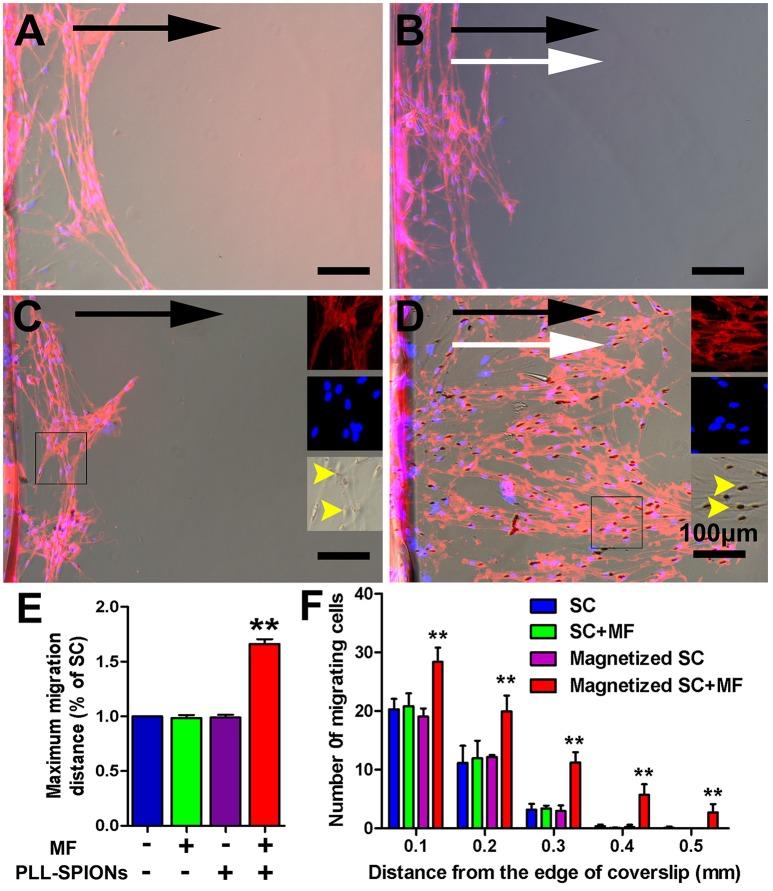
Schwann cells (SCs) are one of the most promising cellular candidates for the treatment of spinal cord injury. However, SCs show poor migratory ability within the astrocyte-rich central nervous system (CNS) environment and exhibit only limited integration with host astrocytes. Our strategy for improving the therapeutic potential of SCs was to magnetically drive SCs to migrate across the astrocyte-SC boundary to intermingle with astrocytes. SCs were firstly magnetized with poly-L-lysine-coated superparamagnetic iron oxide nanoparticles (SPIONs). Internalization of SPIONs showed no effect upon the migration of SCs in the absence of a magnetic field (MF). In contrast, magnetized SCs exhibited enhanced migration along the direction of force in the presence of a MF. An inverted coverslip assay showed that a greater number of magnetized SCs migrated longer distances onto astrocytic monolayers under the force of a MF compared to other test groups. More importantly, a confrontation assay demonstrated that magnetized SCs intermingled with astrocytes under an applied MF. Furthermore, inhibition of integrin activation reduced the migration of magnetized SCs within an astrocyte-rich environment under an applied MF. Thus, SPION-mediated forces could act as powerful stimulants to enhance the migration of SCs across the astrocyte-SC boundary, via integrin-mediated mechanotransduction, and could represent a vital way of improving the therapeutic potential of SCs for spinal cord injuries.
施万细胞(SCs)是治疗脊髓损伤最有前景的细胞候选者之一。然而,施万细胞在富含星形胶质细胞的中枢神经系统(CNS)环境中迁移能力较差,与宿主星形胶质细胞的整合也很有限。我们提高施万细胞治疗潜力的策略是通过磁场驱动施万细胞跨越星形胶质细胞 - 施万细胞边界与星形胶质细胞混合。首先用聚 - L - 赖氨酸包被的超顺磁性氧化铁纳米颗粒(SPIONs)对施万细胞进行磁化。在没有磁场(MF)的情况下,SPIONs的内化对施万细胞的迁移没有影响。相反 在存在磁场的情况下,磁化的施万细胞沿力的方向迁移增强。倒置盖玻片试验表明,与其他测试组相比,在磁场力作用下,更多的磁化施万细胞迁移到星形胶质细胞单层上更远的距离。更重要的是,对抗试验表明,在施加的磁场下,磁化的施万细胞与星形胶质细胞混合。此外,整合素激活的抑制降低了在施加磁场的富含星形胶质细胞的环境中磁化施万细胞的迁移。因此,SPION介导的力可以作为强大的刺激物,通过整合素介导的机械转导增强施万细胞跨越星形胶质细胞 - 施万细胞边界的迁移,并且可能是提高施万细胞治疗脊髓损伤潜力的重要途径。
 Zotero 插件