Department of Orthopaedics, Xijing Hospital, Fourth Military Medical University, Xi'an, Shaanxi, People's Republic of China.
Int J Nanomedicine. 2016 Dec 12;11:6727-6741. doi: 10.2147/IJN.S122358. eCollection 2016.
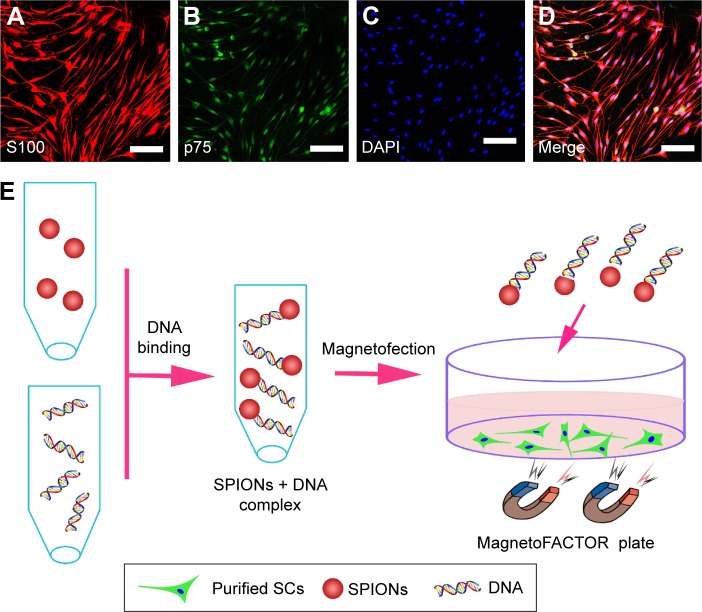
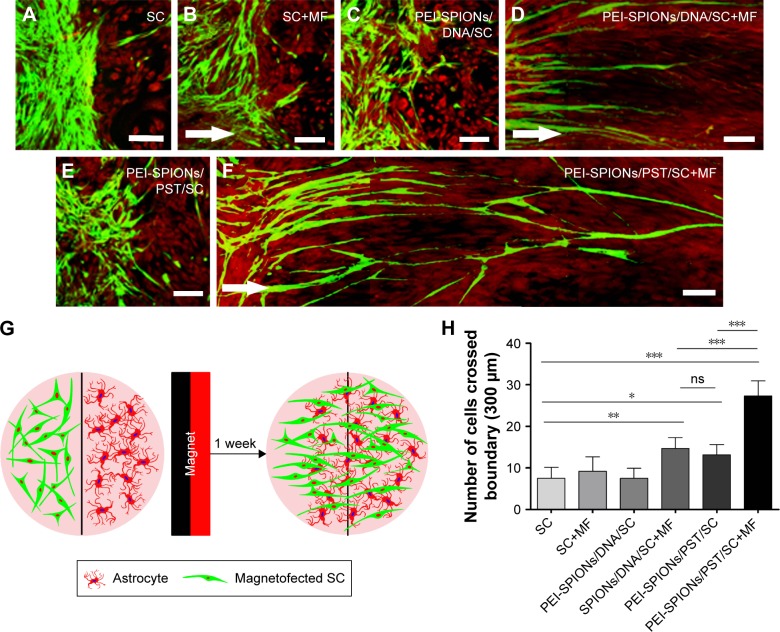
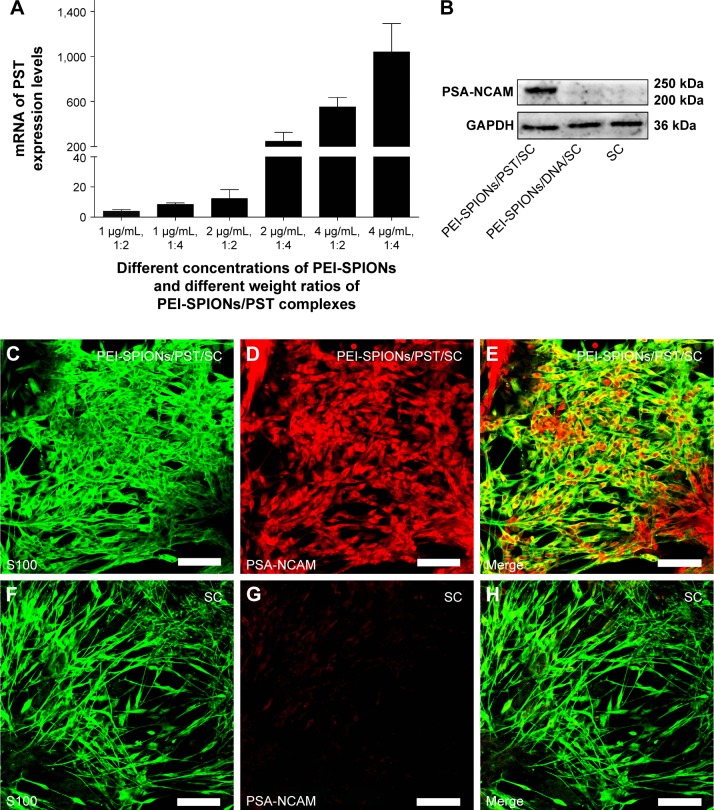
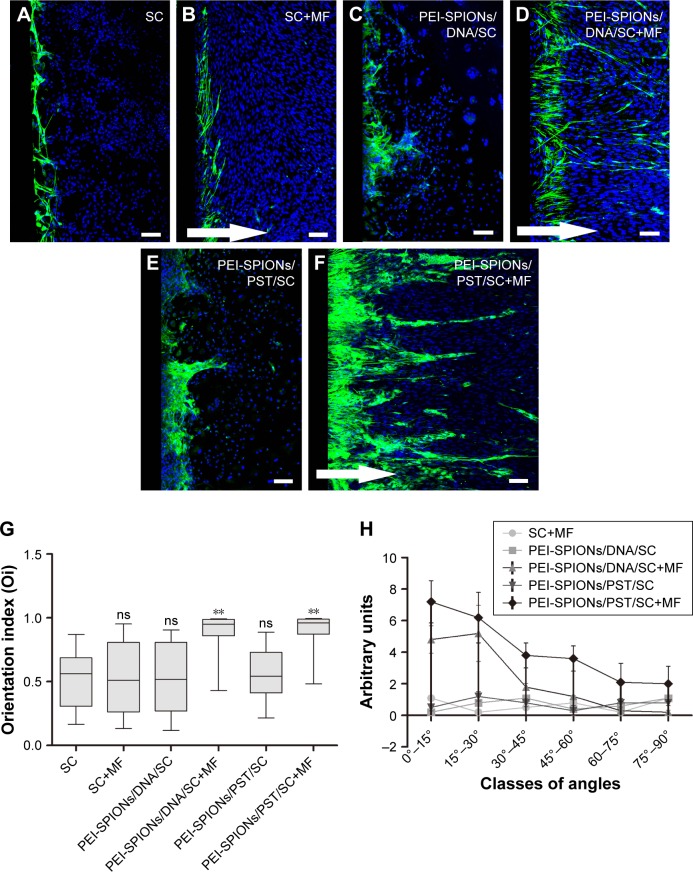
Schwann cell (SC) transplantation is an attractive strategy for spinal cord injury (SCI). However, the efficacy of SC transplantation has been limited by the poor migratory ability of SCs in the astrocyte-rich central nervous system (CNS) environment and the inability to intermingle with the host astrocyte. In this study, we first magnetofected SCs by polysialyltransferase-functionalized superparamagnetic iron oxide nanoparticles (PST/SPIONs) to induce overexpression of polysialylation of neural cell adhesion molecule (PSA-NCAM) to enhance SC migration ability, before manipulating the direction of SC migration with the assistance of an applied magnetic field (MF). It was found that magnetofection with PST/SPIONs significantly upregulated the expression of PSA-NCAM in SCs, which significantly enhanced the migration ability of SCs, but without preferential direction in the absence of MF. The number and averaged maximum distance of SCs with PST/SPIONs migrating into the astrocyte domain were significantly enhanced by an applied MF. In a 300 μm row along the astrocyte boundary, the number of SCs with PST/SPIONs migrating into the astrocyte domain under an MF was 2.95 and 6.71 times higher than that in the absence of MF and the intact control SCs, respectively. More interestingly, a confrontation assay demonstrated that SCs with PST/SPIONs were in close contact with astrocytes and no longer formed boundaries in the presence of MF. In conclusion, SCs with PST/SPIONs showed enhanced preferential migration along the axis of a magnetic force, which might be beneficial for the formation of Büngner bands in the CNS. These findings raise the possibilities of enhancing the migration of transplanted SCs in astrocyte-rich CNS regions in a specific direction and creating an SC bridge in the CNS environment to guide regenerated axons to their distal destination in the treatment of SCI.
施万细胞(SCs)移植是脊髓损伤(SCI)的一种有吸引力的策略。然而,SCs 在富含星形胶质细胞的中枢神经系统(CNS)环境中的迁移能力差,并且无法与宿主星形胶质细胞混合,这限制了SCs 移植的疗效。在这项研究中,我们首先通过多涎酸转移酶功能化超顺磁性氧化铁纳米粒子(PST/SPIONs)对SCs 进行磁转染,以诱导神经细胞黏附分子(PSA-NCAM)的多涎酸化过度表达,从而增强SCs 的迁移能力,然后在施加磁场(MF)的帮助下操纵SCs 的迁移方向。结果发现,PST/SPIONs 的磁转染显著上调了SCs 中 PSA-NCAM 的表达,这显著增强了SCs 的迁移能力,但在没有 MF 的情况下没有优先方向。施加 MF 后,SCs 迁移到星形胶质细胞区域的数量和平均最大距离显著增加。在沿星形胶质细胞边界的 300μm 行中,MF 下 PST/SPIONs 迁移到星形胶质细胞区域的SCs 数量分别比没有 MF 和完整对照 SC 高 2.95 倍和 6.71 倍。更有趣的是,对抗试验表明,在 MF 存在的情况下,携带 PST/SPIONs 的SCs 与星形胶质细胞紧密接触,不再形成边界。总之,携带 PST/SPIONs 的SCs 表现出沿磁力轴的增强的优先迁移,这可能有利于在 CNS 中形成 Büngner 带。这些发现提高了在富含星形胶质细胞的 CNS 区域中以特定方向增强移植SCs 迁移和在 CNS 环境中创建SCs 桥以引导再生轴到达其远端目的地的可能性,从而为 SCI 的治疗提供了帮助。