Penadés Rafael, González-Rodríguez Alexandre, Catalán Rosa, Segura Bàrbara, Bernardo Miquel, Junqué Carme
Rafael Penadés, Alexandre González-Rodríguez, Rosa Catalán, Miquel Bernardo, Department of Psychiatry and Psychology, Clinical Institute of Neurosciences, Hospital Clínic, 08036 Barcelona, Spain.
World J Psychiatry. 2017 Mar 22;7(1):34-43. doi: 10.5498/wjp.v7.i1.34.
To examine the effects of cognitive remediation therapies on brain functioning through neuroimaging procedures in patients with schizophrenia.
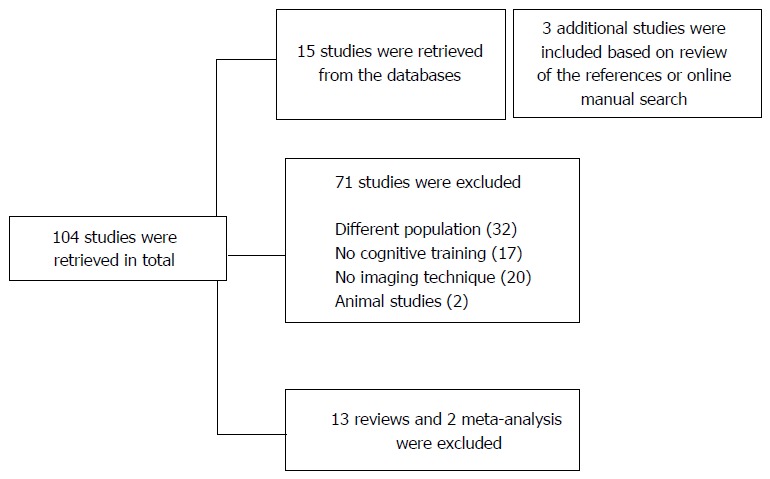
A systematic, computerised literature search was conducted in the PubMed/Medline and PsychInfo databases. The search was performed through February 2016 without any restrictions on language or publication date. The search was performed using the following search terms: [("cogniti*" and "remediation" or "training" or "enhancement") and ("fMRI" or "MRI" or "PET" or "SPECT") and (schizophrenia or schiz*)]. The search was accompanied by a manual online search and a review of the references from each of the papers selected, and those papers fulfilling our inclusion criteria were also included.
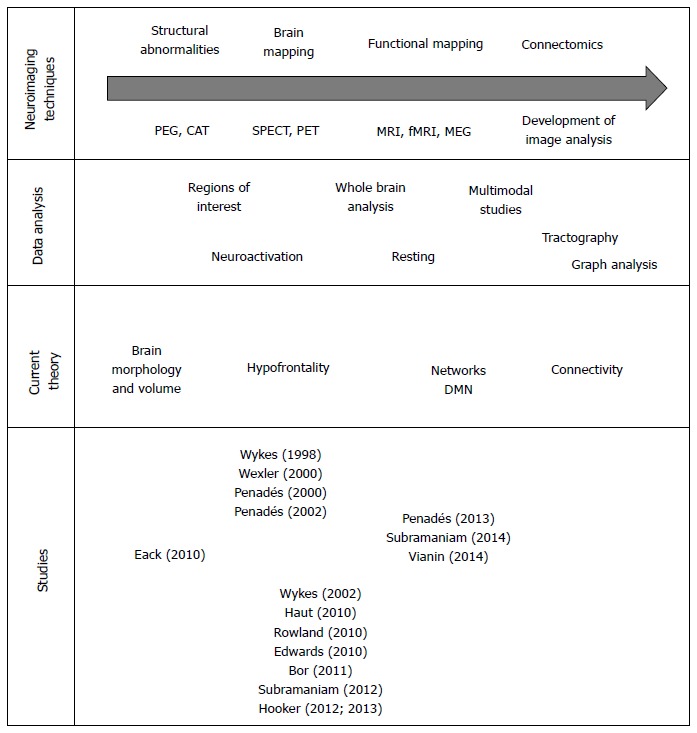
A total of 101 studies were found, but only 18 of them fulfilled the inclusion criteria. These studies indicated that cognitive remediation improves brain activation in neuroimaging studies. The most commonly reported changes were those that involved the prefrontal and thalamic regions. Those findings are in agreement with the hypofrontality hypothesis, which proposes that frontal hypoactivation is the underlying mechanism of cognitive impairments in schizophrenia. Nonetheless, great heterogeneity among the studies was found. They presented different hypotheses, different results and different findings. The results of more recent studies interpreted cognitive recovery within broader frameworks, namely, as amelioration of the efficiency of different networks. Furthermore, advances in neuroimaging methodologies, such as the use of whole-brain analysis, tractography, graph analysis, and other sophisticated methodologies of data processing, might be conditioning the interpretation of results and generating new theoretical frameworks. Additionally, structural changes were described in both the grey and white matter, suggesting a neuroprotective effect of cognitive remediation. Cognitive, functional and structural improvements tended to be positively correlated.
Neuroimaging studies of cognitive remediation in patients with schizophrenia suggest a positive effect on brain functioning in terms of the functional reorganisation of neural networks.
通过神经影像学检查,探究认知康复疗法对精神分裂症患者脑功能的影响。
在PubMed/Medline和PsychInfo数据库中进行系统的计算机文献检索。检索截至2016年2月,对语言和出版日期无任何限制。检索使用以下检索词:[(“cogniti*”和“remediation”或“training”或“enhancement”)和(“fMRI”或“MRI”或“PET”或“SPECT”)和(精神分裂症或schiz*)]。检索同时进行手动在线检索,并对所选每篇论文的参考文献进行回顾,符合纳入标准的论文也纳入其中。
共检索到101项研究,但只有18项符合纳入标准。这些研究表明,认知康复在神经影像学研究中可改善脑激活。最常报告的变化涉及前额叶和丘脑区域。这些发现与前额叶功能低下假说一致,该假说认为额叶激活不足是精神分裂症认知障碍的潜在机制。然而,研究之间存在很大的异质性。它们提出了不同的假说、不同的结果和不同的发现。近期研究的结果在更广泛的框架内解释认知恢复,即作为不同网络效率的改善。此外,神经影像学方法的进展,如全脑分析、纤维束成像、图形分析和其他复杂的数据处理方法,可能会影响结果的解释并产生新的理论框架。此外,还描述了灰质和白质的结构变化,表明认知康复具有神经保护作用。认知、功能和结构的改善往往呈正相关。
对精神分裂症患者认知康复的神经影像学研究表明,认知康复对神经网络的功能重组具有积极影响,从而对脑功能产生积极作用。