Trabelsi Rahma, Sellami Hanen, Gharbi Yâakoub, Krid Samira, Cheffi Manel, Kammoun Sonia, Dammak Mariem, Mseddi Aymen, Gdoura Radhouane, Triki Mohamed Ali
Laboratoire d'Amélioration et Protection des Ressources Génétique de l'Olivier, Institut de l'Olivier, Université de Sfax, BP1078, Sfax, Tunisia.
Laboratoire de Recherche Toxicologie-Microbiologie Environnementale et Santé (LR17ES06), Faculté des Sciences de Sfax, Université de Sfax, Sfax, Tunisia.
3 Biotech. 2017 May;7(1):28. doi: 10.1007/s13205-016-0587-3. Epub 2017 Apr 11.
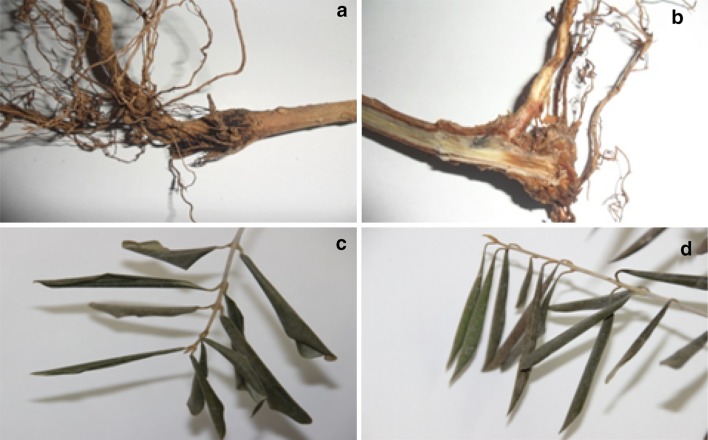
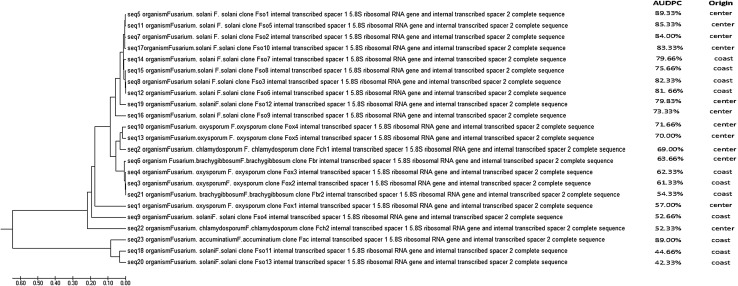
Dieback and wilting symptoms caused by complex soilborne fungi are nowadays the most serious threatening disease affecting olive trees (Olea europaea) in Tunisia and presumably in many Mediterranean basin countries. Fusarium is one of the important phytopathogenic genera associated with dieback symptoms of olive trees. The objective of the present study was to confirm the pathogenicity of Fusarium spp. isolated from several olive-growing areas in Tunisia. According to the pathogenic test done on young olive trees (cv. Chemlali), 23 out of 104 isolates of Fusarium spp. were found to be pathogenic and the others were weakly or not pathogenic. The pathogenic Fusarium spp. isolates were characterized using molecular methods based on ITS PCR. Isolation results revealed the predominance of Fusarium solani (56.5%) and F. oxysporum species (21.7%) compared to F. chalmydosporum (8.7%), F. brachygibbosum (8.7%) and F. acuminatum (4.34%). Based on pathogenicity test, disease severity was highly variable among the 23 pathogenic isolates tested (P < 0.05) where F. solani was the most aggressive dieback agent. To the best of our knowledge, this is the first work that shows that Fusarium spp. might be a major agent causing dieback disease of olive trees in Tunisia.
由复杂的土传真菌引起的枯萎和萎蔫症状,是目前影响突尼斯橄榄树(油橄榄)以及可能影响许多地中海盆地国家橄榄树的最严重的威胁性病害。镰刀菌是与橄榄树枯萎症状相关的重要植物病原属之一。本研究的目的是确认从突尼斯几个橄榄种植区分离出的镰刀菌的致病性。根据对幼龄橄榄树(品种:Chemlali)进行的致病性测试,104株镰刀菌分离株中有23株被发现具有致病性,其他分离株致病性较弱或无致病性。使用基于ITS PCR的分子方法对致病性镰刀菌分离株进行了鉴定。分离结果显示,与厚垣镰刀菌(8.7%)、短梗镰刀菌(8.7%)和锐顶镰刀菌(4.34%)相比,茄病镰刀菌(56.5%)和尖孢镰刀菌(21.7%)占优势。基于致病性测试,在测试的23株致病分离株中,病害严重程度差异很大(P < 0.05),其中茄病镰刀菌是最具侵袭性的枯萎病菌。据我们所知,这是第一项表明镰刀菌可能是突尼斯橄榄树枯萎病主要病原菌的研究。