van den Berg M M G A, Winkels R M, de Kruif J Th C M, van Laarhoven H W M, Visser M, de Vries J H M, de Vries Y C, Kampman E
Division of Human Nutrition, Wageningen University, Stippeneng 4, 6708, WE, Wageningen, The Netherlands.
Department of Health Sciences, VU University Amsterdam, De Boelelaan 1085, 1081, HV, Amsterdam, The Netherlands.
BMC Cancer. 2017 Apr 12;17(1):259. doi: 10.1186/s12885-017-3242-4.
Weight gain during chemotherapy in women with breast cancer is commonly reported. However, there are important differences between studies that examined weight change during chemotherapy; e.g. type of chemotherapy, menopausal status, time between body weight measurements and sample size. The purpose of this meta-analysis was to quantify changes in body weight during chemotherapy for women with breast cancer, taking these differences into account.
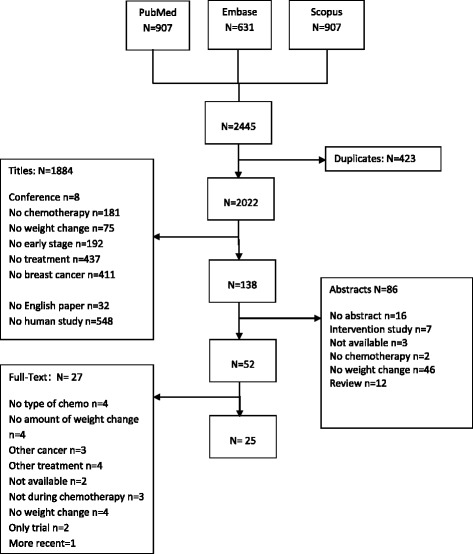
We identified relevant studies using PubMed, Scopus and Embase databases. The search was limited to human studies published in English up to and including December 2015. Only studies among women with early stage breast cancer treated with chemotherapy, with reported body weight before and after chemotherapy and type of chemotherapy were included. Random-effect models were used, and heterogeneity between studies was explored through stratified analyses and meta-regression. Sensitivity analyses were done to explore whether a specific study markedly affected the results.
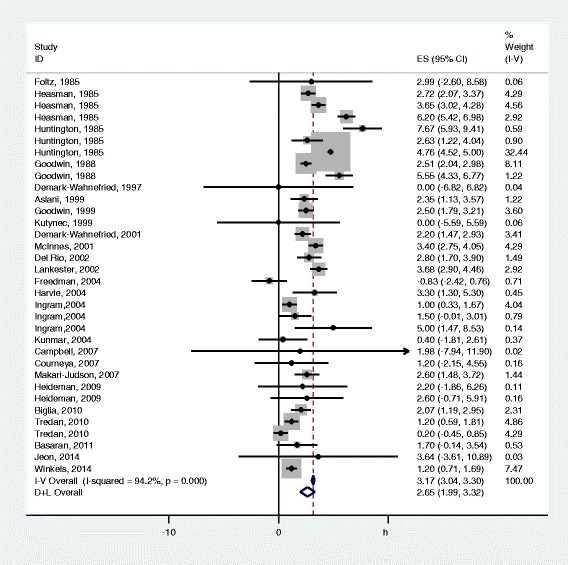
In total 25 papers were found, including data from 2620 women. Overall, body weight increased during chemotherapy: 2.7 kg (95% CI 2.0, 7.5) with a high degree of heterogeneity (I = 94.2%). Stratified analyses showed weight gain in all strata, but did not substantially reduce heterogeneity. Univariate meta-regression showed less weight gain in prospective studies compared to chart review studies (-2.0, 95% CI: -3.1, -0.8). Studies including cyclophosphamide, methotrexate and 5-fluorouracil (CMF) regimes showed a greater weight gain compared to those that did not (2.2, 95% CI: 1.1, 3.3); and papers published until the year 2000 showed a greater weight gain compared to those published after 2000 (1.9, 95% CI:-0.8, 3.1). In the multivariate models only studies including CMF regimes and studies published until 2000 were associated with significant weight gain of respectively 1.3 and 1.4 kg.
Despite the high heterogeneity, this meta-analysis shows significant weight gain during chemotherapy for women with breast cancer. Weight gain was more pronounced in papers published until 2000 and women receiving CMF as chemotherapy regime. Although weight gain after chemotherapy has decreased over the course of time, weight gain is still substantial and deserves clinical attention.
乳腺癌女性化疗期间体重增加的情况常有报道。然而,研究化疗期间体重变化的各项研究之间存在重要差异,例如化疗类型、绝经状态、体重测量间隔时间以及样本量。本荟萃分析的目的是在考虑这些差异的情况下,量化乳腺癌女性化疗期间的体重变化。
我们使用PubMed、Scopus和Embase数据库识别相关研究。检索限于截至2015年12月(含)以英文发表的人体研究。仅纳入早期乳腺癌女性接受化疗且报告了化疗前后体重及化疗类型的研究。采用随机效应模型,并通过分层分析和元回归探讨研究间的异质性。进行敏感性分析以探究特定研究是否显著影响结果。
共找到25篇论文,包含2620名女性的数据。总体而言,化疗期间体重增加:2.7千克(95%置信区间2.0,7.5),异质性程度较高(I² = 94.2%)。分层分析显示各层均有体重增加,但并未大幅降低异质性。单变量元回归显示,前瞻性研究的体重增加少于病历回顾研究(-2.0,95%置信区间:-3.1,-0.8)。包含环磷酰胺、甲氨蝶呤和5-氟尿嘧啶(CMF)方案的研究相比未包含该方案的研究体重增加更多(2.2,95%置信区间:1.1,3.3);2000年之前发表的论文相比2000年之后发表的论文体重增加更多(1.9,95%置信区间:-0.8,3.1)。在多变量模型中,仅包含CMF方案的研究和2000年之前发表的研究分别与显著的体重增加1.3千克和1.4千克相关。
尽管异质性较高,但本荟萃分析显示乳腺癌女性化疗期间体重显著增加。在2000年之前发表的论文以及接受CMF作为化疗方案的女性中,体重增加更为明显。尽管化疗后体重增加随时间有所减少,但仍较为显著,值得临床关注。