Skopelja-Gardner Sladjana, Saha Madhurima, Alvarado-Vazquez Perla Abigail, Liponis Brenna S, Martinez Elena, Romero-Sandoval E Alfonso
Department of Anesthesiology, Geisel School of Medicine at Dartmouth, Lebanon, NH.
Department of Pharmaceutical and Administrative Sciences, Presbyterian College School of Pharmacy, Clinton, SC, USA.
J Pain Res. 2017 Mar 28;10:763-774. doi: 10.2147/JPR.S129826. eCollection 2017.
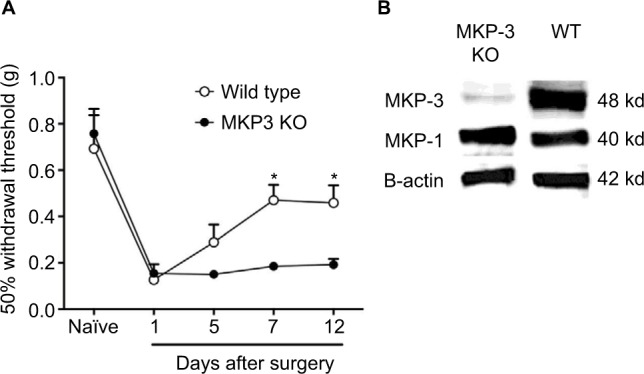
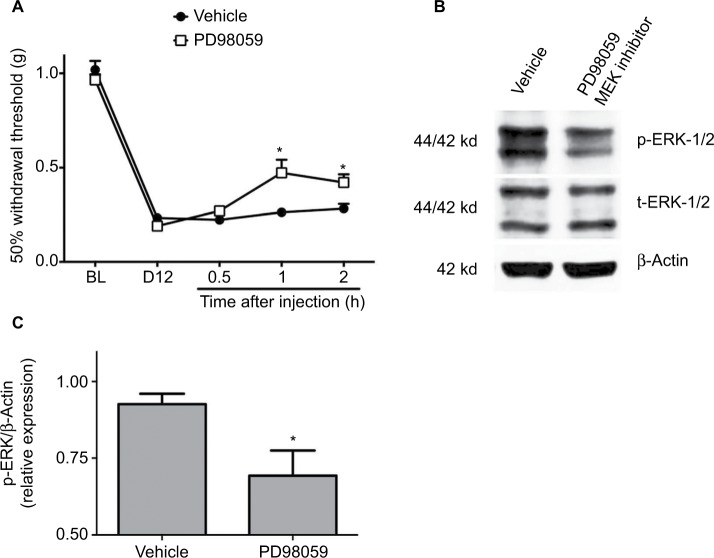
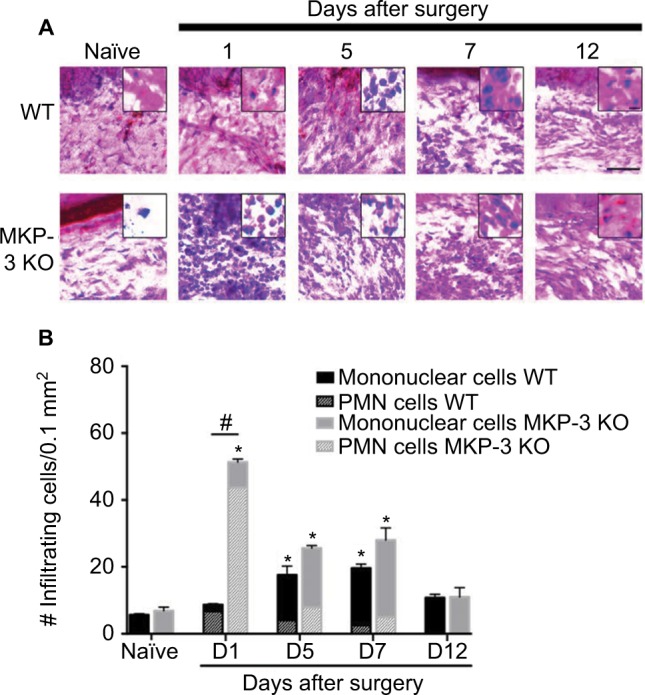
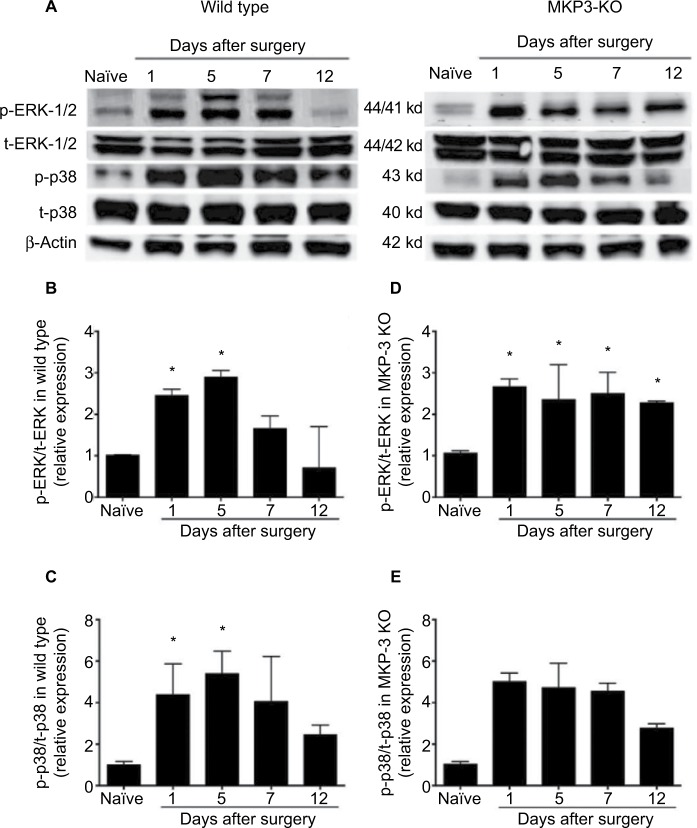
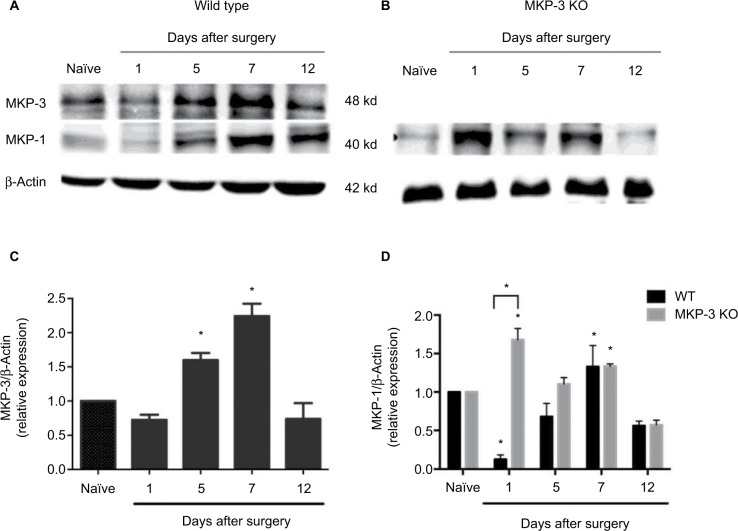
Mitogen-activated protein kinase (MAPK) phosphatase-3 (MKP-3) and its substrates (extracellular signal-regulated kinase [ERK] and p38) play an important role in pathophysiological mechanisms of acute postoperative and chronic neuropathic pain in the spinal cord. This study aimed to understand the role of MKP-3 and its target MAPKs at the site of surgical incision in nociceptive behavior. Wild-type (WT) and MKP-3 knockout (KO) mice underwent unilateral plantar hind paw incision. Mechanical allodynia was assessed by using von Frey filaments. Peripheral ERK-1/2 and p38 phosphorylation were measured by Western blot. Cell infiltration was determined using hematoxylin and eosin histological staining. Peripheral phosphorylated ERK-1/2 (p-ERK-1/2) inhibition was performed in MKP-3 KO mice. In WT mice, mechanical hypersensitivity was observed on postoperative day 1 (0.69±0.17 g baseline vs 0.13±0.08 g day 1), which resolved normally by postoperative day 12 (0.46±0.08 g, N=6). In MKP-3 KO mice, this hypersensitivity persisted at least 12 days after surgery (0.19±0.06 g; N=6). KO mice displayed higher numbers of infiltrating cells (51.4±6 cells/0.1 mm) than WT mice (8.7±1.2 cells/0.1 mm) on postoperative day 1 (vs 5-6 cells/0.1 mm at baseline) that returned to baseline 12 days after surgery (10-12 cells/0.1 mm). In WT mice, peripheral p-p38 and p-ERK-1/2 expression increased (5- and 3-fold, respectively) on postoperative days 1 and 5, and returned to basal levels 7-12 days after surgery (N=3 per group). Peripheral p-p38 levels in MKP-3 KO mice followed a similar expression pattern as WT mice. Peripheral p-ERK-1/2 levels in MKP-3 KO mice remained elevated 12 days after surgery (2.5-fold, N=3 per group). Administration of PD98059 (MEK inhibitor, N=8, vehicle N=9) reduced p-ERK-1/2 expression in the incised tissue and blocked hypersensitivity in MKP-3 KO mice (N=6). The findings of this study suggest that MKP-3 is pivotal for normal resolution of acute postoperative allodynia, through the regulation of peripheral p-ERK-1/2.
丝裂原活化蛋白激酶(MAPK)磷酸酶-3(MKP-3)及其底物(细胞外信号调节激酶[ERK]和p38)在脊髓急性术后疼痛和慢性神经性疼痛的病理生理机制中起重要作用。本研究旨在了解MKP-3及其靶标MAPKs在手术切口部位对伤害性感受行为的作用。野生型(WT)和MKP-3基因敲除(KO)小鼠接受单侧后足底切开术。使用von Frey细丝评估机械性异常性疼痛。通过蛋白质印迹法测量外周ERK-1/2和p38的磷酸化水平。使用苏木精和伊红组织学染色确定细胞浸润情况。在MKP-3基因敲除小鼠中进行外周磷酸化ERK-1/2(p-ERK-1/2)抑制实验。在野生型小鼠中,术后第1天观察到机械性超敏反应(基线为0.69±0.17 g,第1天为0.13±0.08 g),术后第12天正常恢复(0.46±0.08 g,N = 6)。在MKP-3基因敲除小鼠中,这种超敏反应在手术后至少持续12天(0.19±0.06 g;N = 6)。基因敲除小鼠在术后第1天的浸润细胞数量(51.4±6个细胞/0.1 mm)高于野生型小鼠(8.7±1.2个细胞/0.1 mm)(与基线时的5 - 6个细胞/0.1 mm相比),术后12天恢复到基线水平(10 - 12个细胞/0.1 mm)。在野生型小鼠中,外周p-p38和p-ERK-1/2表达在术后第1天和第5天增加(分别为5倍和3倍),术后7 - 12天恢复到基础水平(每组N = 3)。MKP-3基因敲除小鼠外周p-p38水平的表达模式与野生型小鼠相似。MKP-3基因敲除小鼠外周p-ERK-1/2水平在术后12天仍保持升高(2.5倍,每组N = 3)。给予PD98059(MEK抑制剂,N = 8,溶媒对照组N = 9)可降低切开组织中p-ERK-1/2的表达,并阻断MKP-3基因敲除小鼠的超敏反应(N = 6)。本研究结果表明,MKP-3通过调节外周p-ERK-1/2对急性术后异常性疼痛的正常缓解起关键作用。