Lecarpentier Yves, Claes Victor, Vallée Alexandre, Hébert Jean-Louis
Centre de Recherche Clinique, Hôpital de Meaux, 6-8 rue Saint Fiacre, 77100, Meaux, France.
Department of Pharmaceutical Sciences, University of Antwerp, Wilrijk, Belgium.
Clin Transl Med. 2017 Dec;6(1):14. doi: 10.1186/s40169-017-0144-7. Epub 2017 Apr 12.
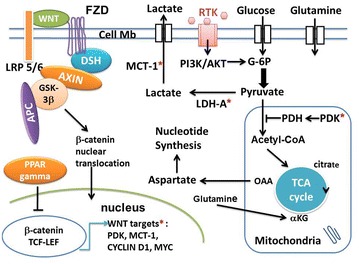
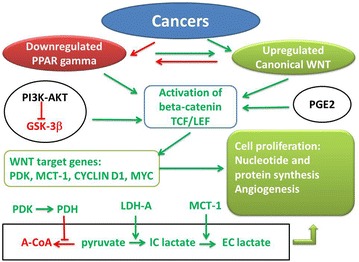
Cancer cells are the site of numerous metabolic and thermodynamic abnormalities. We focus this review on the interactions between the canonical WNT/beta-catenin pathway and peroxisome proliferator-activated receptor gamma (PPAR gamma) in cancers and their implications from an energetic and metabolic point of view. In numerous tissues, PPAR gamma activation induces inhibition of beta-catenin pathway, while the activation of the canonical WNT/beta-catenin pathway inactivates PPAR gamma. In most cancers but not all, PPAR gamma is downregulated while the WNT/beta-catenin pathway is upregulated. In cancer cells, upregulation of the WNT/beta-catenin signaling induces dramatic changes in key metabolic enzymes that modify their thermodynamic behavior. This leads to activation of pyruvate dehydrogenase kinase1 (PDK-1) and monocarboxylate lactate transporter. Consequently, phosphorylation of PDK-1 inhibits the pyruvate dehydrogenase complex (PDH). Thus, a large part of pyruvate cannot be converted into acetyl-coenzyme A (acetyl-CoA) in mitochondria and only a part of acetyl-CoA can enter the tricarboxylic acid cycle. This leads to aerobic glycolysis in spite of the availability of oxygen. This phenomenon is referred to as the Warburg effect. Cytoplasmic pyruvate is converted into lactate. The WNT/beta-catenin pathway induces the transcription of genes involved in cell proliferation, i.e., MYC and CYCLIN D1. This ultimately promotes the nucleotide, protein and lipid synthesis necessary for cell growth and multiplication. In cancer, activation of the PI3K-AKT pathway induces an increase of the aerobic glycolysis. Moreover, prostaglandin E2 by activating the canonical WNT pathway plays also a role in cancer. In addition in many cancer cells, PPAR gamma is downregulated. Moreover, PPAR gamma contributes to regulate some key circadian genes. In cancers, abnormalities in the regulation of circadian rhythms (CRs) are observed. CRs are dissipative structures which play a key-role in far-from-equilibrium thermodynamics. In cancers, metabolism, thermodynamics and CRs are intimately interrelated.
癌细胞存在众多代谢和热力学异常。本综述聚焦于癌症中经典WNT/β-连环蛋白信号通路与过氧化物酶体增殖物激活受体γ(PPARγ)之间的相互作用,以及从能量和代谢角度探讨其影响。在众多组织中,PPARγ激活会诱导β-连环蛋白信号通路的抑制,而经典WNT/β-连环蛋白信号通路的激活则会使PPARγ失活。在大多数但并非所有癌症中,PPARγ表达下调,而WNT/β-连环蛋白信号通路上调。在癌细胞中,WNT/β-连环蛋白信号的上调会诱导关键代谢酶发生显著变化,从而改变其热力学行为。这会导致丙酮酸脱氢酶激酶1(PDK-1)和单羧酸乳酸转运蛋白的激活。因此,PDK-1的磷酸化会抑制丙酮酸脱氢酶复合体(PDH)。这样一来,大部分丙酮酸无法在线粒体中转化为乙酰辅酶A(acetyl-CoA),只有一部分乙酰辅酶A能进入三羧酸循环。尽管有氧气供应,这仍会导致有氧糖酵解。这种现象被称为瓦伯格效应。细胞质中的丙酮酸会转化为乳酸。WNT/β-连环蛋白信号通路会诱导参与细胞增殖的基因转录,即MYC和细胞周期蛋白D1。这最终促进了细胞生长和增殖所需的核苷酸、蛋白质和脂质合成。在癌症中,PI3K-AKT信号通路的激活会导致有氧糖酵解增加。此外,前列腺素E2通过激活经典WNT信号通路在癌症中也发挥作用。另外,在许多癌细胞中,PPARγ表达下调。而且,PPARγ有助于调节一些关键的昼夜节律基因。在癌症中,观察到昼夜节律(CRs)调节异常。CRs是耗散结构,在远离平衡的热力学中起关键作用。在癌症中,代谢、热力学和CRs密切相关。