Errington Jeff
Centre for Bacterial Cell Biology, Newcastle University, Newcastle-upon-Tyne NE1 7RU, U.K.
Biochem Soc Trans. 2017 Apr 15;45(2):287-295. doi: 10.1042/BST20160435.
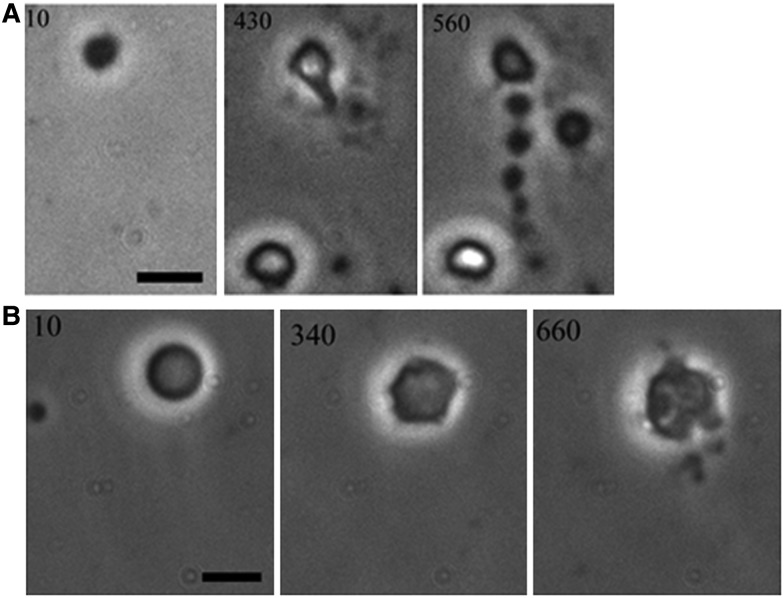
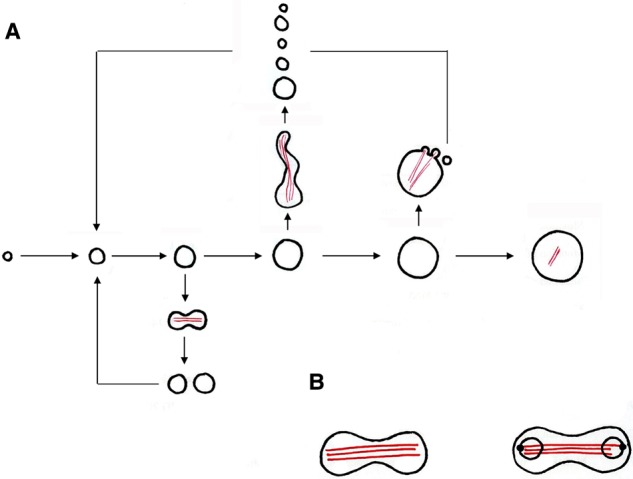
The peptidoglycan (PG) cell wall is a defining feature of the bacteria. It emerged very early in evolution and must have contributed significantly to the success of these organisms. The wall features prominently in our thinking about bacterial cell function, and its synthesis involves the action of several dozen proteins that are normally essential for viability. Surprisingly, it turns out to be relatively simple to generate bacterial genetic variants called L-forms that completely lack PG. They grow robustly provided that lack of the cell wall is compensated for by an osmoprotective growth medium. Although their existence has been noted and studied on and off for many decades, it is only recently that modern molecular and cellular methods have been applied to L-forms. We used as an experimental model to understand the molecular basis for the L-form switch. Key findings included the discovery that L-forms use an unusual blebbing, or tubulation and scission mechanism to proliferate. This mechanism is completely independent of the normal FtsZ-based division machinery and seems to require only an increased rate of membrane synthesis, leading to an increased surface area-to-volume ratio. Antibiotics that block cell wall precursor synthesis, such as phosphomycin, efficiently induce the L-form switch without the need for genetic change. The same antibiotics turned out to induce a similar L-form switch in a wide range of bacteria, including , in which we showed that proliferation was again FtsZ-independent. Aside from further basic science, future work on L-forms is likely to focus on their possible role in chronic or recurrent infections, their use as a model in studies of the origins of life, and possibly, biotechnological applications.
肽聚糖(PG)细胞壁是细菌的一个标志性特征。它在进化过程中很早就出现了,肯定对这些生物体的成功起到了重要作用。细胞壁在我们对细菌细胞功能的认识中占据显著地位,其合成涉及几十种对生存能力通常至关重要的蛋白质的作用。令人惊讶的是,事实证明,产生完全缺乏PG的细菌遗传变体即L型细菌相对简单。只要缺乏细胞壁能通过渗透保护生长培养基得到补偿,它们就能茁壮生长。尽管它们的存在已被断断续续地注意和研究了几十年,但直到最近现代分子和细胞方法才被应用于L型细菌。我们以 作为实验模型来理解L型转变的分子基础。关键发现包括发现L型细菌利用一种不寻常的出泡、或成管和分裂机制进行增殖。这种机制完全独立于正常的基于FtsZ的分裂机制,似乎只需要增加膜合成速率,从而导致表面积与体积比增加。阻断细胞壁前体合成的抗生素,如磷霉素,能有效诱导L型转变而无需基因改变。事实证明,同样的抗生素能在多种细菌中诱导类似的L型转变,包括 ,我们在其中表明增殖同样不依赖FtsZ。除了进一步的基础科学研究外,未来关于L型细菌的工作可能会集中在它们在慢性或复发性感染中的可能作用、它们作为生命起源研究模型的用途以及可能的生物技术应用上。