Liu Chao, Hu Jie, Mao Zhi, Kang Hongjun, Liu Hui, Fu Wanlei, Lv Yangfan, Zhou Feihu
Department of Critical Care Medicine, Chinese People's Liberation Army General Hospital, Beijing, People's Republic of China.
Department of Pathology, Xinqiao Hospital, Third Military Medical University, Chongqing, People's Republic of China.
Clin Interv Aging. 2017 Mar 29;12:593-602. doi: 10.2147/CIA.S132277. eCollection 2017.
Recently, the d-galactose (d-gal)-induced mimetic aging rat model has been widely used in studies of age-associated diseases, which have shown that chronic d-gal exposure induces premature aging similar to natural aging in rats. With the increasing rate of sepsis in the geriatric population, an easy-access animal model for preclinical studies of elderly sepsis is urgently needed. This study investigates whether a sepsis model that is established in d-gal-induced aging rats can serve as a suitable model for preclinical studies of elderly patients with sepsis.
To investigate the acute kidney injury (AKI) and inflammatory response of sepsis following cecal ligation and puncture (CLP) in d-gal-induced aging rats.
Twelve-week-old male Sprague Dawley rats were divided into low-dose d-gal (L d-gal, 125 mg/kg/d), high-dose d-gal (H d-gal, 500 mg/kg/d), and control groups. After daily subcutaneous injection of d-gal for 6 weeks, the CLP method was used to establish a sepsis model.
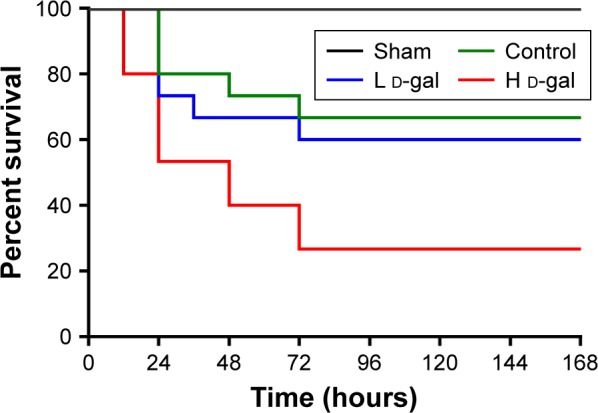
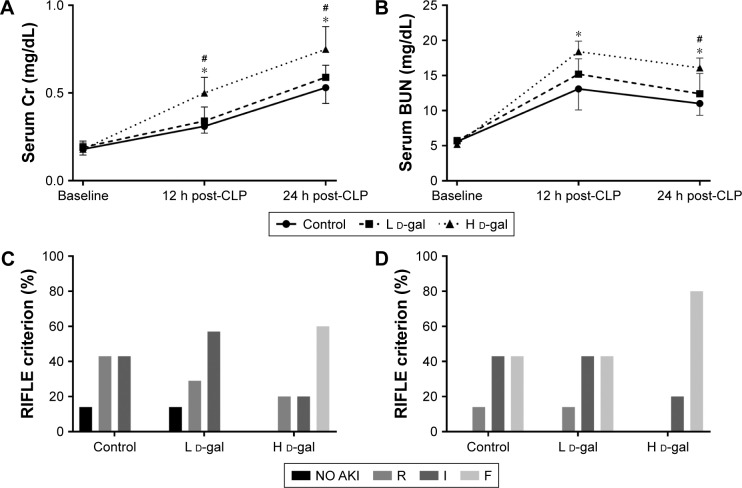
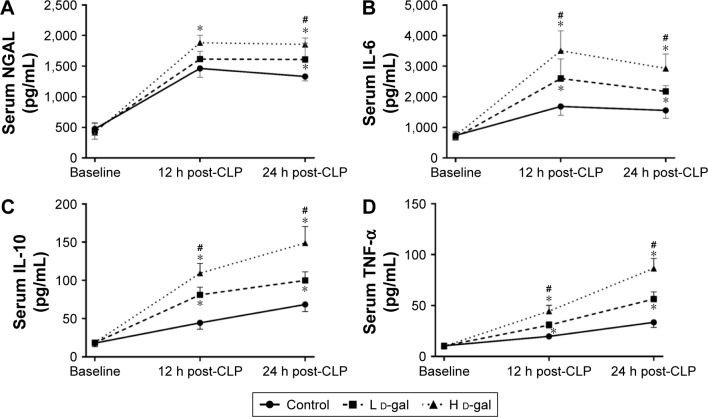
The mortality was 73.3%, 40%, and 33.3% in the H d-gal, L d-gal, and control groups, respectively. Blood urea nitrogen, creatinine, plasma neutrophil gelatinase-associated lipocalin, interleukin-6, interleukin-10, and tumor necrosis factor-α were markedly increased in the H d-gal group after establishment of the sepsis model (H d-gal vs control, <0.05 at 12 h and 24 h post-CLP). The rate of severe AKI (RIFLE-F) at 24 h post-CLP was 43% for both the control and L d-gal groups and 80% for the H d-gal group.
High-dose- d-gal-induced aging rats are more likely to die from sepsis than are young rats, and probably this is associated with increased severity of septic AKI and an increased inflammatory response. Therefore, use of the high-dose- d-gal-induced aging rat model of sepsis for preclinical studies can provide more useful information for the treatment of sepsis in elderly patients.
近年来,d-半乳糖(d-gal)诱导的拟衰老大鼠模型已广泛应用于衰老相关疾病的研究,研究表明,长期暴露于d-gal可诱导大鼠早衰,类似于自然衰老。随着老年人群中败血症发病率的上升,迫切需要一种易于获取的动物模型用于老年败血症的临床前研究。本研究旨在探讨在d-gal诱导的衰老大鼠中建立的败血症模型是否可作为老年败血症患者临床前研究的合适模型。
研究d-gal诱导的衰老大鼠经盲肠结扎穿孔术(CLP)后败血症的急性肾损伤(AKI)及炎症反应。
将12周龄雄性Sprague Dawley大鼠分为低剂量d-gal组(L d-gal,125 mg/kg/d)、高剂量d-gal组(H d-gal,500 mg/kg/d)和对照组。每日皮下注射d-gal 6周后,采用CLP法建立败血症模型。
H d-gal组、L d-gal组和对照组的死亡率分别为73.3%、40%和33.3%。败血症模型建立后,H d-gal组的血尿素氮、肌酐、血浆中性粒细胞明胶酶相关脂质运载蛋白、白细胞介素-6、白细胞介素-10和肿瘤坏死因子-α显著升高(CLP术后12 h和24 h,H d-gal组与对照组相比,P<0.05)。CLP术后24 h,对照组和L d-gal组的严重AKI(RIFLE-F)发生率均为43%,H d-gal组为80%。
高剂量d-gal诱导的衰老大鼠比年轻大鼠更容易死于败血症,这可能与败血症性AKI严重程度增加和炎症反应增强有关。因此,将高剂量d-gal诱导的衰老大鼠败血症模型用于临床前研究可为老年败血症患者的治疗提供更有用的信息。