Miyoshi Toru, Murakami Takashi, Sakuragi Satoru, Doi Masayuki, Nanba Seiji, Mima Atsushi, Tominaga Youkou, Oka Takafumi, Kajikawa Yutaka, Nakamura Kazufumi, Ito Hiroshi
Department of Cardiovascular Medicine, Okayama University Graduate School of Medicine, Dentistry and Pharmaceutical Sciences, Okayama, Japan.
Department of Cardiology, Okayama Heart Clinic, Okayama, Japan.
Open Heart. 2017 Mar 11;4(1):e000591. doi: 10.1136/openhrt-2017-000591. eCollection 2017.
The effects of antihypertensive drug combination therapy on central blood pressure (BP) and augmentation index (AI) have not been fully elucidated. We investigated the effects of the direct renin inhibitor, aliskiren, or a diuretic added to an angiotensin II receptor blocker on AI in patients with essential hypertension.
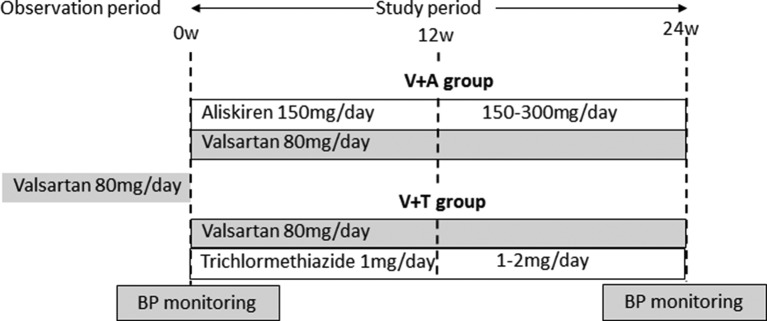
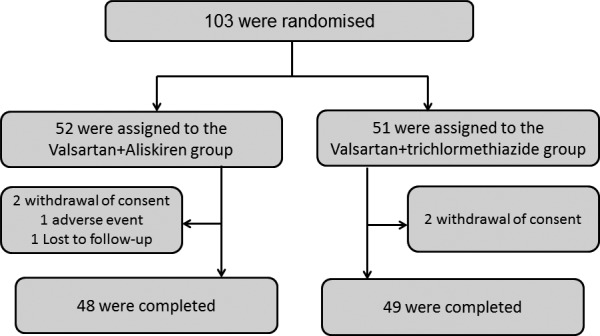
A 24-week, prospective, multicentre, randomised, open-label study enrolled 103 patients already treated with valsartan. Participants were randomly allocated to receive either valsartan with aliskiren (V+A), or valsartan with trichlormethiazide (V+T). The primary outcome was the change in AI derived from radial artery tonometry. Secondary outcome measures included systolic and diastolic BP, cardio-ankle vascular index (CAVI, which reflects arterial stiffness) and urinary 8-hydroxydeoxyguanosine concentration.
After 24 weeks, systolic and diastolic BP were significantly reduced in both groups to a broadly comparable extent. There was no significant difference in AI at the end of the study between the V+A group and the V+T group (between-group difference: -2.3%, 95% CI -6.9% to 2.2%, p=0.31). Central BP at the end of the study also did not differ between the two groups (p=0.62). There was no significant difference in the CAVI between the groups at the end of the study. Urinary 8-hydroxydeoxyguanosine concentration was significantly lower in the V+A group than in the V+T group (p<0.01), suggesting that V+A attenuated oxidative stress more than V+T.
The combination of valsartan and aliskiren had an effect on AI comparable with that of the combination of valsartan and trichlormethiazide.
UMIN000005726.
联合使用抗高血压药物治疗对中心血压(BP)和增强指数(AI)的影响尚未完全阐明。我们研究了在原发性高血压患者中,直接肾素抑制剂阿利吉仑或添加到血管紧张素II受体阻滞剂中的利尿剂对AI的影响。
一项为期24周的前瞻性、多中心、随机、开放标签研究纳入了103例已接受缬沙坦治疗的患者。参与者被随机分配接受缬沙坦联合阿利吉仑(V+A)或缬沙坦联合三氯噻嗪(V+T)。主要结局是通过桡动脉张力测量得出的AI变化。次要结局指标包括收缩压和舒张压、心踝血管指数(CAVI,反映动脉僵硬度)和尿8-羟基脱氧鸟苷浓度。
24周后,两组的收缩压和舒张压均显著降低,且降低程度大致相当。研究结束时,V+A组和V+T组之间的AI无显著差异(组间差异:-2.3%,95%CI -6.9%至2.2%,p=0.31)。研究结束时两组之间的中心血压也无差异(p=0.62)。研究结束时两组之间的CAVI无显著差异。V+A组的尿8-羟基脱氧鸟苷浓度显著低于V+T组(p<0.01),表明V+A比V+T更能减轻氧化应激。
缬沙坦和阿利吉仑联合使用对AI的影响与缬沙坦和三氯噻嗪联合使用的效果相当。
UMIN临床试验注册号:UMIN000005726。