Worthington Jo, Taylor Hilary, Abrams Paul, Brookes Sara T, Cotterill Nikki, Noble Sian M, Page Tobias, Swami K Satchi, Lane J Athene, Hashim Hashim
Bristol Randomised Trials Collaboration (BRTC), School of Social and Community Medicine, University of Bristol, Canynge Hall, 39 Whatley Road, Bristol, BS8 2PS, UK.
Bristol Urological Institute, Level 3, Learning and Research Building, North Bristol NHS Trust, Southmead Hospital, Bristol, BS10 5NB, UK.
Trials. 2017 Apr 17;18(1):179. doi: 10.1186/s13063-017-1916-5.
Transurethral resection of the prostate (TURP) has been the standard operation for benign prostatic obstruction (BPO) for 40 years, with approximately 25,000 procedures performed annually, and has remained largely unchanged. It is generally a successful operation, but has well-documented risks for the patient. Thulium laser transurethral vaporesection of the prostate (ThuVARP) vaporises and resects the prostate using a surgical technique similar to TURP. The small amount of study data currently available suggests that ThuVARP may have certain advantages over TURP, including reduced blood loss and shorter hospital stay, earlier return to normal activities, and shorter duration of catheterisation.
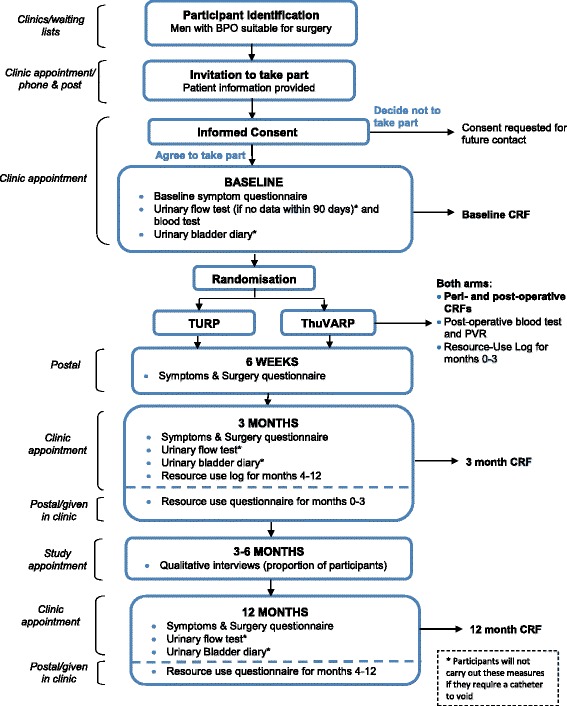
A multicentre, pragmatic, randomised, controlled, parallel-group trial of ThuVARP versus standard TURP in men with BPO. Four hundred and ten men suitable for prostate surgery were randomised to receive either ThuVARP or TURP at four university teaching hospitals, and three district general hospitals. The key aim of the trial is to determine whether ThuVARP is equivalent to TURP judged on both the patient-reported International Prostate Symptom Score (IPSS) and the maximum urine flow rate (Qmax) at 12 months post-surgery.
The general population has an increased life expectancy. As men get older their prostates enlarge, potentially causing BPO, which often requires surgery. Therefore, as the population ages, more prostate operations are needed to relieve obstruction. There is hence sustained interest in the condition and increasing need to find safer techniques than TURP. Various laser techniques have become available but none are widely used in the NHS because of lengthy training required for surgeons or inferior performance on clinical outcomes. Promising initial evidence from one RCT shows that ThuVARP has equivalent clinical effectiveness when compared to TURP, as well as other potential advantages. As ThuVARP uses a technique similar to that used in TURP, the learning curve is short, potentially making it also very quickly generalisable. This randomised study is designed to provide the high-quality evidence, in an NHS setting, with a range of patient-reported, clinical and cost-effectiveness outcomes, which will underpin and inform future NICE guidance.
ISRCTN registry, ISRCTN00788389 . Registered on 20 September 2013.
经尿道前列腺切除术(TURP)40年来一直是治疗良性前列腺梗阻(BPO)的标准手术,每年约进行25000例,且基本保持不变。这通常是一种成功的手术,但对患者存在诸多已被充分记录的风险。铥激光经尿道前列腺汽化切除术(ThuVARP)使用与TURP类似的手术技术汽化并切除前列腺。目前少量的研究数据表明,ThuVARP可能比TURP具有某些优势,包括减少失血、缩短住院时间、更早恢复正常活动以及缩短导尿持续时间。
一项针对患有BPO的男性进行的ThuVARP与标准TURP的多中心、实用、随机、对照、平行组试验。410名适合前列腺手术的男性在四家大学教学医院和三家地区综合医院被随机分配接受ThuVARP或TURP。该试验的主要目的是根据患者报告的国际前列腺症状评分(IPSS)和术后12个月的最大尿流率(Qmax)来确定ThuVARP是否等同于TURP。
普通人群的预期寿命有所增加。随着男性年龄增长,前列腺会增大,可能导致BPO,这通常需要手术治疗。因此,随着人口老龄化,需要更多的前列腺手术来缓解梗阻。所以,人们一直关注这种疾病,并且越来越需要找到比TURP更安全的技术。各种激光技术已经出现,但由于外科医生需要长时间培训或临床效果不佳,在英国国家医疗服务体系(NHS)中均未广泛应用。一项随机对照试验的初步证据显示,与TURP相比,ThuVARP具有同等的临床疗效以及其他潜在优势。由于ThuVARP使用的技术与TURP类似,学习曲线较短,这可能使其也能很快得到广泛应用。这项随机研究旨在在NHS环境中提供高质量证据,涵盖一系列患者报告的、临床的和成本效益结果,这将为未来英国国家卫生与临床优化研究所(NICE)的指导提供依据并提供信息。
国际标准随机对照试验编号注册库,ISRCTN00788389。于2013年9月20日注册。