Cui Ning, Hu Min, Khalil Raouf A
Vascular Surgery Research Laboratories, Brigham and Women's Hospital, Harvard Medical School, Boston, MA, United States.
Vascular Surgery Research Laboratories, Brigham and Women's Hospital, Harvard Medical School, Boston, MA, United States.
Prog Mol Biol Transl Sci. 2017;147:1-73. doi: 10.1016/bs.pmbts.2017.02.005. Epub 2017 Mar 22.
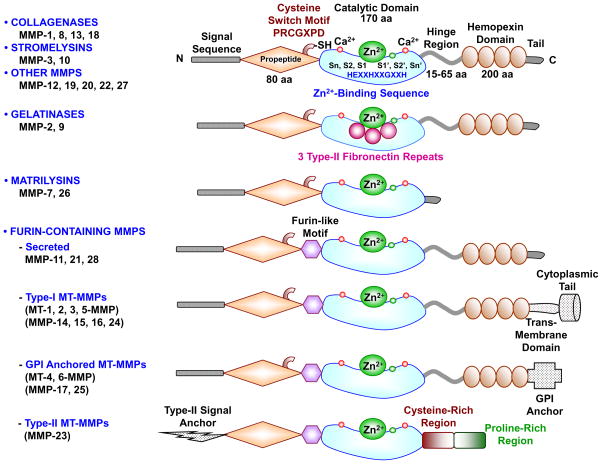
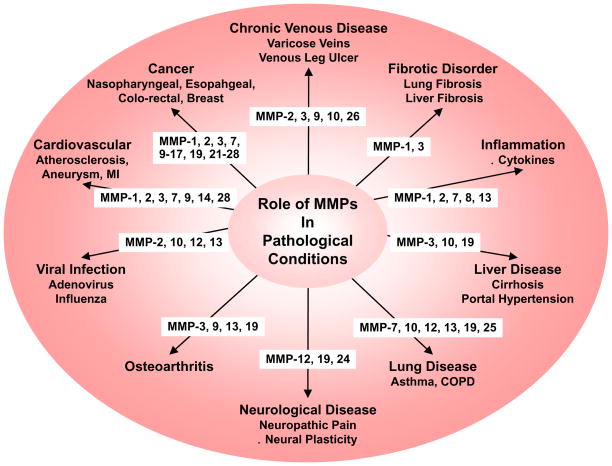
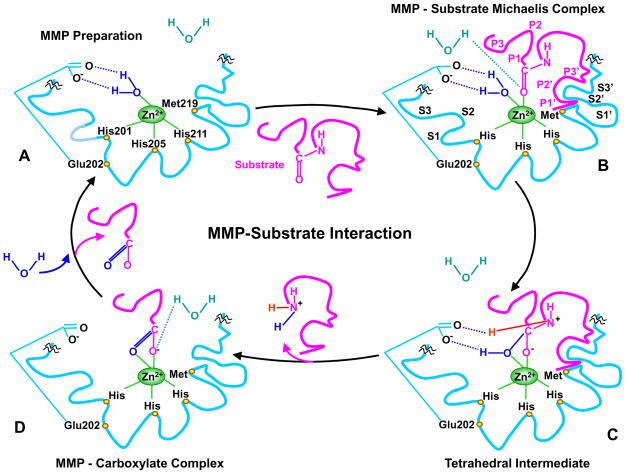
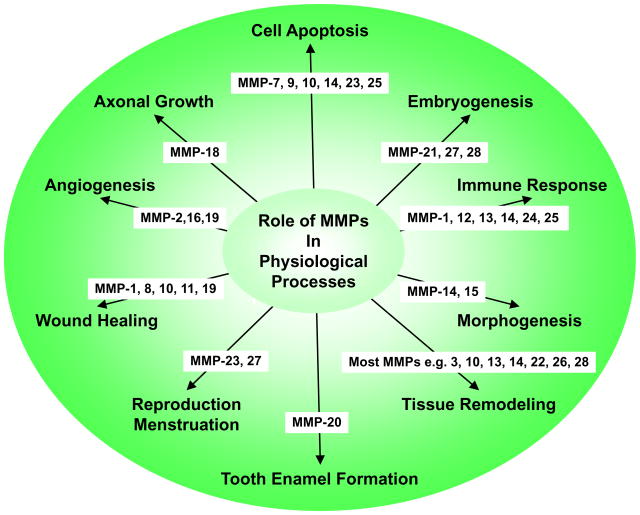
Matrix metalloproteinases (MMPs) are a family of zinc-dependent endopeptidases that are involved in the degradation of various proteins in the extracellular matrix (ECM). Typically, MMPs have a propeptide sequence, a catalytic metalloproteinase domain with catalytic zinc, a hinge region or linker peptide, and a hemopexin domain. MMPs are commonly classified on the basis of their substrates and the organization of their structural domains into collagenases, gelatinases, stromelysins, matrilysins, membrane-type (MT)-MMPs, and other MMPs. MMPs are secreted by many cells including fibroblasts, vascular smooth muscle (VSM), and leukocytes. MMPs are regulated at the level of mRNA expression and by activation of their latent zymogen form. MMPs are often secreted as inactive pro-MMP form which is cleaved to the active form by various proteinases including other MMPs. MMPs cause degradation of ECM proteins such as collagen and elastin, but could influence endothelial cell function as well as VSM cell migration, proliferation, Ca signaling, and contraction. MMPs play a role in tissue remodeling during various physiological processes such as angiogenesis, embryogenesis, morphogenesis, and wound repair, as well as in pathological conditions such as myocardial infarction, fibrotic disorders, osteoarthritis, and cancer. Increases in specific MMPs could play a role in arterial remodeling, aneurysm formation, venous dilation, and lower extremity venous disorders. MMPs also play a major role in leukocyte infiltration and tissue inflammation. MMPs have been detected in cancer, and elevated MMP levels have been associated with tumor progression and invasiveness. MMPs can be regulated by endogenous tissue inhibitors of metalloproteinases (TIMPs), and the MMP/TIMP ratio often determines the extent of ECM protein degradation and tissue remodeling. MMPs have been proposed as biomarkers for numerous pathological conditions and are being examined as potential therapeutic targets in various cardiovascular and musculoskeletal disorders as well as cancer.
基质金属蛋白酶(MMPs)是一类锌依赖性内肽酶,参与细胞外基质(ECM)中各种蛋白质的降解。通常,MMPs具有一个前肽序列、一个带有催化锌的催化金属蛋白酶结构域、一个铰链区或连接肽以及一个血红素结合蛋白结构域。MMPs通常根据其底物和结构域的组织方式分为胶原酶、明胶酶、基质溶解素、基质溶素、膜型(MT)-MMPs和其他MMPs。MMPs由许多细胞分泌,包括成纤维细胞、血管平滑肌(VSM)和白细胞。MMPs在mRNA表达水平以及其潜在酶原形式的激活方面受到调节。MMPs通常以无活性的前MMP形式分泌,该形式被包括其他MMPs在内的各种蛋白酶切割成活性形式。MMPs导致ECM蛋白如胶原蛋白和弹性蛋白的降解,但也可影响内皮细胞功能以及VSM细胞迁移、增殖、钙信号传导和收缩。MMPs在各种生理过程如血管生成、胚胎发生、形态发生和伤口修复的组织重塑中发挥作用,以及在病理状况如心肌梗死、纤维化疾病、骨关节炎和癌症中发挥作用。特定MMPs的增加可能在动脉重塑、动脉瘤形成、静脉扩张和下肢静脉疾病中起作用。MMPs在白细胞浸润和组织炎症中也起主要作用。在癌症中已检测到MMPs,MMP水平升高与肿瘤进展和侵袭性相关。MMPs可由金属蛋白酶的内源性组织抑制剂(TIMPs)调节,MMP/TIMP比值通常决定ECM蛋白降解和组织重塑的程度。MMPs已被提议作为多种病理状况的生物标志物,并正在作为各种心血管和肌肉骨骼疾病以及癌症的潜在治疗靶点进行研究。