Shu Jian, Yu Hanjie, Li Xiaojie, Zhang Dandan, Liu Xiawei, Du Haoqi, Zhang Jiaxu, Yang Zhao, Xie Hailong, Li Zheng
Laboratory for Functional Glycomics, College of Life Sciences, Northwest University, Xi'an, China.
Department of Pothology. First People`s Hospital of Chenzhou, Chenzhou, China.
Oncotarget. 2017 May 30;8(22):35718-35727. doi: 10.18632/oncotarget.16082.
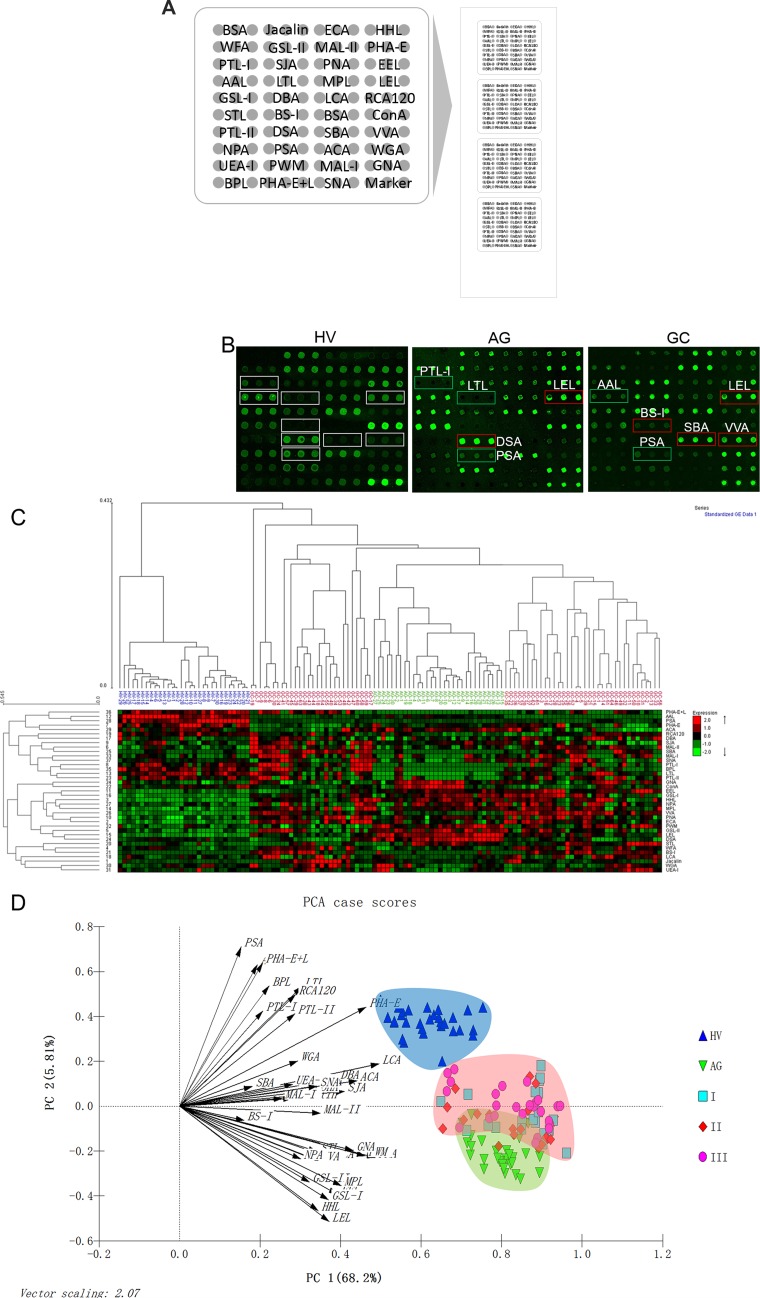
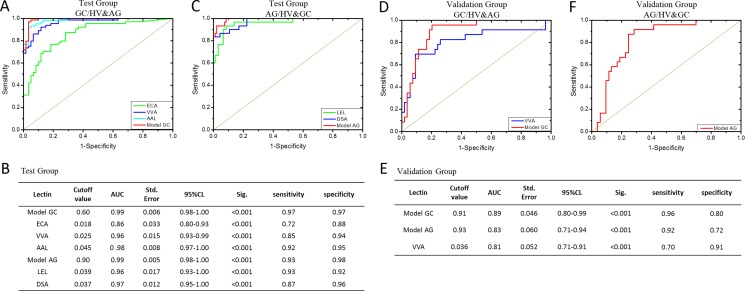
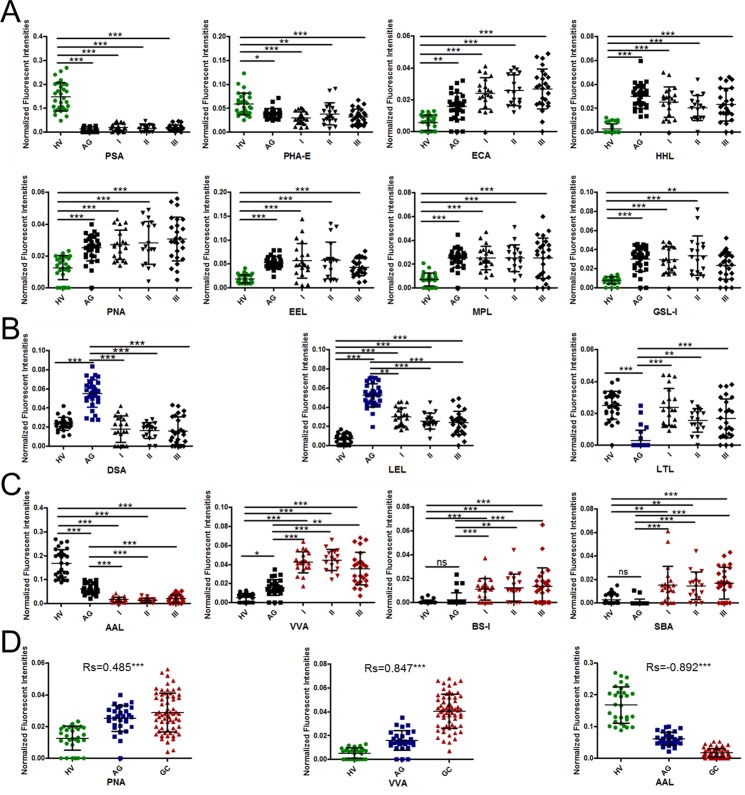
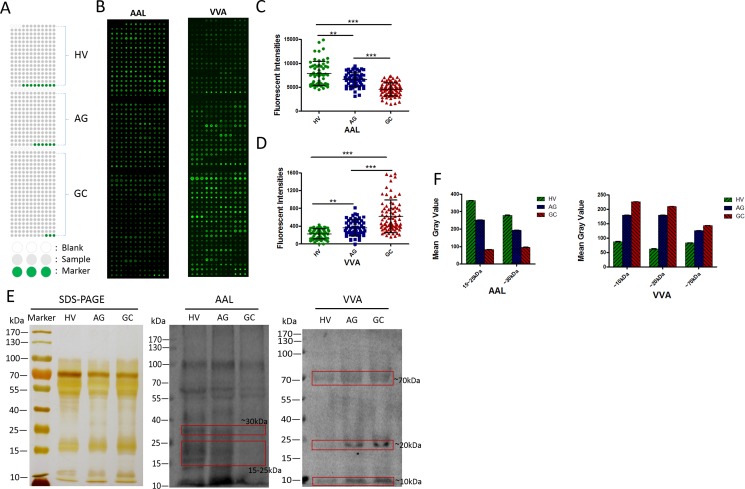
Gastric cancer (GC) is still an extremely severe health issue with high mortality due to the lacking of effective biomarkers. In this study, we aimed to investigate the alterations of salivary protein glycosylation related to GC and assess the possibility of salivary glycopatterns as potential biomarkers for the diagnosis of GC. Firstly, 94 patients with GC (n = 64) and atrophic gastritis (AG) (n = 30), as well as 30 age- and sex-matched healthy volunteers (HV) were enrolled in the test group to probe the difference of salivary glycopatterns using lectin microarrays, the results were validated by saliva microarrays and lectin blotting analysis. Then, the diagnostic model of GC (Model GC) and AG (Model AG) were constructed based on 15 candidate lectins which exhibited significant alterations of salivary glycopattern by logistic stepwise regression. Finally, two diagnostic models were assessed in the validation group including HV (n = 30) and patients with GC (n = 23) and AG (n = 24) and achieved high diagnostic power (Model GC (AUC: 0.89, sensitivity: 0.96 and specificity: 0.80), Model AG (AUC: 0.83, sensitivity: 0.92 and specificity: 0.72)). This study provides pivotal information to distinguish HV, AG and GC based on precise alterations in salivary glycopatterns, which have great potential to be biomarkers for diagnosis of GC.
由于缺乏有效的生物标志物,胃癌(GC)仍然是一个极其严重的健康问题,死亡率很高。在本研究中,我们旨在研究与胃癌相关的唾液蛋白糖基化变化,并评估唾液糖型作为胃癌诊断潜在生物标志物的可能性。首先,94例胃癌患者(n = 64)和萎缩性胃炎(AG)患者(n = 30)以及30名年龄和性别匹配的健康志愿者(HV)被纳入测试组,使用凝集素微阵列探测唾液糖型的差异,结果通过唾液微阵列和凝集素印迹分析进行验证。然后,基于15种候选凝集素构建胃癌(模型GC)和萎缩性胃炎(模型AG)的诊断模型,这些凝集素通过逻辑逐步回归显示出唾液糖型的显著变化。最后,在包括HV(n = 30)、胃癌患者(n = 23)和AG患者(n = 24)的验证组中评估了两个诊断模型,获得了较高的诊断能力(模型GC(AUC:0.89,敏感性:0.96,特异性:0.80),模型AG(AUC:0.83,敏感性:0.92,特异性:0.72))。本研究提供了基于唾液糖型精确变化来区分HV、AG和GC的关键信息,这些变化具有作为胃癌诊断生物标志物的巨大潜力。